

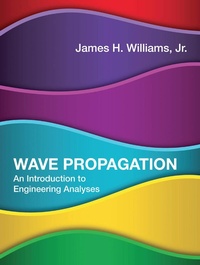
Wave Propagation
Description

A wave is a traveling disturbance or oscillation—intentional or unintentional—that usually transfers energy without a net displacement of the medium in which the energy travels. Wave propagation is any of the means by which a wave travels. This book offers an engineering-oriented introduction to wave propagation that focuses on wave propagation in one-dimensional models that are anchored by the classical wave equation. The text is written in a style that is highly accessible to undergraduates, featuring extended and repetitive expositions and displaying and explaining mathematical and physical details—many classical but others not heretofore published. The formulations are devised to provide analytical foundations for studying more advanced topics of wave propagation.
After a precalculus summary of rudimentary wave propagation and an introduction of the classical wave equation, the book presents solutions for the models of systems that are dimensionally infinite, semi-infinite, and finite. Chapters typically begin with a vignette based on some aspect of wave propagation, drawing on a diverse range of topics. The book provides more than two hundred end-of-chapter problems (supplying answers to most problems requiring a numerical result or brief analytical expression). Appendixes cover equations of motion for strings, rods, and circular shafts; shear beams; and electric transmission lines.
More details
Other editions
Additional editions
Person
Content
- Intro
- Title Page
- Copyright Page
- Dedication
- About the Author
- Acknowledgments
- Preface
- Table of Contents
- 1. Introduction to Waves and Their Propagation
- 1-1. Some Fundamental Concepts of Wave Propagation
- 1-2. Modeling in Mechanical Dynamics
- Example 1-1: Is a Steel Coil a Mass or a Spring?
- 1-3. Generation and Propagation of Waves
- 1-4. Rudimentary Quantitative Wave Analysis
- 1-5. Examples of Rudimentary Wave Propagation
- Example 1-2: Period of Longitudinal Wave in Glass Rod
- Example 1-3: Elastic Modulus of Rod
- Example 1-4: Frequency of Electromagnetic Radio Wave
- Example 1-5: Tension in String
- Example 1-6: Bandwidth of Human Hearing
- Problems for Chapter One
- Vignette I. Is There a Smallest Quantity of Energy?
- 2. The Classical Wave Equation
- 2-1. A Bit of History
- 2-2. One-dimensional Continua Modeled by the Classical Wave Equation
- 2-3. Wave Motion Governed by the Classical Wave Equation
- 2-4. Partial Derivatives of Wave Functions
- 2-5. Sample Functions and Wave Functions
- Example 2-1: Bell-shaped Traveling Wave
- 2-6. Principle of Superposition
- Example 2-2: Superposition of Two Waves
- Problems for Chapter Two
- Vignette II. Gravitational Waves and LIGO
- 3. Wave Propagation in Infinite Media
- 3-1. Introduction
- 3-2. Determination of Waveforms from Initial Conditions
- Example 3-1: Longitudinal Waves Propagating in Two Directions Due to Initial Displacement
- 3-3. Characteristics
- Example 3-2: Reexamination of Example 3-1
- 3-4. Determination of Waveforms Due to Single Functional Initial Conditions
- Example 3-3: Displacement and Particle Velocity Waves in Shear Beam Due to Nonzero Initial Displacement
- Example 3-4: Displacement and Particle Velocity Waves in Shear Beam Due to Nonzero Initial Particle Velocity
- Example 3-5: Initial Conditions Yielding a Rightward-Only Single Wave
- 3-5. Domain of Dependence
- Example 3-6: Displacement and Particle Velocity in Rod at Specific Location and Time Due to Initial Conditions
- 3-6. Range of Influence
- Example 3-7: Range of Influence of Space-Time Point in Aluminum Rod
- Vignette III. NDE Using Ultrasonic and Thermographic Waves for Residual Life Characterizations of Composite Materials and Structures
- 3-7. Harmonic Waves
- 3-7.1. Definitions of Fundamental Quantities of Harmonic Waves
- 3-7.2. Relationships among Fundamental Quantities of Harmonic Waves
- 3-7.3. Examples
- Example 3-8: Evaluation of Tension in String
- Example 3-9: Material of Elastic Rod
- Example 3-10: Wavelength of Transverse Wave in String
- Example 3-11: Period of Torsional Wave in Cast-Iron Alloy
- Example 3-12: Wave Speed and Wavelength of Harmonic Wave in Electric Transmission Line
- Example 3-13: String with Cosinusoidal Initial Displacement
- 3-8. Another Look at Harmonic Traveling Waves
- 3-9. Displacement, Force, and Particle Velocity in Elastic Rod
- 3-10. Transmission of Energy
- 3-10.1. Transmission of Energy by Arbitrary (General) Waveform
- Example 3-14: Power Transmission in Strings, Circular Shafts, Shear Beams, and Electric Transmission Lines
- 3-10.2. Summary and Generic Expressions for Power Transmission
- Example 3-15: Power Transmission by Displacement Wave in Shear Beam
- 3-10.3. Power Transmission by Harmonic Waves
- Example 3-16: Power Transmission by Harmonic Wave in Steel Rod
- 3-11. Dispersion
- 3-12. Relatively Advanced Examples
- Example 3-17: Periodic Function and Periodic Wave
- Example 3-18: Tone Burst Function and Tone Burst Wave
- Example 3-19: Attenuation of Tone Burst Wave
- Example 3-20: Ultrasonic NDE of Residual Static Strength of Impact-Damaged Graphite Fiber Composite Using Tone Burst Waves
- Example 3-21: Ultrasonic NDE of Residual Fatigue Strength of As-fabricated Graphite Fiber Composite Using Tone Burst Waves
- Problems for Chapter Three
- Vignette IV. Sound Waves and Sound Channels in the Ocean
- 4. Wave Propagation in Semi-Infinite Media
- 4-1. Introduction
- 4-2. Junctions between Two Media
- 4-2.1. Displacements in Reflected and Transmitted Waves in Rods
- Example 4-1: Reflection and Transmission at Junction of Aluminum and Graphite Epoxy Rods
- Example 4-2: Displacement Reflection and Transmission Coefficients as Functions of Rod Properties
- 4-2.2. Particle Velocities in Reflected and Transmitted Waves in Rods
- 4-2.3. Forces in Reflected and Transmitted Waves in Rods
- 4-2.4. Power in Reflected and Transmitted Waves in Rods
- 4-2.5. Summary and Discussion of Reflection and Transmission Coefficients in Rods
- 4-2.6. Examples of Reflection and Transmission in Other Media
- Example 4-3: Reflection and Transmission of Transverse Waves at Junction Joining Two Strings
- Example 4-4: Reflection and Transmission of Transverse Waves at Junction Joining Two Circular Shafts
- Example 4-5: Reflection and Transmission of Charge Waves at Junction Joining Two Electric Transmission Lines
- 4-2.7. Analogy among Various Media
- 4-3. Characteristic Impedances
- 4-3.1. Characteristic Impedances of Various One-dimensional Media
- Example 4-6: Characteristic Impedances of Strings, Circular Shafts, Shear Beams, and Electric Transmission Lines
- 4-3.2. Reflection and Transmission Coefficients in Terms of Characteristic Impedances for Rods, Strings, Circular Shafts, Shear Beams, and Electric Transmission Lines
- 4-4. General Reflection and Transmission Coefficients Versus Impedance
- Example 4-7: Junction between Semi-infinite Elastic Rod and Viscous Dashpot
- 4-5. Reflection at Clamped and Free Ends
- 4-5.1. Clamped End
- 4-5.2. Free End
- 4-5.3. Alternative Paths to Reflection Coefficients for Clamped and Free Ends
- Example 4-8: Reflection of Compressive Axial Force Pulse at Free End of Elastic Rod
- 4-6. External Forcing of Semi-Infinite Rod
- Example 4-9: Radiation Damping in Spring-Mass-Rod System
- Problems for Chapter Four
- Vignette V. Domino Waves
- 5. Wave Propagation in Finite Media
- 5-1. Introduction
- 5-2. One-dimensional Wave Motion Parameters in Finite Media
- Example 5-1: Frequency of Longitudinal Wave
- Example 5-2: Length of Titanium Shaft
- Example 5-3: Capacitances of Electric Transmission Lines
- Example 5-4: Location of Break in Electric Transmission Line
- Example 5-5: Length of Microcylindrical Electric Transmission Line
- Example 5-6: Power Transmission through Graphite Fiber Epoxy Shear Beam
- Example 5-7: Pulse-echo Nondestructive Evaluation (NDE) of Specific Segment of Compound Rod
- Example 5-8: Ultrasonic Determination of Temperature
- Example 5-9: Ultrasonic Determination of Length in Multiple-Temperature Structure
- Example 5-10: Wave Motion in Finite-Length Shear Beam
- Vignette VI. Falling Slinky
- 5-3. One-Dimensional Wave Propagation Fields in Finite Media
- Example 5-11: Wave Motion in Clamped-Clamped Rod
- Example 5-12: Wave Motion in Clamped-Free Rod
- Example 5-13: Time Dependence of Displacements in Clamped-Free Rod
- Example 5-14: Wave Motion in Free-Free Rod
- Example 5-15: Collision of Elastic Rods
- Example 5-16: Modal Analysis of Clamped-Free Rod
- Example 5-17: Time Dependence of Displacements in Clamped-Free Rod via Modal Analysis
- Example 5-18: Equivalence of Modal Analysis and Wave Analysis for Clamped-Free Rod
- Example 5-19: Falling Elastic Rod
- Problems for Chapter Five
- General References
- Appendix A. Equations of Motion for Uniform Strings, Rods, and Circular Shafts
- A-1. String
- A-2. Rod
- A-3. Circular Shaft
- Appendix B. Shear Beams
- B-1. Introduction
- B-2. Model
- B-3. Equation of Motion via Momentum Principle
- B-4. An Alternative Route to Equation of Motion
- B-5. The Shear Coefficient, ?0
- B-6. Conclusion
- B-7. References
- Appendix C. Electric Transmission Lines
- C-1. Introduction
- C-2. Introducing a Transmission Line into a Circuit
- C-3. Distributive Properties of Transmission Lines
- C-4. Equations of Motion of Lossless Transmission Line
- C-5. Reference
- Answers to End-of-Chapter Problems
- List of Vignettes
- List of Tables
- Index
