

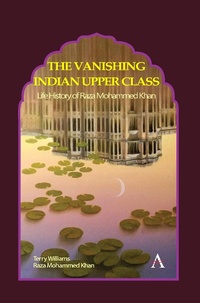
The Vanishing Indian Upper Class
Life History of Raza Mohammed Khan
Published on 30. October 2020
360 pages
978-1-78527-445-9 (ISBN)
Description

This book itemize the familial, cultural, religious, and historical themes in a unique life story. The book is distinctive in that it continues the life story as a sociological genre, and as a methodological construct [it] attempts the comprehensive life story which engages the totality of a person's life by capturing the essence and the development of a peerless human being. Though there are questions whether it is possible to arrange the totality of a life, an important part of the legacy at the moment comes in various forms, including biographies, video diaries, autobiographies, home web pages, and journals, but I realize all life stories are constructed and partial, yet, the attempt here is to tell a story of a member of the ruling elite rarely told. This book is part of a series about cosmopolitan life and no better way to serve that purpose than to use the life story as part of that tradition.
Reviews / Votes
The Vanishing Indian Upper Class: The Life History of Raza Mohammed Khan: This masterful work brings together a leading American sociologist and an Indian elite. The result is a powerful narrative and thoughtful reflections on modern India with gripping insights on gender, family, the ruling class, religion, the caste system, poverty, greed and power. Its life history approach makes The Vanishing Indian Upper Class an exemplary read, weaving together the everyday tapestry of a Muslim aristocrat, his household, which then merge into the very structural fabric of India herself, a modern democracy built upon the sheaf of a vibrant civilization. Terry Williams is one of the leading ethnographers of our time and his ability to narrate the depth of the human condition gives us a work that is searing, elucidating, and sobering. Raza Mohammed Khan, a prominent member of the upper-class in India, affords us the right of passage to make this possible. In the end, readers come away with a journey well worth the trip. - Zain Abdullah, author of Black Mecca: The African Muslims of Harlem and associate professor of Religion and Society and Islamic Studies, Temple University. "As India shudders and splits apart, this enthralling ethnography traces one royal family's story as it loses its place in the old social order, disperses to Baghdad, Karachi and London, and struggles to maintain family ties and traditions even as it adapts to the new world." - Anwar Shaikh, Professor of Economics, New School for Social Research Terry Williams is one of the most original and imaginative sociologists, anywhere. Each of his many works is different from the previous, in content, method as well as implicit argument. What ties them together is that each is both a search for truth as well as a methodological experiment. He calls The Vanishing Indian Upper Class: The Life History of Raza Mohammed Khan an ethnographic excavation. It is that but also much more. The work reconstructs the life of a prince in exile, Raza Mohammed Khan, as a mirror simultaneously of the Indian aristocracy, the society of which it was once a significant part, the life of exile, as well as stormy family relations that resemble "unhappy families" elsewhere, in spite of Tolstoy's dictum. The stories are told by both Khan and Williams, two master raconteurs, and thus very generously both are included as the authors. But the experiment is designed by Williams, who wants it to be a test of ethnography itself. Can a man originally from the Mississippi of the Jim Crow era, understand the lifeworld of an Indian prince? The book shows that he can, that totally different horizons of experience can after all be fused. For the reader, the work promises many repeats of the very same fundamentally human experience. - Andrew Arato, Dorothy Hirshon Professor in Political and Social Theory, New School for Social ResearchMore details
Series
Language
English
Place of publication
London
United Kingdom
Target group
Professional and scholarly
File size
2,51 MB
ISBN-13
978-1-78527-445-9 (9781785274459)
Copyright in bibliographic data and cover images is held by Nielsen Book Services Limited or by the publishers or by their respective licensors: all rights reserved.
Schweitzer Classification
Other editions
Additional editions
Terry Williams | Raza Mohammed Khan
The Vanishing Indian Upper Class
Life History of Raza Mohammed Khan
Book
10/2020
Anthem Press
€58.40
Shipment within 10-15 days
Content
Part One; Chapter 1 Introduction; Chapter 2 The Family Tapestry; Chapter 3 Amadabad's Zenith: The Life and Times of Nawab Ali Mohammad; Chapter 4 Nawab Dawood Ahmad; Chapter 5 Raza's Early Childhood; Chapter 6 Raza's Later Childhood and Adolescence; Chapter 7 Beginning of an Exile: Boarding School; Chapter 8 The Wedding of Zainab and Hurr; Chapter 9 Abid Arrives to Join Raza; Chapter 10 The School Rebel; Chapter 11 Crammers; Chapter 12 Secret Love; Chapter 13 Journey Home; Chapter 14 Return to London and Shireen; Chapter 15 Farewell to Shireen; Chapter 16 Down but Not Out; Chapter 17 The Garret; Part Two Ithaka; Chapter 18 An Indian Odyssey; Chapter 19 Nawab Dawood Ahmad in Pakistan; Chapter 20 Bombay Itinerary; Chapter 21 The Return; Chapter 22 Raza's Second Aldermaston March; Chapter 23 Tess and Raza; Part Three; Chapter 24 The Decline; Chapter 25 Ibn Dawood's Claim; Chapter 26 Ibn Dawood's Victory; Chapter 27 Raza and Maysam; Chapter 28 The Ugly Portraits of Ibn Dawood and Begum; Chapter 29 The Sad and Tragic Deaths of Hurr Bhai and Zainab Baji; Chapter 30 Raza Visits His Ailing Sister; Chapter 31 Tragic Ends; Epilogue; Acknowledgments; Bibliography; Index.
