

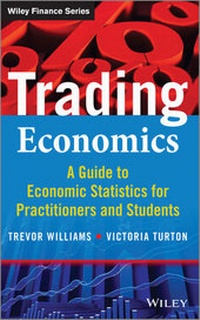
Trading Economics
Description

More details
Other editions
Additional editions
Persons
Content
Acknowledgements ix
Introduction xi
Surprise Indices xii
Mapping a New Landscape xix
1 Surveys 1
Surveys and Behavioural Economics 2
Types of Survey 3
Business Surveys 3
Consumer Surveys 21
Conclusion 28
2 Economic Growth 31
Economic Growth Through the Ages 31
GDP 34
What Is GDP? 39
Breaking Down GDP 42
Why Is GDP Important? How Is It Measured? 43
Index Numbers of GDP and the Price Deflators
Used in Calculating Them 45
Detailed Breakdown of the GDP Measures 48
AMarket Link 61
Components of GDP 62
Conclusion 64
3 Labour Markets 65
Employment Trends 66
What Has Driven the Change? 70
Consequences for Economic Growth 72
Phillips Curve Shows no Durable Trade-Off Exists 74
NAIRU Matters More 75
Employment Measures 76
Why We Measure Unemployment 77
The Nature of Unemployment 79
The Impact of Demographics on Labour Markets 81
Vacancies 90
Changing Labour Patterns 92
The UK in Comparison to Its Global Competitors 96
How Do We Extract Value from This? 96
Conclusion 98
4 Inflation 99
What Is Inflation? 99
The History of Inflation 99
Causes of Inflation 101
Earnings/Wage Inflation 109
Price Basket 110
How Is Price Inflation Measured? 110
GDP Deflator 111
Why so Many Measures of Inflation? 112
A Focus on the CPI and RPI 118
Why Is Inflation Important? 122
Deflation 123
Other Measures of Inflation Targeting 123
How Can We Extract Value from This? 125
Conclusion 125
5 Monetary Statistics 127
Monetary Policy and Inflation Management 130
The UK in a Global Context 133
Central Bank's Role 133
What About the Bank of England? 135
How Monetary Policy Works in the UK 136
Decomposition of Money 144
Why Does Money Supply Matter? 149
Why Is This Sort of Analysis Useful? 155
A Brief History of Monetary Targeting 155
How Do We Extract Value from This? 158
Conclusion 158
6 Fiscal Indicators 161
A Brief History of UK Fiscal Policy 163
Measuring Government Debt 164
Fiscal Policy Impact and Terminology 166
The Impact of Government on Markets 168
Fiscal Policy and Growth 168
The Data We Should Consider 169
Fiscal Policy in Boom and Bust 170
Market Relevance 173
Bank of England Regains Regulatory Powers 176
What Role Does the Office for Budget Responsibility Play in the Fiscal Policy Process? 180
The Monetary Policy Committee 181
Forward Guidance - Another Bank Innovation 183
The Debt Management Office's Role 185
Comparison of International Debt 188
Fiscal Targets Add Credibility to Debt Reduction 190
How Can We Extract Value from This? 192
Conclusion 193
7 Global Trade Statistics 195
What Is a Country's Balance of Payments? 197
Why Do We Measure the Balance of Payments? 197
What Does It Mean? 198
The Concept of the Balance of Payments 199
UK Is Not Alone in Having a Trade Deficit 204
A Chronic Goods Deficit 208
A Chronic Services Surplus to Offset (Almost) the Trade Deficit 210
The Ever-Changing Pattern of Visible and Invisible Trade 213
Balance of Payments and GDP 222
Shifting Trade Patterns 222
How Can We Extract Value from This? 224
Conclusion 225
Conclusion 227
Appendices
Appendix 1 Surveys 235
Appendix 2 Bank of England: Agents' Summary of Business Conditions (January 2014) 241
Appendix 3 Inflation: Contributions to Change in the 12-Month Rate 247
Appendix 4 Voting on Interest Rates by the Monetary Policy Committee - 1997 to January 2014 249
Appendix 5 Voting on Asset Purchases Financed with central bank reserves by the Monetary Policy Committee - March 2009 to January 2014 251
Bibliography 253
Index 255
Introduction
Today's interconnected world, linked by freer trade, by some of the greatest movements of people through tourism and immigration the world has ever seen, by the movement of goods and services – all underpinned by new methods of open communication that were unimaginable a generation or so ago and involving more countries than ever before – means that an understanding of economics matters more than ever. It is no surprise, therefore, that headlines scream economic news, newspapers are full of stories based on statistics about economic performance within and amongst countries, government officials are constantly discussing the economy and there are pundits, radio and TV shows, some broadcasting 24 hours a day, with ‘experts’ claiming to know all sorts of things based on economic data. Then there are all the blogs, tweets and internet media channels to add to the mixture. With the cacophony of noise from these media, it is increasingly hard to discern the underlying economic trends from what are often conflicting data.
What has allowed today's world to come into being is a belief that more trade is better than less trade, that producing goods and services where it is cheapest to do so allows for a rise in living standards for all concerned (though not all to the same extent). This outcome is based on one of the fundamental elements of economic rationale – the division of labour and comparative trade advantage. What is economics about, if not the production of goods and services to satisfy human wants and needs? It is the acceptance of this notion across many societies around the world that has given rise to the explosive increase in global wealth that has taken place in the last 50 years and that we see all around us.
This is why an understanding of economic statistics and what they mean is crucial. These statistics are the basis for individual, corporate and collective or societal decision-making. Governments use economic statistics to plan spending and policy; companies use them to decide when and where to produce goods and services; investors (including pension funds, insurance companies, individuals etc.) use them to decide where to put their wealth; and households use them to decide when to buy or sell goods and services.
These data drive trends in the financial markets. Without the constant drip feed of economic news, markets tend to drift. What they await – what they in fact need – is the next piece of new information to jolt them into action. The experience of recent years has taught us that financial markets do not inhabit a separate realm, detached from the ‘real economy’. Far from it – financial markets are fundamentally tethered to the real economy. They have an impact on us all. That is why they matter and why understanding the data that drives the financial markets will support traders and practitioners in reading the markets more comprehensively and framing their own reactions accordingly.
SURPRISE INDICES
The Value of Economic Indicators
A surprise index, as its name suggests, measures the extent to which economic indicators are better or worse than expectations – in other words, they surprise interested observers, the markets.
Economic surprise indices illustrate just how important economic indicators are to financial markets, affecting the decision-making process of the millions of participants whose buying and selling decisions ultimately make them up.
Surprise indices are therefore a cumulative measure of figures released pertaining to the economy that are appreciably different from the average predicted by those who are forecasting them. If the results continue to be better than expected, the index will rise. Of course, if they are worse than expected then it will fall. You would expect positive surprises to be positively correlated with asset price change, including equity prices.
This is partly about the psychology of price movements in asset markets. If the momentum is linked to a feelgood factor about a trend and the data support it, by coming in better than expected, then optimism is boosted. Sentiment is key to the movements of financial markets, and shifts in asset prices are often linked not just to the absolute outcome of economic and other data that are being released, but also to whether they are better or worse than people (i.e. investors) thought they would be.
Among the most traded, well understood and liquid of assets, of course, are equity market indices. Naturally, therefore, one would expect to see a very good link, over time, between them and surprise indices, whether up or down. This is what our analysis demonstrates has plenty of validity in different countries over different time periods.
Surprise indices can be created for different countries, regions and any category of economic data that are being released. We look at some, but not all, of this diversity in this analysis.
Impact on Financial Markets
Surprise indices can be based on subsets of economic data issued weekly, monthly or quarterly. The list of subsets includes inflation, growth, industrial activity, retail sales indicators and surveys. Economic surprise indices are available for both countries and economic areas, such as the Eurozone or the BRIC economies (Brazil, Russia, India and China). The aim and the design remain the same. Taking a broad view across these indices demonstrates that this simple explanation of how forecast and actual data correlate holds true.
In an ‘efficient’ market where ‘news’ is generally known or anticipated by market participants, there is little market reaction to new information. That ‘news’ should already be ‘priced in’, in other words, taken into account in the decisions about what to buy or sell.
It is when there are shocks or volatility that the data surprise effect occurs – where a particular number or set of numbers changes perceptions – and has the greatest impact on financial markets.
Tracking the Markets
Looking at the charts in Figures I.1–I.9, you will see that surprise indices do indeed track the direction of equity markets. This is to be expected, as equity markets are composed of companies whose profits and dividend payments are closely linked to what happens in the economy. However, the links are not always straightforward, as equity markets often lead the economy. In other words, the shares of companies themselves are lead indicators of general trends in the wider economy, often moving before the economy shows a reaction to emerging trends.
Figure I.1 US data surprise vs US equities.
Source: Haver Analytics.
Insofar as equity markets track the economy, therefore, one might expect surprise indices to be coincident, or at least in line with, the equity markets rather than leading them.
In the case of the US, if we look at Figure I.1, we can see that the surprise index moves closer to its domestic equity market index after the financial crash than before it. Before the crash, the links were not, in fact, that great (and the same trend seems to apply to the other countries we look at in the charts that follow). This seems to suggest that equity markets paid less heed to economic trends during the boom years (as the pace of economic growth negated the need to consider the direction of the economic surprise), in the run-up to the financial crash of 2007/08.
However, after the crash the connection between surprise indices and economic indicators seems to be much stronger. Did the economic data flow start to suggest a slowing economy before the equity market collapse? The answer is broadly in the affirmative. And once the downturn started, the surprise index tracked it very well indeed. This may well have been because market participants started to pay much more attention to the economic news than they did when they were showing nothing but buoyant economic trends.
Japan's economic surprise index seems to be the one that is most distinct from its domestic equity market performance (see Figure I.2).
Figure I.2 Japanese data surprise vs Japanese equities.
Source: Haver Analytics.
However, for all the economies analysed here, what is most striking is that the G10 economic surprise index, which is a weighted average of all the countries in the so-called Group of 10,1 is actually a better guide to domestic equity market trends than the surprise indices based solely on domestic economic indicators (see Figures I.3–I.5).
Figure I.3 G10 data surprise vs Japanese equities.
Source: Haver Analytics.
Figure I.4 G10 data surprise vs UK equities.
Source: Haver Analytics.
Figure I.5 UK data surprise vs UK equities.
Source: Haver Analytics.
This may be a result of the increasingly interlinked nature of these economies and the fact that equity markets, and hence companies, are so global in their operations that it makes more sense to track an amalgam of the G10 economic data surprise, and then track that to domestic equity markets, than to focus on individual country data classes. It is also reflecting the massive shift in cross-national share ownership, which we have seen in the last...
