

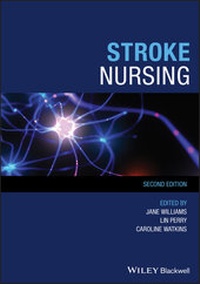
Stroke Nursing
Description

Drawing from years of clinical and research experience, the authors provide practical guidance on the essential areas of stroke nursing, including stroke classification, stabilisation, thrombolysis and thrombectomy, rehabilitation and recovery, nutrition and oral care, palliative and long-term care, physical impairment management, and more.
Now in its second edition, this indispensable guide helps practitioners expand their knowledge, skills and competence in all areas of stroke nursing services.
* Adopts a practical and evidence-based approach to stroke management, exploring UK and international perspectives
* Authored by expert clinicians and leaders in the field of nursing practice, research and education
* Includes updated case studies and practice examples, expanded coverage of clinical application in practice, and new discussions of the knowledge and skills required by nurses
Stroke Nursing is essential reading for students of nursing and neuroscience, and is the definitive reference for practicing nurses and healthcare professionals caring for stroke patients.
More details
Other editions
Additional editions
Persons
Jane Williams is Divisional Director for Transformation, based in Southern Health Foundation Trust, Southampton, UK.
Lin Perry is Professor of Nursing Research & Practice Development, South Eastern Sydney Local Health District and University of Technology Sydney, Sydney, Australia.
Dame Caroline Watkins is Professor of Stroke and Older Peoples' Care, University of Central Lancashire, Preston, UK.
Content
Editors and Contributors ix
Foreword: Stroke Nursing xiii
Foreword: Stroke Services In Australia xv
Foreword: Stroke Care In Hong Kong xix
Acknowledgements xxiii
1 Setting the Scene 1
Caroline Watkins and Dominique Cadilhac
1.1 Introduction 1
1.2 Stroke Epidemiology 2
1.3 Cost Burden 3
1.4 Stroke Policy 4
1.5 Stroke Management Strategies 8
1.6 Research and Education 11
1.7 Conclusion 13
References 13
2 What Is a Stroke? 19
Anne W. Alexandrov
2.1 Introduction 19
2.2 Stroke Classification 20
2.3 Risk Factors for Stroke 22
2.4 Anatomy, Physiology, and Related Stroke Clinical Findings 23
2.5 Standardised Instruments for Acute Neurological Assessment 41
2.6 Conclusion 44
References 50
3 Reducing the Risk of Stroke 53
Josephine Gibson and Stephanie Jones
3.1 Introduction 54
3.2 Primary Prevention 55
3.3 Primary Prevention - Medical Considerations 56
3.4 Secondary Medical Prevention After TIA or Stroke 59
3.5 Interventions for Secondary Prevention After TIA or Recovered Stroke 63
3.6 Conclusion 68
References 68
4 Acute Stroke Nursing Management 75
Anne W. Alexandrov
4.1 Introduction 76
4.2 Priorities in Acute Stroke Management 76
4.3 Hyper-acute Stroke Management 77
4.4 Hyper-acute Treatment of Haemorrhagic Stroke 90
4.5 Acute Stroke Management 93
4.6 Conclusion 96
References 96
5 Nutritional Aspects of Stroke Care 103
Lin Perry and Elizabeth Boaden
5.1 Introduction 104
5.2 Do Stroke Patients Experience Nutritional Problems Pre-Stroke? 106
5.3 How Does Stroke Affect Dietary Intake? 107
5.4 How Can Stroke Patients Be Helped to Maintain Adequate Dietary Intake? 119
5.5 Conclusion 132
References 133
6 Oral Care After Stroke 143
Mary Lyons
6.1 Introduction 144
6.2 Oral Assessment 145
6.3 Management and Care 146
6.4 Patient and Carer Perspective 147
6.5 Conclusion 148
References 148
7 Communication 153
Jane Marshall, Katerina Hilari, Madeline Cruice, and Kirsty Harrison
7.1 Introduction 154
7.2 Aphasia 155
7.3 Dysarthria and Apraxia of Speech 160
7.4 Right-Hemisphere Damage (RHD) Communication Deficit 163
7.5 Language Minorities 165
7.6 What Can SLTs Contribute in Acute Stroke Care? 166
7.7 Psychological Issues and Quality of Life 169
7.8 Conclusion 171
References 171
8 Management of Physical Impairments Post-Stroke 177
Cherry Kilbride, Rosie Kneafsey, and Vicky Kean
8.1 Introduction 178
8.2 Movement 179
8.3 Promoting Physical Activity and Movement After Stroke 180
8.4 Promoting Early Rehabilitation 184
8.5 Re-education of Movement 188
8.6 Management of the Upper Limb 192
8.7 Patients' Perspectives on Early Physical Rehabilitation 195
8.8 Conclusion 195
References 196
9 Rehabilitation and Recovery Processes 203
Jane Williams and Julie Pryor
9.1 Introduction 204
9.2 Understanding Rehabilitation 204
9.3 Initiation of Rehabilitation 207
9.4 Nursing's Rehabilitation Role 208
9.5 Outcomes of Rehabilitation 210
9.6 Goal-Directed Rehabilitation 210
9.7 Recovery Processes 212
9.8 Transfer to Rehabilitation 214
9.9 Rehabilitation Provision 216
9.10 Length of Rehabilitation 219
9.11 Adjustment to Life After Stroke 220
9.12 Conclusion 221
References 222
10 Promoting Continence 229
Kathryn Getliffe and Lois Thomas
10.1 Introduction 230
10.2 Prevalence and Causes of Continence Problems Post-Stroke 230
10.3 Importance of Continence Care 231
10.4 Bladder Function and Dysfunction 233
10.5 Main Types of UI 234
10.6 Transient Causes of UI 236
10.7 Assessment of UI and Bladder Dysfunction 236
10.8 Treatment Strategies and Care Planning for UI 242
10.9 Management and Containment of Incontinence 247
10.10 Bowel Problems and Care 249
10.11 Conclusion 254
References 255
11 Emotional and Cognitive Changes Following a Stroke 259
Peter Knapp and Elizabeth Lightbody
11.1 Introduction 260
11.2 Psychological Reactions to the Onset of Stroke 260
11.3 Coping with Stroke 261
11.4 Depression 261
11.5 Conclusion 274
References 274
12 Stroke and Palliative Care 281
Clare Thetford, Munirah Bangee, Elizabeth Lightbody, and Caroline Watkins
12.1 Introduction 282
12.2 Specific Challenges in Stroke 283
12.3 Tools to Support Palliative Care 286
12.4 Case Studies 291
12.5 Discussion 294
12.6 Conclusion 296
References 296
13 Minimally Responsive Stroke Patients 301
Elaine Pierce
13.1 Introduction 302
13.2 Definitions 302
13.3 Assessment and Diagnosis 303
13.4 Management and Care 308
13.5 Locked-In Syndrome 314
13.6 Conclusion 318
References 319
14 Longer-Term Support for Survivors of Stroke and Their Carers 323
Judith Redfern, Clare Gordon, and Dominique Cadilhac
14.1 Introduction 324
14.2 Longer-Term Consequences of Stroke, Informal Care and Costs 325
14.3 The Need for Support 325
14.4 Responsibilities of Health and Social Care Professionals 330
14.5 Identifying Those at Risk 331
14.6 Interventions to Support Stroke Survivors and Carers 334
14.7 Supporting Working-Age Survivors of Stroke 338
14.8 Conclusion 339
References 340
Appendix A: The stroke-specific education framework (ssef) 347
Index 349
CHAPTER 1
Setting the Scene
Caroline Watkins1 and Dominique Cadilhac2,3
1 University of Central Lancashire, Preston, UK
2 School of Clinical Sciences, Monash University, Clayton, VIC, Australia
3 Stroke Division, Florey Institute of Neuroscience and Mental Health, Parkville, VIC, Australia
KEY POINTS
- Transforming stroke services is of paramount importance in the quest to save lives and reduce dependency.
- Translating research evidence into clinical practice is challenging but many examples show that this is both achievable and worthwhile.
- Continued development of stroke nursing through expansion of the stroke nursing knowledge base and demonstration of competence and skill is pivotal to the future of the specialism.
- Continued development of stroke nursing is essential for development of stroke services, locally, nationally, and internationally.
1.1 Introduction
Internationally, stroke - and its impact on people's lives - is finally gaining the recognition it deserves, not only as an acute event and a chronic disease, but also as a preventable condition. The profile of stroke has more recently increased because a greater number of effective treatments, including those for prevention, have become available, and mechanisms for implementation have been established. However, in order to make these treatments available for everyone who might benefit, it is imperative that the public knows about, and has a heightened awareness of, stroke risk factors and stroke symptoms.
Public awareness campaigns are planned to raise the profile of modifiable stroke risk factors: smoking, hypertension, and atrial fibrillation, amongst others. Public campaigns for recognising the signs of stroke have been graphically driving home the message that if a stroke is suspected, the emergency medical services should be contacted. Emergency services must respond rapidly and get patients to centres providing specialist acute-stage treatments, ongoing rehabilitation, and long-term support. Throughout this care pathway, best-available treatment can only be provided if staff have stroke-specific knowledge and skills commensurate with their roles, and if all agencies involved work collaboratively, providing a seamless journey for the person affected by stroke. Nurses are the largest section of the workforce, and are involved throughout the entire stroke care pathway. Consequently, nurses have the greatest opportunity to play a primary role in providing leadership and ensuring the delivery of evidence-based stroke care.
The focus of this chapter is to describe the importance of stroke nursing in the context of wider systems. The extent of the problem of stroke is illustrated, and the reason stroke has become a burning issue for healthcare and research is explored. Policy imperatives are discussed, as well as the present and future of stroke-specific infrastructure. Importantly, the need to support stroke service developments and put in place mechanisms to produce evidence for practice is outlined, and how evidence can be implemented into practice is clarified. Fundamental to delivery of this huge agenda is the development of a stroke-specialist workforce. Staff delivering care along the stroke pathway need the right knowledge, skills, and experience in stroke, and should achieve recognition for it. Suitable recognition for specialising in stroke care should ensure that the most able staff pursue rewarding careers in stroke care. This then should establish a virtuous circle, whereby able staff stay in the speciality and contribute further to advancing the field, including delivery of sustainable quality improvements into the future. Staff can then also participate in ongoing audits of care, reflection on performance, and instigation of further improvements, and thus constantly drive up the quality of care.
1.2 Stroke Epidemiology
Stroke is a major cause of mortality and morbidity in adults. Globally, it is the second leading cause of disease burden after ischaemic heart disease given the combined effects of premature death and long-term disability [1]. In addition, over 90% of this stroke burden is attributed to modifiable risk factors, with about 74% being associated with behavioural factors such as smoking, poor diet, and physical inactivity [2]. Therefore, much could be done to reduce the incidence and prevalence of stroke. Crude incidence varies greatly amongst countries, according to both the different risk factor profiles and the timing of different studies. The reported age-adjusted incidence rates range from 54 per 100 000 population per year in Lagos, Nigeria (2007-2008) to 146 per 100 000 per year in Iwate, Japan (based on World Health Organization World standard population) [3]. Stroke incidence rates are generally greater in men that in women, and women will generally experience their stroke event at an older age. Greater mortality in women is mostly explained by age, but also by stroke severity, atrial fibrillation, and pre-stroke functional limitations [4]. Case-fatality rates within 28-30 days also range widely amongst countries, from about 10% in Dijon, France to 37% in rural Trivandrum, India [3].
Many countries are experiencing increases in life expectancy. Since age is the strongest factor contributing to stroke incidence, there are concerns that the numbers will rise and this will impact on the ability of the health systems to manage stroke effectively. Currently, trends are unclear, and further research is needed to understand what the future holds. Whilst stroke incidence may not increase, and may even decrease [5], it is clear that more people are surviving stroke and living with the sequelae [6]. Surviving with moderate to severe disability can have profound effects in all domains of life [7], and poor quality of life has been associated with greater unmet needs over the longer term. Whilst we want acute stroke interventions to improve survival rates, we also want them to ensure independent survival.
Importantly, we also need prevention interventions to be a priority, given that the overall global burden of stroke is substantial. Summary measures of population health capture both morbidity and mortality and are used to describe the burden of disease. These summary measures include Health Adjusted Life Expectancy (), Disability Adjusted Life Years (s), and Quality Adjusted Life Years (s). The HALE value represents the number of expected years of life equivalent to years lived in full health adjusted for time spent in poor health, based on current rates of ill health (e.g. chronic disease) and mortality in a community. The DALY is a health gap measure and captures the years of life lost () due to premature mortality and the years of life lived with disability (), for example as a consequence of experiencing stroke. QALYs are based on a similar conceptual framework (life expectancy plus quality of life), but assumptions and methods differ. In recent work to determine the health gap experienced by stroke survivors compared to the normal population, it was determined that the QALYs lost per first-ever stroke were about 5.09 for ischaemic stroke and 6.17 for intracerebral haemorrhage [8]. In other words, if a stroke was prevented, this represents the health gain that could be achieved on average per person.
1.3 Cost Burden
The costs of stroke are substantial, due to the complexity and chronic nature of this condition. The greatest costs incurred in the first year are associated with hospital care and rehabilitation [9]. Comparing results of cost-of-illness studies between countries is complicated due to the different methodological approaches, such as the types of costs included and the time horizon [10]. Since the costs of stroke peak within the first year and decline over time, it is important to quantify long-term resource use in order to gain a greater understanding of the potential lifetime impact on society. Furthermore, the direct costs of informal care and indirect costs of productivity losses (inability to work or perform important home duties) after stroke are often omitted, despite these costs being substantial. Using 10 years of follow-up data, the authors of the North East Melbourne Stroke Incidence study (Australia) estimated the average lifetime costs at US$68,769 for ischaemic stroke and US$54,956 for intracerebral haemorrhage in 2010 [11]. In other recent work undertaken in a more remote geographic Australian location, the lifetime costs of stroke were substantially larger (US$207,218), and the greatest costs were associated with patients who had an Indigenous background, renal disease, heart disease, or hypertension [12].
In contrast, 5-year costs per stroke in the United Kingdom have been reported as £29,405 in 2001-2002, if informal care was included [13]. In the United States, the average costs within 1 year of hospitalisation per stroke averaged US$47,790 in 2008 [14], and the lifetime health costs were estimated to be US$140,000 per patient with ischaemic stroke in 2010 [15, 16]. To contain the growing total costs of stroke and associated health expenditure, it is essential that cost-effective prevention and treatment...
