

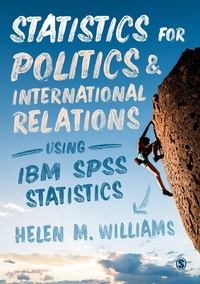
Statistics for Politics and International Relations Using IBM SPSS Statistics
1st Edition
Published on 3. February 2020
408 pages
978-1-5264-5199-6 (ISBN)
Description

Guiding you from first principles to advanced techniques, this book uses IBM SPSS Statistics examples specific to your Politics and International Relations studies to equip you with the tools to understand key concepts in quantitative research, and use them to produce and interpret data. The book takes you through the entire research process, from choosing a research question through to writing up your findings.
Key features include:
Software-specific sections in each chapter to show you how to use SPSS, while mathematical equations are kept to a minimum
Packed with real life examples
Extensive learning features including: chapter objectives, boxed summaries, illustrations, exercises and end-of-chapter questions, suggestions of further reading and a glossary
Accompanied by a collection of online resources including datasets, exercises, multiple choice questions, podcasts, videos and further reading and weblinks.
This is an invaluable research companion for students of Politics and International Relations using IBM SPSS Statistics.
Key features include:
Software-specific sections in each chapter to show you how to use SPSS, while mathematical equations are kept to a minimum
Packed with real life examples
Extensive learning features including: chapter objectives, boxed summaries, illustrations, exercises and end-of-chapter questions, suggestions of further reading and a glossary
Accompanied by a collection of online resources including datasets, exercises, multiple choice questions, podcasts, videos and further reading and weblinks.
This is an invaluable research companion for students of Politics and International Relations using IBM SPSS Statistics.
Reviews / Votes
Dr Williams' book is an excellent and scary-free introduction to statistics. Using engaging examples from politics and international relations help to illustrate difficult, abstract concepts, making learning statistics fun and approachable. A must-read for all politics undergraduate students!Anja Neundorf, Professor of Politics and Research Methods, University of Glasgow. -- Anja Neundorf This book boldly outlines existing issues with the teaching statistical analysis to scholars of Politics and International Relations who often lack formal Maths and statistics training and, therefore, are rarely at ease with methodologically heavy ways of teaching statistics and quantitative data analysis. Instead, this book offers an application-based approach to teaching quantitative data analysis that is meant to inspire, as well as educate scholars with little to no background in statistical analysis.
By using relevant Politics and IR examples from a range of reliable data sources and exploring them using simple and robust data analysis techniques, this book makes statistical analysis accessible to a wide range of scholars and encourages their independent learning by offering a range of activities and additional resources for every chapter.
Dr Ekaterina Kolpinskaya is Lecturer in Politics at the University of Exeter. -- Dr Ekaterina Kolpinskaya
More details
Edition
1. Auflage
Language
English
Place of publication
London
United Kingdom
Target group
College/higher education
Product notice
Reflowable
ISBN-13
978-1-5264-5199-6 (9781526451996)
Copyright in bibliographic data and cover images is held by Nielsen Book Services Limited or by the publishers or by their respective licensors: all rights reserved.
Schweitzer Classification
Other editions
Additional editions
Book
02/2020
1st Edition
SAGE Publications Ltd
€148.00
Shipment within 15-20 days
Book
02/2020
1st Edition
SAGE Publications Ltd
€68.80
Shipment within 15-20 days
Person
Helen Williams is Associate Professor in the School of Politics and IR at the University of Nottingham. She is passionate about teaching research methods and applied statistics to reluctant undergraduates. Her innovations in making quantitative research more accessible won the Political Studies Association Innovation in Teaching Politics Award in 2014.
Content
Chapter 1: Introduction
Chapter 2: Approaches to the social world
Chapter 3: Getting started with SPSS
Chapter 4: Describing Categorical Data
Chapter 5: Visualizing categorical data
Chapter 6: Inference with categorical data
Chapter 7: Describing continuous data
Chapter 8: Visualizing continuous data
Chapter 9: Comparing group means
Chapter 10: Inference with continuous data
Chapter 11: Writing about data
Appendix: Activity answers
Chapter 2: Approaches to the social world
Chapter 3: Getting started with SPSS
Chapter 4: Describing Categorical Data
Chapter 5: Visualizing categorical data
Chapter 6: Inference with categorical data
Chapter 7: Describing continuous data
Chapter 8: Visualizing continuous data
Chapter 9: Comparing group means
Chapter 10: Inference with continuous data
Chapter 11: Writing about data
Appendix: Activity answers
