

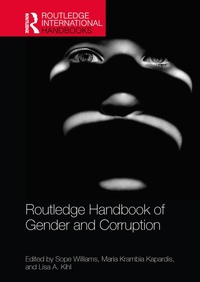
Routledge Handbook of Gender and Corruption
1st Edition
Published on 31. December 2025
482 pages
978-1-040-80579-4 (ISBN)
Description

The Routledge Handbook of Gender and Corruption showcases the most innovative and exciting research being conducted in this area of study, providing a comprehensive go-to reference for all who are interested in the topic.
In the last two decades, there has been an increasing awareness of the importance of understanding the nexus between gender and corruption in terms of understanding the way men and women experience corruption and the differential impact of anti-corruption frameworks on men and women, as well as an understanding of how women in different spaces affect the prevalence and kinds of corruption. This Handbook examines these issues as well as the role of social and gender norms in relation to corruption. This understanding is crucial for our ability to design anti-corruption frameworks that are effective and do not create unintended consequences for any group. Despite the importance of this issue, there remains a lack of in-depth, analytical, and geographically diverse investigations into the nexus of gender and corruption. This book addresses this gap by providing a comprehensive, multidisciplinary, geographically balanced treatise on gender and corruption. This book combines sectoral, thematic, and country-specific studies to allow readers to easily compare differing perspectives and approaches on cutting-edge issues and their implications for gender and corruption. Key sectors such as education, politics, public procurement, healthcare, sport, sanitation, and immigration are considered, as well as the role of new technologies, in supporting whistleblowing.
This Handbook provides academics, practitioners, and graduate researchers of public policy, public administration, law, and anti-corruption with all of the tools they need to understand the nuances of gender and corruption.
In the last two decades, there has been an increasing awareness of the importance of understanding the nexus between gender and corruption in terms of understanding the way men and women experience corruption and the differential impact of anti-corruption frameworks on men and women, as well as an understanding of how women in different spaces affect the prevalence and kinds of corruption. This Handbook examines these issues as well as the role of social and gender norms in relation to corruption. This understanding is crucial for our ability to design anti-corruption frameworks that are effective and do not create unintended consequences for any group. Despite the importance of this issue, there remains a lack of in-depth, analytical, and geographically diverse investigations into the nexus of gender and corruption. This book addresses this gap by providing a comprehensive, multidisciplinary, geographically balanced treatise on gender and corruption. This book combines sectoral, thematic, and country-specific studies to allow readers to easily compare differing perspectives and approaches on cutting-edge issues and their implications for gender and corruption. Key sectors such as education, politics, public procurement, healthcare, sport, sanitation, and immigration are considered, as well as the role of new technologies, in supporting whistleblowing.
This Handbook provides academics, practitioners, and graduate researchers of public policy, public administration, law, and anti-corruption with all of the tools they need to understand the nuances of gender and corruption.
Reviews / Votes
"It should not astonish that corruption and anti-corruption systems affect men and women differently. As for power relations in general, corruption is a gendered issue. Women are typically more affected by corruption in areas like access to health, education, public contracts etc. Women may not be less corrupt as such, but they are typically (still) excluded from core power networks. This book provides a long-needed in-depth analysis of gender and corruption. Its approach is multidisciplinary and geographically balanced. It is exactly what we have long been waiting for."Mark Pieth, Professor, University of Basel, Switzerland
"From examining women's vulnerability to corruption to the specific ways in which corruption targets women, including specific forms of corruption such as sextortion to computing the cost of corruption to women and girls, the evidence-based essays traverse the globe and offer innovative ideas that could address 'retail' corruption that confronts everyday women to large scale corruption that has derailed public procurement and public service delivery primarily needed by the most vulnerable. This book is a major contribution towards reigniting integrity by transcending a one-size fits all paradigm in the fight against corruption. I foresee the book having a catalytic effect that will transcend academic scholarship and transform policy making and judicial scrutiny thus contributing to human rights advancement and judicial work."
Thuli (Thulisile) Madonsela, Professor, Law Trust Research Chair in Social Justice; Director of the Centre for Social Justice - Stellenbosch University, South Africa
"The gendered aspect of corruption is a topic which has been recognised for some time. However, until recently, the topic has been under examined and misunderstood and has not properly informed anti-corruption policies and practice. The Routledge Handbook of Gender and Corruption is thus a timely intervention and an incredibly valuable resource placing the issue of gender and the differential and particular impact of corruption squarely at the centre of the discussion. This is an important addition to our growing body of anti-corruption resources."
Karam Singh, Deputy Director, Integrity Initiatives International, USA
More details
Series
Edition
1. Auflage
Language
English
Place of publication
London
United Kingdom
Publishing group
Taylor & Francis Ltd
Target group
College/higher education
Professional and scholarly
Illustrations
39 Tables, black and white; 13 Line drawings, black and white; 3 Halftones, black and white; 16 Illustrations, black and white
File size
3,99 MB
ISBN-13
978-1-040-80579-4 (9781040805794)
Copyright in bibliographic data and cover images is held by Nielsen Book Services Limited or by the publishers or by their respective licensors: all rights reserved.
Schweitzer Classification
Other editions
Additional editions
Sope Williams | Maria Krambia Kapardis | Lisa A. Kihl
Routledge Handbook of Gender and Corruption
Book
approx. 12/2025
1st Edition
Routledge
€342.80
Not yet published
Persons
Sope Williams is Professor of Public Procurement Law and Deputy Director of the African Procurement Law Unit at Stellenbosch University, South Africa. Her research interests lie at the intersection of Public Procurement Law, anti-corruption, and gender.
Maria Krambia Kapardis is Professor of Accounting at Cyprus University of Technology. Her research interests are corruption and anti-corruption; ethical behaviour; fraud detection, investigation, and prevention; and ethical leadership and modern slavery.
Lisa A. Kihl is Professor of Sport Management in the School of Kinesiology at the University of Minnesota, USA, and Director of the Global Institute for Responsible Sport Organizations.
Maria Krambia Kapardis is Professor of Accounting at Cyprus University of Technology. Her research interests are corruption and anti-corruption; ethical behaviour; fraud detection, investigation, and prevention; and ethical leadership and modern slavery.
Lisa A. Kihl is Professor of Sport Management in the School of Kinesiology at the University of Minnesota, USA, and Director of the Global Institute for Responsible Sport Organizations.
Content
Foreword Part I: Overarching themes in gender and corruption 1. Framing the discourse on gender and corruption 2. Gender and corruption: International frameworks, challenges and pathways for inclusive governance 3. Sexual corruption: Emerging directions in research and policy 4. Sexual corruption: the silent intersection between sexual violence and corruption 5. Gender, corruption, and social norms: Findings from a study of the intersections of gender norms and social norms driving corruption in primary healthcare delivery in Nigeria Part II: Corruption and gendered agency, access, and participation 6. The symbolic effect of women in politics on trust in parliament: A multilevel panel study 7. Gender representation and integrity in criminal justice institutions in the Western Balkans 8. The presence of women on boards has a moderating effect on masking bribery and corruption 9. Women in high-level positions as perpetrators of corruption in Croatia 10. Women as "victims" of corruption: Addressing gendered vulnerabilities 11. Anonymizing technology, women and whistleblowing 12. The impact of gendered corruption on Moroccan women 13. Gendered clientelism and corruption: Are women less corrupt than men in China? Part III: Gender and Corruption: Perspectives and sectors 14. Gendered corruption barriers in public procurement systems 15. Bids, bias and barriers: Approaches and challenges in using data to measure corruption and gender participation in public procurement 16. The gendered impacts of corruption on women's health in Southern Africa 17. Fighting corruption in water and sanitation services: A South African perspective 18. Gendered forms of corruption in South African public universities 19. Gender, corruption and human trafficking 20. The intersection between gender, human trafficking and corruption by law enforcement officials: A South African legislative perspective 21. Escape or endure? How corruption fuels women's migration intentions 22. Gender and sport corruption 23. Conceptualizing the association between gender (in)equality and corruption in sport governing bodies 24. Pedalling uphill: Corruption and gender inequality in professional sports 25. Artificial Intelligence and corruption: Whistleblowing integrity systems to the rescue 26. Understanding gender and corruption: Domains and challenges
