

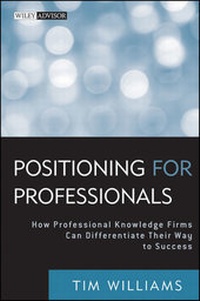
Positioning for Professionals
How Professional Knowledge Firms Can Differentiate Their Way to Success
Published on 17. June 2010
208 pages
978-0-470-87752-4 (ISBN)
Description

It's not the best companies that prevail in the marketplace,but rather the best brands. The goal of business strategy is notjust to be better, but different. Learn how to build adifferentiating value proposition by clearly and carefully definingyour brand boundaries: Calling, Competencies, Customers, andCulture.
Positioning for Professionals shows how awell-defined value proposition can help professional service firmscreate their own success instead of copying the success of others,including such concepts as:
* How and why professional service brands become homogenized
* Why standing for everything is the same as standing fornothing
* Why there's no such thing as full service
* Deep and narrow as a strategic imperative
* Why it's better to be a profit leader than a marketleader
* Differentiation and price premiums
* How to map your brand on the matrix of relevance anddifferentiation
* How to define a value proposition that will make your firmintensely appealing to the customers who want you for what you dobest
Based on the proven premise that the most profitable businessstrategy is not to aim at the center of the market, but rather atthe edges, Positioning for Professionals is written forleaders, managers, and other senior executives of service companiesin with a particular emphasis on professional service firms.
Positioning for Professionals shows how awell-defined value proposition can help professional service firmscreate their own success instead of copying the success of others,including such concepts as:
* How and why professional service brands become homogenized
* Why standing for everything is the same as standing fornothing
* Why there's no such thing as full service
* Deep and narrow as a strategic imperative
* Why it's better to be a profit leader than a marketleader
* Differentiation and price premiums
* How to map your brand on the matrix of relevance anddifferentiation
* How to define a value proposition that will make your firmintensely appealing to the customers who want you for what you dobest
Based on the proven premise that the most profitable businessstrategy is not to aim at the center of the market, but rather atthe edges, Positioning for Professionals is written forleaders, managers, and other senior executives of service companiesin with a particular emphasis on professional service firms.
More details
Other editions
Additional editions
Tim Williams
Positioning for Professionals
How Professional Knowledge Firms Can Differentiate Their Way to Success
Book
09/2010
Wiley
€44.00
Shipment within 10-20 days
Person
TIM WILLIAMS leads Ignition Consulting Group (www.ignitiongroup.com), a business consultancy devoted to helping professional knowledge firms create and capture more value. As a recognized thought leader in marketing, Tim is a frequent speaker for marketing and business organizations worldwide. He is a regular contributor to business and professional publications and is author of Take a Stand for Your Brand, ranked by Amazon as one of the top ten books on brand building. As an adviser in developing professional service brands, Tim has worked with both large and small professional service firms--most notably advertising agencies and other marketing communications firms--in both the U.S. and abroad. He began his career on Madison Avenue working for large multinational advertising agencies and later served as president and owner of several midsize independent firms.
Content
Introduction.
Chapter 1 Size Is Not a Strategy.
Maintaining Pricing Integrity.
Better to Be a Profit Leader than a Market Leader.
Why Bigness Doesn't Lead to Greatness.
Hired to Be Effective, Not Efficient.
Chapter 2 How and Why Brands Become Homogenized.
The Urge to Copy.
The Folly of All-In-One.
Line Extension Is Not Branding.
There's No Such Thing as Full Service.
The Natural Fear of Focus
Chapter 3 The Mature Company's Identity Crisis.
Differentiation and Price Premiums.
Columbus, Not Napoleon.
The Diffusion of Identity.
Landing in No-Man's Land.
Strategy at the Edges.
Not Best Practices, but Next Practices.
Chapter 4 Expanding Business by Narrowing Focus.
There's No Such Thing as a General Market.
Vertical Success versus Horizontal Success.
The Strategic Value of Going Deep.
Chapter 5 Positioning as the Centerpiece of BusinessStrategy.
What Are You Really Selling?
Becoming Hard to Imitate.
Two Critical Dimensions of an Effective Value Proposition.
A Category of One.
A Brand Is the Customer's Idea of the Product.
Natural Outcomes of a Powerful Value Proposition.
Chapter 6 Building Brand Boundaries.
Brand Boundary 1: Calling.
Brand Boundary 2: Customers.
Brand Boundary 3: Competencies.
Brand Boundary 4: Culture.
The Confluence of Calling, Customers, Competencies, andCulture.
Chapter 7 Validating the Value Proposition.
Be Rooted in the Future, Not the Past.
The Value Proposition Team.
Asking the Right Questions.
Chapter 8 Without Execution, There Is No Strategy.
Services.
Staffing.
Self-Promotion.
Systems.
Staging.
Executing a Positioning Strategy with Alignment Teams.
Rebuilding Your Ship While at Sea.
Chapter 9 Getting Paid for Creating Value.
The Perils of Cost-Based Compensation.
Changing the Language.
Pricing as a Core Competency.
Why a Value-Based Approach is in the Client's BestInterest.
The Alignment of Incentives.
Creating a Virtuous Circle.
Chapter 10 A New and Better Way to Price ProfessionalServices.
Forms of Value-Based Pricing.
The Right Clients for Outcome-Based Agreements.
The True Meaning of Partnership.
Uncovering Missed Opportunities to Make Pricing a CoreCompetency.
Key Questions in Setting a Value-Based Price.
If Complex Global Companies Can Do It, So Can You.
Better Time Tracking Is Not the Answer.
Thinking of Compensation Plans as a Stock Portfolio.
Setting the Stage for a Value-Based Approach toCompensation.
A Declaration of Value.
Appendix A: The Before-and-After Survey.
Appendix B: More Ways to Differentiate Your Brand.
Appendix C: Indicators of the Firm's Success.
Notes.
About the Author.
Index.
Chapter 1 Size Is Not a Strategy.
Maintaining Pricing Integrity.
Better to Be a Profit Leader than a Market Leader.
Why Bigness Doesn't Lead to Greatness.
Hired to Be Effective, Not Efficient.
Chapter 2 How and Why Brands Become Homogenized.
The Urge to Copy.
The Folly of All-In-One.
Line Extension Is Not Branding.
There's No Such Thing as Full Service.
The Natural Fear of Focus
Chapter 3 The Mature Company's Identity Crisis.
Differentiation and Price Premiums.
Columbus, Not Napoleon.
The Diffusion of Identity.
Landing in No-Man's Land.
Strategy at the Edges.
Not Best Practices, but Next Practices.
Chapter 4 Expanding Business by Narrowing Focus.
There's No Such Thing as a General Market.
Vertical Success versus Horizontal Success.
The Strategic Value of Going Deep.
Chapter 5 Positioning as the Centerpiece of BusinessStrategy.
What Are You Really Selling?
Becoming Hard to Imitate.
Two Critical Dimensions of an Effective Value Proposition.
A Category of One.
A Brand Is the Customer's Idea of the Product.
Natural Outcomes of a Powerful Value Proposition.
Chapter 6 Building Brand Boundaries.
Brand Boundary 1: Calling.
Brand Boundary 2: Customers.
Brand Boundary 3: Competencies.
Brand Boundary 4: Culture.
The Confluence of Calling, Customers, Competencies, andCulture.
Chapter 7 Validating the Value Proposition.
Be Rooted in the Future, Not the Past.
The Value Proposition Team.
Asking the Right Questions.
Chapter 8 Without Execution, There Is No Strategy.
Services.
Staffing.
Self-Promotion.
Systems.
Staging.
Executing a Positioning Strategy with Alignment Teams.
Rebuilding Your Ship While at Sea.
Chapter 9 Getting Paid for Creating Value.
The Perils of Cost-Based Compensation.
Changing the Language.
Pricing as a Core Competency.
Why a Value-Based Approach is in the Client's BestInterest.
The Alignment of Incentives.
Creating a Virtuous Circle.
Chapter 10 A New and Better Way to Price ProfessionalServices.
Forms of Value-Based Pricing.
The Right Clients for Outcome-Based Agreements.
The True Meaning of Partnership.
Uncovering Missed Opportunities to Make Pricing a CoreCompetency.
Key Questions in Setting a Value-Based Price.
If Complex Global Companies Can Do It, So Can You.
Better Time Tracking Is Not the Answer.
Thinking of Compensation Plans as a Stock Portfolio.
Setting the Stage for a Value-Based Approach toCompensation.
A Declaration of Value.
Appendix A: The Before-and-After Survey.
Appendix B: More Ways to Differentiate Your Brand.
Appendix C: Indicators of the Firm's Success.
Notes.
About the Author.
Index.
Introduction Quick, which airline do you associate with the following? "We invite you to sit back, relax, and enjoy your flight with us today. If there's anything we can do to make your flight more enjoyable, please just let us know." Your answer is probably "every airline." That's because pretty much every airline uses the same language on every flight. There is, of course, the government-mandated safety language that every airline must include in its on-board announcements; but beyond that there is a missed opportunity for airlines to say something different. There's also an opportunity for airlines to do something different, but most don't. The result is that you don't know whether you're flying Delta, United, or American. And chances are you don't care. The airlines are just doing what most other companies do: copying their competitors. In a business context, imitation is not "the most sincere form of flattery"; it's just lazy. When you really think about it, copying someone else's business model demonstrates an incredible lack of creativity and imagination. Yet most business and brands are just copies of someone else's. Most managers invest their time and energy in trying to make their brands better, when in fact they should be working to make their brands different. Better isn't necessarily always better; different is better. Behind the scenes, American Airlines may be working hard to recruit the best people, deliver the most efficient service, and build the best maintenance record. But most of that means very little to customers unless their experience with American is actually different than with other airlines.
One definition of a brand is that consumers are willing to spend more money for it than for a similar "product" in the category. Airlines no doubt feel that they are in a constant price war with their competitors. Their explanation will be that airline travel is viewed as a commodity, and that their customers "just want to get from point A to point B at the lowest price." The problem is that there is really no such thing as a commodity. Organizations like airlines feel that they are a special case, that other categories are much easier to "brand" than theirs. Their defense is that a brand like Starbucks has a real advantage since it's obviously easier to develop strong brand affinity for a coffee house than an airline. Really? Why then were there no strong coffee house brands until Starbucks came along? Starbucks built a reputation selling a product that's over 90 percent water. That's because they understand that they're not just selling a product, but the experience of the product. Actually water itself is another startling example of the power of branding. Covering over 75 percent of the earth's surface, it could be argued that water is the ultimate commodity. Nothing is so widely used and distributed as water. Yet millions of people are willing to pay up to one thousand times the cost of tap water for one liter of it. That's because of water quality questions, you say? That doesn't explain the pricing disparity between various brands of bottled water on the supermarket shelf. In a blind taste test, could one really discern the difference between Crystal Geyser spring water (selling for 59 cents per liter) and Evian spring water (selling for 99 cents per liter-very close to double the price)? In restaurants, branded spring water can sell for up to $7.50 per liter. If water can do it, why can't an airline? Or a hotel, or a steel company, or a law firm, or an advertising agency? They can. They just need to stop copying every hotel, steel company, law firm, or agency they compete with.
The urge to copy is exceptionally strong in the human species. The underlying explanation is the "copying" mechanism that has allowed humans to survive and evolve for the past few million years. The work of social observers like Mark Earls demonstrates the simple truth that humans are social creatures, not independent agents, and that as such they rely on copying to learn and survive in society. In fact, says Earls, "Copying is our species' number one learning and adaptive strategy."1 So building a successful brand means going against your instincts. Common sense would tell you to closely examine what competitors in the category are doing, make sure you are offering the same or better features, and adopt the "best practices" in the industry. But while others are studying and following best practices, the innovators and category leaders are developing the "next practices." They are resisting the natural urge to copy. And instead of just working to improve their brand, they are working to differentiate it.
This explains the alarming disparity between the world's top brands and all the rest. Because most brands are more likely to copy than to innovate, the measurement referred to as "brand equity" has been in decline on average since 2004. But a handful of leading brands actually are growing in brand equity. In fact, what the consultancy Core Brand calls "brand equity value" is concentrated among the top 100 brands, which account for over 90 percent of all brand equity value.2 This isn't because the top 100 brands outspend their competitors, but because they out-differentiate them. The reason top brands in a category outpace their rivals is not the power of share of market (as regularly taught in business schools), but rather their share of mind. This is the power of the brand. While companies may occupy a position on the stock exchange, brands occupy a position in the mind of the customer. This is how the term "positioning" was coined. Positioning is the foundation of branding, because it identifies what the brand stands for.
Unless you know what the brand stands for, how can you possibly make effective decisions about how to run your business? Consider how a clearly defined positioning can lead you to good answers to critical questions like: What services and capabilities should we support and develop? Who are our best prospective customers and clients? How should the firm be structured? What should we be doing more of? Less of? What kind of business partnerships do we need? What kind of knowledge and expertise do we need to cultivate? How should the enterprise be structured? What type of people do we need to hire? What kind of training and professional development should we provide? What should our website say? What should our offices look like? Every decision you make about your business either contributes to or detracts from your desired brand; very few are neutral. Business decisions can't be made in a vacuum or based on some vague notion of "excellence." The enterprises that make the best decisions are the ones with the clearest view of who they are and what makes them different. In other words, they are companies with a positioning.
Especially in tough economic times, "common sense" would suggest that a business can improve its revenue streams by expanding products and services, broadening capabilities, and appealing to more customers. It seems like common sense, but it's exactly the wrong response. The best growth strategy-in good economies or bad-is to decide what not to do. The best way to expand is by narrowing. Imagine two architectural firms: one that's extremely focused with a clear value proposition, and one with an unfocused business strategy that attempts to do everything for everybody. Which of these two firms would have: 1. The greatest earning power? 2. The largest geographical market area? 3. The fewest competitors? 4. The greatest degree of respect from clients? 5. The most sophisticated clients? The answer in every case is the focused firm. Let's look at each question individually.
It's a simple fact that the specialist earns more than the generalist. This is true in medicine, law, engineering, architecture, consulting, construction-you name it. This is because the specialist knows more, and we live and work in a knowledge economy.
Focused firms draw clients from all over the globe, not just from their own zip code. That's because what they're selling isn't available down the block from some other firm just like them.
The easiest way to narrow your competition is to narrow your focus. There are far fewer specialists than generalists, and the law of supply and demand dictates that the less the supply, the greater the demand.
Knowledge and expertise equal respect. An effective value proposition allows your firm to develop and leverage its intellectual capital. This makes you valued-and respected-not just for what you do, but for what you know.
A quality value proposition attracts a quality client. A business that proclaims, "We're right for everybody," logically is going to attract both the good and...
NO SUCH THING AS A COMMODITY
One definition of a brand is that consumers are willing to spend more money for it than for a similar "product" in the category. Airlines no doubt feel that they are in a constant price war with their competitors. Their explanation will be that airline travel is viewed as a commodity, and that their customers "just want to get from point A to point B at the lowest price." The problem is that there is really no such thing as a commodity. Organizations like airlines feel that they are a special case, that other categories are much easier to "brand" than theirs. Their defense is that a brand like Starbucks has a real advantage since it's obviously easier to develop strong brand affinity for a coffee house than an airline. Really? Why then were there no strong coffee house brands until Starbucks came along? Starbucks built a reputation selling a product that's over 90 percent water. That's because they understand that they're not just selling a product, but the experience of the product. Actually water itself is another startling example of the power of branding. Covering over 75 percent of the earth's surface, it could be argued that water is the ultimate commodity. Nothing is so widely used and distributed as water. Yet millions of people are willing to pay up to one thousand times the cost of tap water for one liter of it. That's because of water quality questions, you say? That doesn't explain the pricing disparity between various brands of bottled water on the supermarket shelf. In a blind taste test, could one really discern the difference between Crystal Geyser spring water (selling for 59 cents per liter) and Evian spring water (selling for 99 cents per liter-very close to double the price)? In restaurants, branded spring water can sell for up to $7.50 per liter. If water can do it, why can't an airline? Or a hotel, or a steel company, or a law firm, or an advertising agency? They can. They just need to stop copying every hotel, steel company, law firm, or agency they compete with.
THE URGE TO COPY
The urge to copy is exceptionally strong in the human species. The underlying explanation is the "copying" mechanism that has allowed humans to survive and evolve for the past few million years. The work of social observers like Mark Earls demonstrates the simple truth that humans are social creatures, not independent agents, and that as such they rely on copying to learn and survive in society. In fact, says Earls, "Copying is our species' number one learning and adaptive strategy."1 So building a successful brand means going against your instincts. Common sense would tell you to closely examine what competitors in the category are doing, make sure you are offering the same or better features, and adopt the "best practices" in the industry. But while others are studying and following best practices, the innovators and category leaders are developing the "next practices." They are resisting the natural urge to copy. And instead of just working to improve their brand, they are working to differentiate it.
THE BEST AND ALL THE REST
This explains the alarming disparity between the world's top brands and all the rest. Because most brands are more likely to copy than to innovate, the measurement referred to as "brand equity" has been in decline on average since 2004. But a handful of leading brands actually are growing in brand equity. In fact, what the consultancy Core Brand calls "brand equity value" is concentrated among the top 100 brands, which account for over 90 percent of all brand equity value.2 This isn't because the top 100 brands outspend their competitors, but because they out-differentiate them. The reason top brands in a category outpace their rivals is not the power of share of market (as regularly taught in business schools), but rather their share of mind. This is the power of the brand. While companies may occupy a position on the stock exchange, brands occupy a position in the mind of the customer. This is how the term "positioning" was coined. Positioning is the foundation of branding, because it identifies what the brand stands for.
ALIGNMENT IS EVERYTHING
Unless you know what the brand stands for, how can you possibly make effective decisions about how to run your business? Consider how a clearly defined positioning can lead you to good answers to critical questions like: What services and capabilities should we support and develop? Who are our best prospective customers and clients? How should the firm be structured? What should we be doing more of? Less of? What kind of business partnerships do we need? What kind of knowledge and expertise do we need to cultivate? How should the enterprise be structured? What type of people do we need to hire? What kind of training and professional development should we provide? What should our website say? What should our offices look like? Every decision you make about your business either contributes to or detracts from your desired brand; very few are neutral. Business decisions can't be made in a vacuum or based on some vague notion of "excellence." The enterprises that make the best decisions are the ones with the clearest view of who they are and what makes them different. In other words, they are companies with a positioning.
POSITIONING IS NOT COMMON SENSE
Especially in tough economic times, "common sense" would suggest that a business can improve its revenue streams by expanding products and services, broadening capabilities, and appealing to more customers. It seems like common sense, but it's exactly the wrong response. The best growth strategy-in good economies or bad-is to decide what not to do. The best way to expand is by narrowing. Imagine two architectural firms: one that's extremely focused with a clear value proposition, and one with an unfocused business strategy that attempts to do everything for everybody. Which of these two firms would have: 1. The greatest earning power? 2. The largest geographical market area? 3. The fewest competitors? 4. The greatest degree of respect from clients? 5. The most sophisticated clients? The answer in every case is the focused firm. Let's look at each question individually.
Greater Earning Power
It's a simple fact that the specialist earns more than the generalist. This is true in medicine, law, engineering, architecture, consulting, construction-you name it. This is because the specialist knows more, and we live and work in a knowledge economy.
Larger Geographical Market Area
Focused firms draw clients from all over the globe, not just from their own zip code. That's because what they're selling isn't available down the block from some other firm just like them.
Fewer Competitors
The easiest way to narrow your competition is to narrow your focus. There are far fewer specialists than generalists, and the law of supply and demand dictates that the less the supply, the greater the demand.
More Respect from Clients
Knowledge and expertise equal respect. An effective value proposition allows your firm to develop and leverage its intellectual capital. This makes you valued-and respected-not just for what you do, but for what you know.
More Sophisticated Clients
A quality value proposition attracts a quality client. A business that proclaims, "We're right for everybody," logically is going to attract both the good and...
