

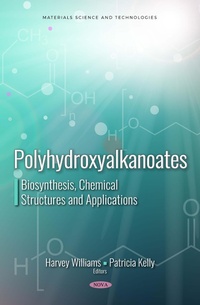
Polyhydroxyalkanoates: Biosynthesis, Chemical Structures and Applications
Biosynthesis, Chemical Structures and Applications
Published on 1. May 2018
332 pages
978-1-5361-3440-7 (ISBN)
Description

Polyhydroxyalkanoates: Biosynthesis, Chemical Structures and Applications opens with an exposé on employing extremophiles as polyhydroxyalkanoate (PHA) producers. The authors suggest that extremophiles may be easily subjected to a long-term continuous cultivation processes, which considerably enhances overall productivity while reducing the energy demand in biopolymer production. Conversely, a range of challenges remain, including improving the metabolic capability of extremophiles, recycling of fermentation broth, various process engineering aspects, and adaptation of bioreactor materials and process controlling devices to conditions shortening their life span. Following this, the enzymes, regulators and genes involved in PHA biosynthesis are analyzed for their potential as an alternative to synthetic polymers. They are synthesized as intracellular carbon and energy storage compounds from over 300 species in the presence of excess carbon and under oxygen, nitrogen or phosphorus limitation, or after pH shifts. This collection goes on to suggest PHA as a promising alternative for petrochemical compounds. The challenges of increasing economic feasibility in the global market, minimizing costs, and improving the polymer yield are reviewed. Additionally, recent research on structural variations of PHAs has been centered on the design, biosynthesis, and properties of biodegradable and biocompatible materials, which can be used for bioengineering. This collection also includes a focus on the roles of polyhydroxyesters and PHAs in the construction of tissue engineering scaffolds, which are used in bone, cartilage, ligament, skin, vascular tissues, neural tissues and skeletal muscles. Their exceptional properties, such as high surface-to-volume ratio, high porosity with very small pore size, and biodegradation have made them gain a lot of attention in this field. The biomedical applications of PHAs are explored, including in-vivo implants, tissue engineering, anticancer agents, drug delivery, biocontrol agents and memory enhancers, as their low acidity allows for minimal risk in usage. In order to enhance its applicability in various fields, the blends and nanocomposites of PHAs are studied and their potential challenges, applications and opportunities are addressed. After which, the industrial and agricultural applications are described, with specific focus on potential applications of PHAs in packaging. Other applications include moulded goods, paper coatings, non-woven fabrics, adhesives, films and performance additives. Recent advances in this area, by means of peer-reviewed literature and patents, are introduced and discussed. Moreover, innovative strategies for the synthesis of novel polymer blends, adequate for food contact applications, are presented.
More details
Other editions
Additional editions
Harvey Williams | Patricia Kelly
Polyhydroxyalkanoates
Biosynthesis, Chemical Structures and Applications
Book
05/2018
Nova Science Publishers Inc
€362.47
Shipment within 15-20 days
Content
- Intro
- Contents
- Preface
- Chapter 1
- Physiological, Kinetic, and Process Engineering Aspects of Polyhydroxyalkanoate Biosynthesis by Extremophiles
- Abstract
- Introduction
- Halophile PHA Production Strains
- General Features of Halophile Microbes
- Gram-Negative Halophile PHA Producers
- PHA Production by Haloarchaea
- Gram-Negative Halophile Eubacteria as PHA Producers
- Gram-Positive Halophile PHA Producers
- Tracing Halophilic PHA Producers
- Cryophilic (Psychrophilic) PHA Producers
- General Features of Cryophilic Organisms
- Reports on PHA Production by Cryophilic Microorganisms
- Thermophilic PHA Producers
- General Features of Thermophiles
- Gram-Negative Thermophile PHA Producers
- Gram-Positive Thermophile PHA Producers
- Additional Stressors Boosting PHA Biosynthesis
- Conclusion
- Acknowledgments
- References
- Chapter 2
- Polyhydroxyalkanoates: New Browsing the PHA Biosynthesis Insights in Native and Recombinant Strains
- Abstract
- 1. Introduction
- 2. PHA Biosynthesis Pathways
- 3. PHA Biosynthetic Enzymes
- 3.1. PHA Synthase/Polymerase
- 3.1.1. Characteristics of PHA Synthase: Size, Structure and Subunit Composition
- 3.1.2. Substrate Specificity of PHA Synthase
- 3.1.3. PHA Synthase Crystallization
- 3.1.4. Catalytic Mechanism of PHA Synthase
- 3.1.5. The Lag Phase of Polymerization Reaction by PhaC
- 3.2. ß-ketoacyl-CoA Thiolase
- 3.3. Acetoacetyl-CoA Reductase
- 4. Organization of PHA Biosynthetic Genes
- 5. PHB/PHA Granules
- 5.1. Models of PHB Granules Formation
- 5.2. Granule-Associated Proteins (GAPs)
- 5.3. The Role of PhaP, PhaR, PhaF and PhaM Proteins in PHA Biosynthesis
- 5.3.1. Phasins or PhaPs Proteins
- 5.3.2. PhaF Phasin
- 5.3.3. PhaR Protein
- 5.3.4. PhaM Protein
- 6. PHA Biosynthesis by Engineered Bacteria
- 7. PHA Biosynthesis by Other Organisms
- 8. Novel Production of PHA Polymers and Nanomaterials
- References
- Chapter 3
- Polyhydroxyalkanoates: A Short Tale from Polymer Synthesis to Future Prospects
- Abstract
- 1. Introduction
- 2. PHAs are Classified According to Their Chemical Structure
- 3. Three Pathways Are the Basis of PHA Biosynthesis
- 4. PHAs Are Promising for Several Applications
- 5. Sustainable Feedstocks for PHA Production
- 6. Challenges and Future Prospects: A Conclusion
- References
- Chapter 4
- Polyhydroxyalkanoates: Chemical Structure
- Abstract
- 1. Introduction
- 2. Basic Chemical Structures of PHAs and Classification
- 2.1. PHA Homopolymers
- 2.2. Production of PHA Heteropolymers (or Copolymers)
- 2.2.1. Specificity of PHA Synthases
- 2.2.2. PHA Structure Correlations with Carbon Substrates and Host Microorganisms
- 2.2.3. PHA Polymer Blends
- 2.2.4. Structural Diversities of PHAs
- 3. Properties of PHA Copolymers
- 3.1. Crystallinity of PHAs
- Conclusion
- References
- Biographical Sketches
- Chapter 5
- Polyhydroxyesters as Scaffolds for Tissue Engineering
- Abstract
- 1. Introduction
- 1.1. Scaffolds and Their Ideal Characteristics
- 1.2. Types of Scaffold in Tissue Engineering
- 1.2.1. Natural
- 1.2.2. Synthetic
- 2. PHEs in Tissue Engineering
- 2.1. Structure and Properties
- 2.1.1. PLA
- 2.1.2. PGA
- 2.1.3. PCL
- 2.1.4. PLGA
- 2.1.5. Physical, Chemical and Mechanical Properties
- 2.2. Synthesis of Biodegradable PHEs in Tissue Engineering
- 2.3. Fabrication of PHE Scaffolds in Tissue Engineering
- 2.3.1. Electrospining
- 2.3.2. Phase Separation
- 2.3.3. Solvent Casting/Particulate Leaching
- 2.3.4. Fibre Bonding
- 2.3.5. Freeze Drying
- 2.4. Functions and Biodegradation
- 2.4.1. Comparison between the Functions of Extracellular Matrix (ECM) and Scaffolds
- 2.4.2. Biodegradation
- 2.5. Application of PHEs in Tissue Engineering
- 2.5.1. Cardiovascular Tissue Engineering
- 2.5.2. Skin Tissue Engineering
- 2.5.3. Bone Tissue Engineering
- 2.5.4. Cartilage Tissue Engineering
- 2.5.5. Tendon and Ligament Tissue Engineering
- 2.6. Specific PHEs and Their Application in Tissue Engineering
- 2.6.1. Polylactide (PLA)
- 2.6.2. Polyglycolide or Poly(Glycolic Acid (PGA)
- 2.6.3. Polycaprolactone (PCL)
- 2.6.4. Poly(Lactide-Co-Glycolide (PLGA)
- 2.6.4.1. Challenges and Drawbacks
- Conclusion and Future Prospects
- References
- Chapter 6
- Polyhydroxyalkanoates (PHAs) as Scaffolds for Tissue Engineering
- Abstract
- Introduction
- Synthesis/Production of Polyhydroxyalkanoates (PHAs)
- Properties of Polyhydroxyalkanoates (PHAs)
- Blending of PHAs with Natural and Synthetic Polymers
- Chemical Modifications of PHAs
- Use of Polyhydroxyalkanoates (PHAs) Scaffolds in Tissue Engineering
- Tissue Engineering Scaffolds (TESs)
- Cardiovascular Products
- Sutures
- Cartilage Repair Devices
- Neural Regeneration/Nerve Tissue Engineering
- PHAs in Orthopaedic Pins and Devices
- Biomedical Applications of Polyhydroxyalkanoates (PHAs)
- Challenges and Future Trends
- Conclusion
- References
- Chapter 7
- Blends and Composites of Polyhydroxyalkanoates and Their Applications
- Abstract
- 1. Introduction
- 2. Structure and Properties
- 3. PHA Blends
- 4. PHA Blends and Their Properties
- 4.1. Mechanical Properties
- 4.2. Thermal Properties
- 5. PHA-Nanocomposites
- 5.1. Mechanical Properties of PHA Nanocomposites
- 5.2. Thermal Properties
- 6. Applications
- 6.1. Biomedical Applications
- 6.2. Packaging
- Conclusion
- Acknowledgments
- References
- Chapter 8
- Polyhydroxyalkanoates: Biodegradability, Recent and Potential Applications in Packaging
- Abstract
- 1. Introduction
- 2. Classification of PHAs
- 2.1. Structure of PHAs
- 2.2. Properties of PHAs
- 2.2.1. Thermal and Mechanical Properties
- 2.2.1.1. Properties of PHB
- 3. Requirements for PHAs in Food Packaging
- 3.1. General
- 3.2. Comparison of PHA with Other Petroleum Polymers for Packaging Applications
- 3.3. Barrier Properties
- 3.4. PHA Packaging in Different Types of Food
- 3.4.1. Cheese
- 3.4.2. Frozen Food or Products
- 3.4.3. Fruits and Vegetables
- 3.4.4. Non-Carbonated Beverages
- 3.5. Biodegradation
- 3.6. Migration
- Conclusion
- Acknowledgments
- References
- Chapter 9
- Polyhydroxyalkanoates: An Ideal Polymeric Material in Food Packaging
- Abstract
- 1. Introduction
- 2. Bio-Based Food Packaging Polymers
- 2.1. Biodegradable Polymers Suitable for Food Packaging
- 2.1.1. PHAs: An Overview
- 2.1.2. PHB: An Overview
- 2.2. Enhancement Techniques of PHA Properties for Food Packaging
- 2.2.1. PHA Copolymerization
- 2.2.2. PHA Blending
- 2.2.3. PHA Nanocomposites and Films
- Conclusion
- References
- Index
- Blank Page
