

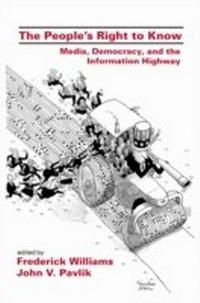
The People's Right To Know
Media, Democracy, and the Information Highway
1st Edition
Published on 13. September 2013
272 pages
978-1-136-68993-2 (ISBN)
Description

This important volume presents the pros and cons of a national service that will meet the information needs and wants of all people. In the preface, Everette E. Dennis, Executive Director of The Freedom Forum Media Studies Center, asks, "What will a true information highway -- where most citizens enjoy a wide range of information services on demand -- do to local communities, government, and business entities, other units of society and democracy itself?"
It is no longer a question of whether a vastly expanded "information highway" will be built in America. Telephone and cable companies have already inaugurated their plans, and government will most likely incorporate such plans into the economic development policy of the late 1990s. The key questions remaining are: Who will pay for it? and Whom exactly will it serve? The People's Right to Know suggests that serving the everyday citizen should be the main objective of any national initiatives in this area. It counsels that evolving electronic services are new communications media that should be deployed with a main focus on the public's needs, interests, and desires.
If advances in the nation's public telephone network will make information services as easy to use as ordinary voice calls, or newspapers promise vast new electronic services awaiting their readers, more attention must also be devoted to the information needs and wants of everyday citizens. In our increasingly multicultural and technology-driven society, enormous inequities exist across America's socioeconomic classes regarding access to information critical to everyday life. If an information highway is to be effective, we need to ensure that all Americans have access to it; its design must start with the everyday citizen. This powerful new medium at our disposal must consider policy that includes attempts to close the information gap among our citizens. It must ensure equal access to data regarding job, education, and health information services; legal information on such topics as immigration; and transactional services that offer assistance on such routine but time-consuming tasks as renewing a driver's license or registering to vote.
Media and telecommunications professionals, communication scholars, and policymakers, including two former chairmen of the Federal Communications Commission, provide insights and pointed commentary on the nature and shape of an information highway designed as a new public medium aimed at serving a wide range of public needs. Their work should improve our basis for deciding if there are means by which an enhanced public telecommunications network can benefit the everyday working American.
It is no longer a question of whether a vastly expanded "information highway" will be built in America. Telephone and cable companies have already inaugurated their plans, and government will most likely incorporate such plans into the economic development policy of the late 1990s. The key questions remaining are: Who will pay for it? and Whom exactly will it serve? The People's Right to Know suggests that serving the everyday citizen should be the main objective of any national initiatives in this area. It counsels that evolving electronic services are new communications media that should be deployed with a main focus on the public's needs, interests, and desires.
If advances in the nation's public telephone network will make information services as easy to use as ordinary voice calls, or newspapers promise vast new electronic services awaiting their readers, more attention must also be devoted to the information needs and wants of everyday citizens. In our increasingly multicultural and technology-driven society, enormous inequities exist across America's socioeconomic classes regarding access to information critical to everyday life. If an information highway is to be effective, we need to ensure that all Americans have access to it; its design must start with the everyday citizen. This powerful new medium at our disposal must consider policy that includes attempts to close the information gap among our citizens. It must ensure equal access to data regarding job, education, and health information services; legal information on such topics as immigration; and transactional services that offer assistance on such routine but time-consuming tasks as renewing a driver's license or registering to vote.
Media and telecommunications professionals, communication scholars, and policymakers, including two former chairmen of the Federal Communications Commission, provide insights and pointed commentary on the nature and shape of an information highway designed as a new public medium aimed at serving a wide range of public needs. Their work should improve our basis for deciding if there are means by which an enhanced public telecommunications network can benefit the everyday working American.
Reviews / Votes
"There is almost a feeling of deja vu when reading (or rereading) this volume, since so much of what it discusses is now part of the political agenda of the average citizen--debates over 'information rich' and 'information poor' for example....The optimistic can take this volume as a guidebook, the pessimistic can take is as an unwitting eulogy to what might have been."-Media Ethics
"Those who wish to know more about the information highway will find that this book fits their needs; those who wish to teach students the importance of this issue will find it a useful tool. Written in terms suitable for scholars and students alike, the book would be a useful resource as well as a suitable textbook for an upper undergraduate- or graduate-level class. Material in the book could easily be used to foster classroom discussion, pro-and-con debate, and specialized research....This book...with its straightforward information and vast compendium of terms, should quell any 'techno-fears.' It is very 'user-friendly.'"
-Journalism Educator
"Useful information and analysis of existing technology and information services reveal how these could be shaped into a national information service without great cost or advanced technology."
-CHOICE
More details
Series
Language
English
Place of publication
London
United Kingdom
Publishing group
Taylor & Francis Ltd
Target group
Professional and scholarly
File size
3,40 MB
ISBN-13
978-1-136-68993-2 (9781136689932)
Copyright in bibliographic data and cover images is held by Nielsen Book Services Limited or by the publishers or by their respective licensors: all rights reserved.
Schweitzer Classification
Other editions
Additional editions
Frederick Williams | John V. Pavlik
The People's Right To Know
Media, Democracy, and the Information Highway
Book
11/1993
Routledge
€223.21
Article not available at the moment
Frederick Williams | John V. Pavlik
The People's Right To Know
Media, Democracy, and the Information Highway
Book
11/1993
Routledge
€63.50
Shipment within 10-20 days
Persons
Frederick Williams, John V. Pavlik
Content
Contents: E.E. Dennis, Preface. Part I:Envisioning the Shape and Feel of a National Information Service.F. Williams, On Prospects for Citizens' Information Services. R. Fidler, Newspapers in the Electronic Age. M.A. Thalhimer, Background Issues Related to Information Services. J.V. Pavlik, M.A. Thalhimer, Roundtable: Sizing up Prospects for a National Information Service. Part II:Citizen Information Services and the Public Interest.W. Dutton, Lessons from Public and Nonprofit Services. J.V. Pavlik, Citizen Access, Involvement, and Freedom of Expression in an Electronic Environment. Part III:Policymaking Regarding Citizen Information Services.A.C. Sikes, Charting the Future of Communication Services. H.S. Dordick, D.E. Lehman, Information Highways: "Trickle Down" Infrastructure? E.M. Noam, C.D. Ferris, E.C. Parker, Policy Implications for Citizen Information Services. F. Williams, J.V. Pavlik, Epilogue.
