

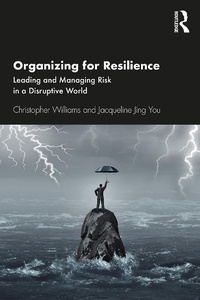
Organizing For Resilience
Leading and Managing Risk in a Disruptive World
1st Edition
Published on 11. July 2021
318 pages
978-1-000-36509-2 (ISBN)
Description

Organizing for Resilience provides a fresh and novel insight into research on how leaders can prepare their organizations to face up to shocks and disruptions in a turbulent and unpredictable world. It provides an analysis of the topic of organizational resilience in a comprehensive and integrative way, with fresh theoretical and research implications as well as important implications for leaders.
The first book to synthesize themes from across a spectrum of resilience using the metaphor of a 'resilience landscape', chapters in Part I are devoted to five analytical levels: individual level resilience; small firms in which major disruption can threaten survival; large firms with disruptions in one part of the organization; large firms facing enterprise-wide disruption; and disruption to a complete community or economic ecosystem of individuals and organizations. Cases and practice insights are presented to bring the topics to life, allowing reflection and debate at each level. In Part II, the construct of the 'resilience landscape' is developed, along with a discussion on leadership for resilience by instilling a resilience mind-set and developing capabilities in relational resilience.
The book is ideally suited to bachelor's and master's degree courses on strategy, organizational behaviour and leadership. PhD and DBA researchers in the field of resilience and strategy will also find the book useful, as will practising consultants and business leaders.
The first book to synthesize themes from across a spectrum of resilience using the metaphor of a 'resilience landscape', chapters in Part I are devoted to five analytical levels: individual level resilience; small firms in which major disruption can threaten survival; large firms with disruptions in one part of the organization; large firms facing enterprise-wide disruption; and disruption to a complete community or economic ecosystem of individuals and organizations. Cases and practice insights are presented to bring the topics to life, allowing reflection and debate at each level. In Part II, the construct of the 'resilience landscape' is developed, along with a discussion on leadership for resilience by instilling a resilience mind-set and developing capabilities in relational resilience.
The book is ideally suited to bachelor's and master's degree courses on strategy, organizational behaviour and leadership. PhD and DBA researchers in the field of resilience and strategy will also find the book useful, as will practising consultants and business leaders.
Reviews / Votes
"This volume offers a much-needed addition to resilience studies, focusing on the often- overlooked need for leaders to consider potential environmental disruptions as a regular part of their strategic planning processes. The authors do a remarkable job of illustrating this process through a series of case studies at distinct yet overlapping levels of analysis. The resulting insights, which build on useful theory from multiple disciplines, enable the authors to draw implications for the need for leaders to quite intentionally chart and navigate the resilience landscapes in which their organizations are situated. Students, scholars, and managers alike will benefit greatly from learning how to think and act in ways that enable them to organize for resilience." - Dr. William Kahn, Boston University, Questrom School of Business, USA"This very accessible book approaches the issues around organisational resilience from a grounded academic start point but then is able to, very deftly, weave in real world examples and situations that demonstrate the value of resilience-related practice. In this way, I see this book being of great interest and use to both practitioners and academics alike, on one of the most important issues of the day." - Dr. Ran Bharma, Wolfson School of Mechanical, Electrical & Manufacturing Engineering, UK
"Williams and You's book is a very timely and insightful addition to the literature on organizational resilience and will be useful both for the academic community as well as managers and leaders grappling with disruptions at a strategic level. The authors cover a wide range of case evidence and literature set in a multi-level framework and provide an interesting metaphor in terms of their depiction of the 'Resilience Landscape'." - Dr. Yanto Chandra, The Hong Kong Polytechnic University, HK
"The book 'Organizing for Resilience' provides an important addition to the literature on organizational resilience. The book offers analytical insights across multiple analytical levels: the resilience of individual employees within an organization, the resilience of organizations when confronted with shocks and disruptions, and the resilience of communities and economies when confronted with large-scale disruptions such as those resulting from the COVID-19 pandemic. The book is a comprehensive resource for researchers and practitioners alike and offers valuable case examples for leaders of both small and large organizations who seek to prepare their organizations for an increasingly turbulent and unpredictable future." - Professor Martina Linnenluecke, Macquarie University, AU "This volume offers a much-needed addition to resilience studies, focusing on the often- overlooked need for leaders to consider potential environmental disruptions as a regular part of their strategic planning processes. The authors do a remarkable job of illustrating this process through a series of case studies at distinct yet overlapping levels of analysis. The resulting insights, which build on useful theory from multiple disciplines, enable the authors to draw implications for the need for leaders to quite intentionally chart and navigate the resilience landscapes in which their organizations are situated. Students, scholars, and managers alike will benefit greatly from learning how to think and act in ways that enable them to organize for resilience."
Professor William Kahn, Boston University, Questrom School of Business, USA
"This very accessible book approaches the issues around organisational resilience from a grounded academic start point but then is able to, very deftly, weave in real world examples and situations that demonstrate the value of resilience-related practice. In this way, I see this book being of great interest and use to both practitioners and academics alike, on one of the most important issues of the day."
Dr. Ran Bhamra, Loughborough University, UK
"Williams and You's book is a very timely and insightful addition to the literature on organizational resilience and will be useful both for the academic community as well as managers and leaders grappling with disruptions at a strategic level. The authors cover a wide range of case evidence and literature set in a multi-level framework and provide an interesting metaphor in terms of their depiction of the 'Resilience Landscape'."
Dr. Yanto Chandra, The Hong Kong Polytechnic University, Hong Kong
"The book Organizing for Resilience provides an important addition to the literature on organizational resilience. The book offers analytical insights across multiple analytical levels: the resilience of individual employees within an organization, the resilience of organizations when confronted with shocks and disruptions, and the resilience of communities and economies when confronted with large-scale disruptions such as those resulting from the COVID-19 pandemic. The book is a comprehensive resource for researchers and practitioners alike and offers valuable case examples for leaders of both small and large organizations who seek to prepare their organizations for an increasingly turbulent and unpredictable future."
Professor Martina Linnenluecke, Macquarie University, Australia
"If ever a book was written more timeously, I am not aware of it. If ever there was a time in history that has highlighted the need for thinking about resilience as part of strategic planning, it is now. The Covid-19 pandemic has changed our world forever and the multitude failings of governments and businesses alike has emphasized the strategic imperative of having resilience built into everything. Lord Harris of Haringey, the new Chair of the UK Resilience Committee put it succinctly; 'We need to move our thinking from 'just in time' to 'just in case'.'
This book gives us a template to do just that. Immaculately researched, drawing on multiple valid examples, it is an immensely valuable addition for any leaders' developmental reading, for the time has come for the greatest accolade aimed at any organization is that it is resilient."
Martin Hogan, Henley on Thames, UK
More details
Edition
1. Auflage
Language
English
Place of publication
London
United Kingdom
Publishing group
Taylor & Francis Ltd
Target group
College/higher education
Professional and scholarly
Product notice
Reflowable
Illustrations
10 Tables, black and white; 10 Illustrations, color
ISBN-13
978-1-000-36509-2 (9781000365092)
Copyright in bibliographic data and cover images is held by Nielsen Book Services Limited or by the publishers or by their respective licensors: all rights reserved.
Schweitzer Classification
Other editions
Additional editions
Christopher Williams | Jacqueline Jing You
Organizing For Resilience
Leading and Managing Risk in a Disruptive World
Book
07/2021
1st Edition
Routledge
€179.81
Shipment within 15-20 days
Christopher Williams | Jacqueline Jing You
Organizing For Resilience
Leading and Managing Risk in a Disruptive World
Book
07/2021
1st Edition
Routledge
€92.60
Available immediately
Persons
Christopher Williams is Professor in the Strategy and Entrepreneurship Department at NEOMA Business School in France. His research interests include international strategy, innovation in international firms and contexts, and organizational resilience. Before entering academia in 2007, Dr Williams spent two decades in industry, mostly in innovative and international environments. His research appears in journals such as Asia Pacific Journal of Management, International Business Review, Journal of Business Research, Journal of Management, Journal of Management Studies, Journal of World Business and Research Policy. He has also published a range of teaching cases on strategy and innovative issues in international contexts with Ivey Publishing and is author of Venturing in International Firms: Contexts and Cases in a High-Tech World (Routledge, 2018) and Management Consultancy for Innovation (Routledge, 2019). Jacqueline Jing You is a doctoral graduate from Durham University Business School in the UK. Her research interests include organizational resilience and disruption, inter-organizational relationships and organizational ecosystems. She worked in industry with international companies and as an entrepreneur before her doctoral studies. Jacqueline has published in the Journal of Sustainable Tourism and The Palgrave Handbook of Corporate Sustainability in the Digital Era. She holds degrees from the University of Shanghai Science and Technology and the University of St Andrews.
Content
Preface
1. Introduction
Part I: A Resilient Past
2. Individual Resilience
3. Small Firms, Big Shocks
4. Big Firms, Isolated Shocks
5. Big Firms, Enterprise-wide Shocks
6. Resilience in an Economic Ecosystem
Part II: A Resilient Future
7. Synthesis: The Resilience Landscape
8. Leadership Implications: Organizing with a Resilience Mind-set
9. Conclusion Appendix: The four Cases of Resilience
1. Introduction
Part I: A Resilient Past
2. Individual Resilience
3. Small Firms, Big Shocks
4. Big Firms, Isolated Shocks
5. Big Firms, Enterprise-wide Shocks
6. Resilience in an Economic Ecosystem
Part II: A Resilient Future
7. Synthesis: The Resilience Landscape
8. Leadership Implications: Organizing with a Resilience Mind-set
9. Conclusion Appendix: The four Cases of Resilience
