

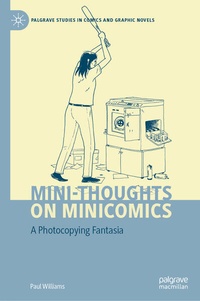
Mini-Thoughts on Minicomics
Description

This book explores how hand-constructed minicomics are made, how they circulate and are stored in readers' homes, the affective histories that surround minicomics, and the implications for conceptualizing the subject that writes, draws, photocopies, distributes, reads, and stores minicomics. Mini-Thoughts on Minicomics contains chapters on stapling and archiving but is primarily concerned with xerography and the social contexts in which comics are made using photocopiers. The focus is on US texts and contexts, though minicomics from Britain and elsewhere in the world are also included. Mini-Thoughts on Minicomics is informed by comics history, media archaeology, folklore studies, workplace ethnography, ontology of paperwork, and critical theory, and the book analyzes how creators have reflected on the making of minicomics through published interviews and as depicted in minicomics themselves.
More details
Other editions
Additional editions
Person
Paul Williams is Associate Professor of Twentieth-Century Literature and Culture at the University of Exeter, UK. In addition to articles on comics published in journals such as American Literary History , Journal of American Studies , Studies in the Novel , and Textual Practice , he has written four books: The US Graphic Novel (2022), Dreaming the Graphic Novel (2020), Paul Gilroy (2012), and Race, Ethnicity and Nuclear War (2011). He co-edited the collection The Rise of the American Comics Artist (2010) with James Lyons.
Content
Introduction: Please Swipe Card.- Chapter 1: Memory Full.- Chapter 2: Add Staples.- Chapter 3: Paper Jam.- Chapter 4: Cancelled Job.- Chapter 5: Original Size Cannot Be Detected. Conclusion: Log Off?.
