

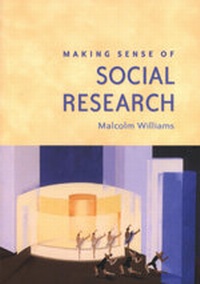
Making Sense of Social Research
1st Edition
Published on 3. December 2002
222 pages
978-1-84860-562-6 (ISBN)
Description

What are the essentials for undergraduates and postgraduates engaged in quantitative and qualitative research? How can the gap between formulating a research question and carrying out research be bridged? This accessible, well-judged text provides students with a matchless introduction to generic research skills. It is uncluttered, direct and unpatronizing. Key features of the book are:
- Accessibility
- Clarification of key issues and problem solving guidance
- Demonstration of the importance of interplay between theory and research
- Realism in defining essential research issues and the problems that researchers encounter
`It is not the case that "anyone can do social research", most research requires training. Here Malcolm Williams provides such training.... Helpful and often humorous' - Roger Sapsford, University of Teesside
- Accessibility
- Clarification of key issues and problem solving guidance
- Demonstration of the importance of interplay between theory and research
- Realism in defining essential research issues and the problems that researchers encounter
`It is not the case that "anyone can do social research", most research requires training. Here Malcolm Williams provides such training.... Helpful and often humorous' - Roger Sapsford, University of Teesside
Reviews / Votes
'It is not the case that "anyone can do social research", most research requires training. Here Malcolm Williams provides such training ... economical. Helpful and often humorous' - Roger Sapsford, University of TeessideAll prices
More details
Edition
First Edition
Language
English
Place of publication
London
United Kingdom
Target group
College/higher education
ISBN-13
978-1-84860-562-6 (9781848605626)
Copyright in bibliographic data and cover images is held by Nielsen Book Services Limited or by the publishers or by their respective licensors: all rights reserved.
Schweitzer Classification
Other editions
Additional editions
Malcolm Williams
Making Sense of Social Research
Book
12/2002
1st Edition
SAGE Publications Inc
€89.33
Shipment within 15-20 days
Malcolm Williams
Making Sense of Social Research
Book
12/2002
1st Edition
SAGE Publications Inc
€245.12
Shipment within 15-20 days
Person
Malcolm Williams is Professor and Director of the School of Social Sciences at Cardiff University. Prior to joining Cardiff in 2010, he was Professor of Social Research Methodology and Head of the School of Psychosocial Sciences at the University of Plymouth where he taught for 16 years.
Malcolm has designed and taught modules in the philosophy of social research for 18 years at both undergraduate and postgraduate level. In these he has introduced a number of innovative pedagogic techniques, such as Problem Based Learning and 'Concept Speed Dating', in which students take a key idea and move from table to table attempting to build conceptual links between ideas.Additionally he has taught many modules and short courses in social theory, research design, questionnaire design, scaling, sampling, scientific method and history of science.
Williams has an extensive publishing record in philosophy of social research, including: Introduction to Philosophy of Social Research (with Tim May, Routledge, 1996), Knowing the Social World (with Tim May, OUP, 1998), Science and Social Science (Routledge, 2000), Making Sense of Social Research (SAGE, 2003), Philosophical Foundations of Social Research (SAGE, 2006), Teaching Quantitative Methods (with Geoff Payne, SAGE, 2011) Objectivity and Subjectivity in Social Research (with Gayle Letherby and John Scott, SAGE, 2012) and The SAGE Handbook of Innovations in Social Research (with W Paul Voght, SAGE, 2014).
Malcolm has designed and taught modules in the philosophy of social research for 18 years at both undergraduate and postgraduate level. In these he has introduced a number of innovative pedagogic techniques, such as Problem Based Learning and 'Concept Speed Dating', in which students take a key idea and move from table to table attempting to build conceptual links between ideas.Additionally he has taught many modules and short courses in social theory, research design, questionnaire design, scaling, sampling, scientific method and history of science.
Williams has an extensive publishing record in philosophy of social research, including: Introduction to Philosophy of Social Research (with Tim May, Routledge, 1996), Knowing the Social World (with Tim May, OUP, 1998), Science and Social Science (Routledge, 2000), Making Sense of Social Research (SAGE, 2003), Philosophical Foundations of Social Research (SAGE, 2006), Teaching Quantitative Methods (with Geoff Payne, SAGE, 2011) Objectivity and Subjectivity in Social Research (with Gayle Letherby and John Scott, SAGE, 2012) and The SAGE Handbook of Innovations in Social Research (with W Paul Voght, SAGE, 2014).
Content
Introduction
Science and Commitment in Social Research
From Question to Method
Research as Interpretation
Selecting and Sampling
Survey Research
Questionnaire Design
Analysing Survey Data
The Ethics of Social Research
Designing Research
Reporting Findings
Science and Commitment in Social Research
From Question to Method
Research as Interpretation
Selecting and Sampling
Survey Research
Questionnaire Design
Analysing Survey Data
The Ethics of Social Research
Designing Research
Reporting Findings
