

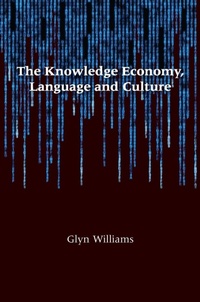
The Knowledge Economy, Language and Culture
Published on 24. March 2010
264 pages
978-1-84769-450-8 (ISBN)
Description

Together with changes in the nature of modernity, globalisation is restructuring society. The sovereignty of the nation-state is undermined, the structuring of identity is realigned and a sense of individualism (which involves a freedom of choice re institutional alignments) prevails. English emerges as the global lingua franca. At the heart of these developments is the knowledge economy within which work is organised according to principles quite different from those of the Taylorism that prevailed in the industrial economy. Language and culture play a crucial role in the elaboration of the shared meaning that is crucial for learning within team working. The book argues that creativity is enhanced by the use of multilingualism within working practices. It concludes with an overview of how our understanding of language is also changing.
Reviews / Votes
This is another important and highly contemporary contribution by Glyn Williams. Noted for his considerable originality and independence of viewpoint, the book is remarkably interdisciplinary, with understandings from economics, sociology, philosophy, business and sociolinguistics. It attacks issues of major current importance: the future knowledge-based economy, globalisation, and the use of technology for information exchange. The book contains critical appreciation and historical analysis but is also a very modern and highly constructive approach to the knowledge economy, and to the future of language. This is Williams' best book from several decades of publishing. * Colin Baker, University of Bangor, Wales * Williams's latest book offers a thoughtful, original and often provocative interpretation of the mutual relationships between the linguistic, the political, the social and the economic. The line of argument weaves together notions that are all too often considered in isolation, and this book can be recommended to advanced students and specialists of language policy and the politics of language who seek access to the big picture, along with wide-ranging scholarship and genuine intellectual engagement. * Francois Grin, University of Geneva, Switzerland * In this book, Williams sets out to provide an account of the role played by culture and language in the workplace practices and labour relations of the knowledge economy. Weaving together themes from industrial sociology, management studies, philosophy of science, linguistics and social theory, he builds an argument focused on parallel changes in the social, economic and academic domains: from a modernity centred on the nation-state to a reflexive modemity centred on selfcreated identity; from an industrial Taylorist economy to a flexible knowledge economy; and from humanist, rationalist theoretical interpretations of human agency to a decentred post-structuralist model of social practice. There can be no doubt that Williams lays down a worthy and ambitious project, especially since engagement with language use in organisational settings remains relatively marginal within discourse-analytic research. * AIon Lischinsky, Umea Universitet, Sweden in Lang Policy (2011) 10:111-113 *More details
Language
English
Place of publication
Bristol
United Kingdom
Publishing group
Channel View Publications Ltd
Target group
Professional and scholarly
Product notice
Reflowable
ISBN-13
978-1-84769-450-8 (9781847694508)
Copyright in bibliographic data and cover images is held by Nielsen Book Services Limited or by the publishers or by their respective licensors: all rights reserved.
Schweitzer Classification
Other editions
Additional editions
Glyn Williams
The Knowledge Economy, Language and Culture
Book
03/2010
Multilingual Matters
€48.40
Shipment within 10-20 days
Glyn Williams
The Knowledge Economy, Language and Culture
E-Book
03/2010
1st Edition
Multilingual Matters
from
€38.09
Available for download
Person
Formerly Research Professor at University Ramon Llull, Barcelona, Glyn Williams has also worked at the University of San Francisco, the University of Bangor, University of Cardiff, and University College Dublin. A sociologist, he has written 14 books and over a hundred papers on a variety of topics including language and society, regional development, ethnicity, media and technology.
Content
Chapter 1 Change and the Knowledge Economy
Chapter 2 Language as an Object
Chapter 3 Human Capital
Chapter 4 Regional Innovation Systems
Chapter 5 Communities of Practice
Chapter 6 Language and the Subject
Chapter 7 The Cultural Economy
Chapter 8 Social Theory and Language
Chapter 2 Language as an Object
Chapter 3 Human Capital
Chapter 4 Regional Innovation Systems
Chapter 5 Communities of Practice
Chapter 6 Language and the Subject
Chapter 7 The Cultural Economy
Chapter 8 Social Theory and Language
