

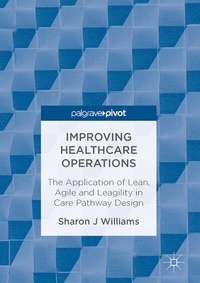
Improving Healthcare Operations
Description

This book examines the design of two care pathways to establish how key principles associated with systems thinking, quality improvement, and supply chain management can improve the design of these services. 'Lean' has typically been the prominent approach when improving the design of healthcare systems and is often selected by healthcare professionals to standardize and improve the delivery of care. Previous literature shows there has been varying success in the application of 'Lean', the author presents a study which examines the benefits of introducing 'Agile' as an alternative and complementary approach. Improving Healthcare Operations explores when 'Lean' and 'Agile' are most applicable, and instances where a hybrid approach can be employed. Including empirical qualitative data collected from two care pathways, it intends to provide organizations with an alternative in order to produce the level and quality of care that is expected by patients.
More details
Other editions
Additional editions
Person
Sharon J Williams is a Senior Lecturer and Lead of the Swansea Centre for Improvement and Innovation at the College of Human & Health Sciences, Swansea University, UK, and is currently an Improvement Science Fellow sponsored by the Health Foundation. Previously she was a lecturer in Logistics and Operations Management at Cardiff Business School, UK, and a senior member of the Clinical Systems Improvement team at Warwick University Medical School, UK. Her research looks at the design of patient care pathways using improvement and redesign techniques originating largely from other sectors.
Content
Chapter 1 Healthcare systems in the 21st Century.- Chapter 2 Improving Healthcare systems.- Chapter 3 Lean in Healthcare.- Chapter 4 Delivering Agile & Person-centred care.- Chapter 5 Leanness plus Agility = Leagility.- Chapter 6 Methodology.- Chapter 7 Analysis of the Chronic Obstructive Pulmonary Disease (COPD) pathway: Lean, Agile and Leagility.- Chapter 8 Analysis of the Huntington's Disease (HD) pathway: Lean, Agile and Leagility.- Chapter 9 Discussion and theoretical reflections.- Chapter 10 Conclusions and Future Research Agenda.
