

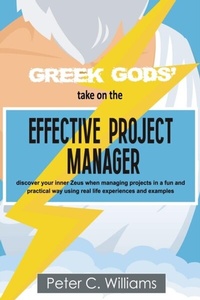
Greek Gods' take on the Effective Project Manager
Description

Let the Greek Gods help you discover your inner Zeus when managing projects! Whether you are a novice or an experienced project manager, this book will help. With over 520 colourful illustrations, easy-to-follow real-life examples and useful tips, the Greek Gods' take on the effective project manager is a fun, yet practical way to learn more about the exciting world of project management.
Throughout the ages, people have used a type or form of project management, whether it was in the building of the great pyramids in Egypt or the Coliseum in Rome, whenever we have a large undertaking that follows a series of steps or actions, we project manage. It is within us all, but to be truly effective it is not just about making sure you deliver, but instead, around how you handle various situations and aspects including managing people, risks and dependencies, all at the same time making sure you stay on track and within budget.
Over 500 pages will walk you through each stage of the project lifecycle and provides all of the necessary theory, real-life examples, methods and handy tips for managing a variety of different types of projects and deliverables. Based on over 20-years of commercial experience, you will be provided with a broad range of tools and techniques, including explanations and real-world examples of fifteen of the most popular methodologies, ways to manage different types of sponsors, how to efficiently resolve problems and much more.
So whether you are just starting out or you are an experienced project manager, the Greek God's take on the effective project manager has something for everyone, and everything within the book has been designed and tailored to help you become the best project manager you can be.
KEY FEATURES
- Fifteen examples of project methodologies
- Project governance framework
- Building robust project plans
- Building a budget or benefits case
- Managing different personality types
- Types of deliveries & deliverables
- Stakeholder management
- Critical Path Method
- Managing different types of sponsors
- Building & managing a RAID
- and much more…
All prices
More details
Person
Content
1. World of Project Management
1.1. What is project management
1.2 Key project manager attributes
1.3. Different types of project managers
1.4. Project manager personality types
1.5. Zeus and the Gods
2. Projects & methodologies
2.1. Project or programme
2.2. Projects & methodologies
2.3. Tools: Selecting a Methodology
2.4. Resource & time focused
2.5. Improvement & customer focused
2.6. Systems & development focused
2.7. Traditional & sequential focused
2.8. Managed & control focused
2.9. Gods: Athena does approach
3. Project fundamentals
3.1. It takes a team
3.2. Project dimensions
3.3. Introduction to the project cycle
3.4. Tool: Project Life Cycles
3.5. Resourcing Models
3.6. Tool: Organisation Charts
3.7. Gods: Ares does strategy
4. Initiating & planning
4.1. Setting goals & objectives
4.2. Tool: Be SMART
4.3. Scoping the project
4.4. Tool: BOSCARD (Terms of Reference)
4.5. Strawman of tasks & activities
4.6. Forecast & foresight
4.7. Estimating & evaluating
4.8. Tool: Mind Mapping
4.9. Gods: Dionysus does planning
5. Defining & executing
5.1. Project governance framework
5.2. Predecessor, successors & dependencies
5.3. Building a robust project plan
5.4. Tool: Gantt Chart
5.5. Requirements Modelling
5.6. Identifying options and solutions
5.7. Tool: Delphi Technique
5.8. Permission to proceed
5.9. Gods: Zeus does approval
6. Managing the deliverables
6.1. Types of deliveries & deliverables
6.2. Focusing resources & stakeholders
6.3. Tool: Critical Path Method
6.4. Managing the delivery
6.5. Resolving Problems
6.6. Managing changes to the delivery
6.7. Preparing for go live
6.8. Tool: Schedule of Events
6.9. Gods: Hermes does delivery
7. Managing communications
7.1. Communicating with different groups
7.2. Identifying your stakeholders
7.3. Tool: Stakeholder Map
7.4. Identifying & managing your stakeholder groups
7.5. Collaboration with our stakeholders
7.6. Types of sponsors
7.7. Creating your stakeholder plan
7.8. Key Personality Types
7.9. Tracking & Communicating Performance
7.10. Gods: Poseidon does communication
8. Managing resources & costs
8.1. Identifying skills, capabilities & capacity
8.2. Tool: RACI Matrix
8.3. Confidential & sensitive
8.4. Building Trust & confidence
8.5. Tool: Work Breakdown Structure
8.6. Knowing the costs
8.7. Building a budget or benefits case
8.8. Tool: Project Management Triangle
8.9. Managing the costs & budget
8.10. Gods: Athena does managing mortals
9. Managing internal & external factors
9.1. Project RAID
9.2. Identifying & managing risks
9.3. Technique: Calculating risks
9.4. Listing assumptions
9.5. Tool: Force-field Analysis
9.6. Managing known issues & constraints
9.7. Tool: RAID Log
9.8. Identifying and managing dependencies
9.9. Gods: Ares does risks and issues
10. Handling the end of the project
10.1. Preparing for the handover
10.2. Success or Failure
10.3. Tool: Failure Mode & Effects Analysis (FMEA)
10.4. Post Go Live
10.5. Project Closure
10.6. What did we learn
10.7. Technique: Project closure report
10.8. Gods: Poseidon does success
