


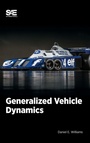
Generalized Vehicle Dynamics
1st Edition
Published on 30. April 2022
370 pages
978-1-4686-0141-1 (ISBN)
Description

Author Daniel E. Williams, an industry professional with more 30 years of experience in chassis control systems from concept to launch, brings this experience and his unique approach to readers of Generalized Vehicle Dynamics.This book makes use of nomenclature and conventions not used in other texts. This combination allows the derivation of complex vehicles that roll with multiple axles, any of which can be steered, to be directly predicted by manipulation of a generalized model. Similarly the ride characteristics of such a generalized vehicle are derived. This means the vehicle dynamic behavior of these vehicles can be directly written from the results derived in this work, and there is no need to start from Newtons Second Law to create such insight. Using new and non-standard conventions allows wider applicability to complex vehicles, including autonomous vehicles.Generalized Vehicle Dynamics is divided into two main sections-ride and handling-with roll considered in both. Each section concludes with a case study that applies the concepts presented in the preceding chapters to actual vehicles. Chapters include Simple Suspension as a Linear Dynamic System, The Quarter-Car Model, The Pitch Plane Model, The Roll Plane Mode, Active Suspension to Optimize Ride, Handling Basics, Reference Frames, New Conventions, Two-Axle Yaw Plane Model, Rear Axle Steering and Lanekeeping, Two-Axle Vehicles that Roll, Three-Axle Vehicle Dynamics, Generalized Multi-Axle Vehicle Dynamics and Automated Vehicle Architecture from Vehicle Dynamics. "e,A fresh and more inclusive book that lays out much new material in vehicle dynamics."e, - L. Daniel Metz, Ph.D.
More details
Other editions
Additional editions
Daniel Williams
Generalized Vehicle Dynamics
Book
04/2022
SAE International
€152.50
Shipment within 15-20 days
Content
- Cover
- Contents
- Foreword
- Acknowledgments
- 1 Introduction
- 1.1 Overview
- 1.2 Historical Perspective
- 1.3 Structure of the Text
- References
- 2 Simple Suspension as a Linear Dynamic System
- 2.1 Introduction
- 2.2 The Simply Suspended Mass and Linear Systems Theory
- 2.3 A Suspended Mass with Damping
- 2.4 Basic Frequency Responses
- 2.5 State Space and Block Diagram Algebra
- 2.6 State Space Realization
- 2.7 First-Order Matrix Differential Equations
- 2.8 Summary
- 3 The Quarter-Car Model
- 3.1 Introduction
- 3.2 Representing Reality with the Quarter-Car Model
- 3.3 Two Fundamental Frequencies of Interest
- 3.4 The Conventional Quarter-Car Model
- 3.5 Stochastic Road Input and Human Sensitivity to Vibration
- 3.6 Nonlinear Damping
- 3.7 Summary
- References
- 4 The Pitch-Plane Model
- 4.1 Introduction
- 4.2 Basic Pitch-Plane Model
- 4.3 Pitch-Plane-Free Response
- 4.4 Road Inputs to the Pitch-Plane Model
- 4.5 Pitch-Plane Ride Quality and the Olley Ride Criteria
- 4.6 Pitch-Plane Model with Damping
- 4.7 Generalized Pitch-Plane Model and Olley Solution
- 4.8 Three-Axle Vehicle Example
- 4.9 Summary
- References
- 5 The Roll-Plane Model
- 5.1 Introduction
- 5.2 Simple Two-Axle Roll-Plane Model
- 5.3 The Roll Mode for a Single Axle
- 5.4 The Roll-Plane Model with Stabilizer Bar
- 5.5 Single-Wheel Inputs
- 5.6 Passenger Car Roll
- 5.7 Generalized Roll-Plane Model
- 5.8 Roll and Handling
- 5.9 Summary
- 6 Active Suspension to Optimize Ride
- 6.1 Introduction
- 6.2 Inertial Damping
- 6.3 Lotus Modal Control
- 6.4 Modal Inertial Damping
- 6.5 Sprung Mass Acceleration Feedforward
- 6.6 Quarter-Car Optimal Control
- 6.7 Full Vehicle Optimal Control
- 6.8 Modal Inertial Damping and Handling
- 6.9 Summary
- References
- 7 Handling Basics
- 7.1 Introduction
- 7.2 Ackermann Steering
- 7.3 Steering Efforts
- 7.4 Slip Angles
- 7.5 Tire Forces
- 7.6 The Conventional Bicycle Model
- 7.7 Summary
- References
- 8 Reference Frames
- 8.1 Introduction
- 8.2 Reference Frames in General
- 8.3 Velocity of a Point Translating in a Rotating Reference Frame
- 8.4 Velocity and Acceleration of a Point in a Translating and Rotating Reference Frame
- 8.5 External Forces and Inertia
- 8.6 The Vehicle as a Rigid Body
- 8.7 Summary
- Reference
- 9 New Conventions
- 9.1 Introduction
- 9.2 State-of-the-Art Conventions
- 9.3 New Axle Location Convention
- 9.4 New Attack Angle Convention
- 9.5 Summary
- References
- 10 Two-Axle Yaw-Plane Model
- 10.1 Introduction
- 10.2 The Two-Axle Vehicle Model
- 10.3 Drift Angle and Yaw Rate Transfer Functions
- 10.4 Ideal Two-Axle Model
- 10.5 Steady-State Analysis
- 10.6 Pole Locations
- 10.7 Summary
- References
- 11 Rear Axle Steering and Lanekeeping
- 11.1 Introduction
- 11.2 Vehicle Model with Rear Axle Steering
- 11.3 Determination of Rear Axle Steer Control
- 11.4 Open-Loop Response of Ideal Vehicle
- 11.5 Specified Preview
- 11.6 Determination of Rear Axle Control of Ideal Vehicle
- 11.7 Numerical Results
- 11.8 Theoretical Interpretation of Practical Systems
- 11.9 Summary
- References
- 12 Two-Axle Vehicles that Roll
- 12.1 Introduction
- 12.2 Roll Axis Definitions
- 12.3 Acceleration Equations
- 12.4 External Roll Forces on Sprung Mass
- 12.5 Camber Effects
- 12.6 Roll Steer Effects
- 12.7 Differential Equations of Motion with Roll
- 12.8 Roll Steer Compensation
- 12.9 Including Steering Compliance in Understeer
- 12.10 Inclusion of Nonlinear Tires
- 12.11 Summary
- Reference
- 13 Three-Axle Vehicle Dynamics
- 13.1 Introduction
- 13.2 Peculiarities of the Three-Axle Vehicle
- 13.3 The Three-Axle Model
- 13.4 Third Axle Steering
- 13.5 Trajectory Tracking
- 13.6 Summary
- References
- 14 Generalized Multiaxle Vehicle Dynamics
- 14.1 Introduction
- 14.2 General Model
- 14.3 An Arbitrarily Steered Axle
- 14.4 All Arbitrary Axles Steered Proportionally
- 14.5 The Multiaxle Vehicle with Roll
- 14.6 Summary
- References
- 15 Automated Vehicle Architecture from Vehicle Dynamics
- 15.1 Introduction
- 15.2 Properties of a Typical Three-Axle Commercial Vehicle
- 15.3 Control of Rear Axle
- 15.4 Rear Axle Control for Yaw Rate Equivalence
- 15.5 Vehicle Results
- 15.6 Proposed Three-Axle Vehicle
- 15.7 Summary
- References
- Afterword
- Index
- About the Author
