

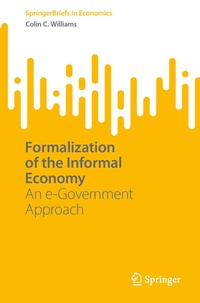
Formalization of the Informal Economy
Description

This Brief provides a cutting-edge evaluation of the application of digital technologies to tackle the informal economy. Employing institutional theory to explain the informal economy, this book reveals that the informal economy arises when formal institutional failings trigger a gap between the formal rules of the game and social norms. Chapters outline how use of digital technologies by public authorities, such as tax, social security and labor authorities, can alter social norms so that they accord with the formal rules of the game and generate a formalization of the informal economy. Setting out the e-government tools that can improve the relationship between businesses, employers, workers and citizens, and government, this book will be essential reading for academics and advanced students studying development economics, labor economics, public economics, behavioral economics, economic sociology and institutional economics as well as for government policymakers working in related fields.
More details
Other editions
Additional editions

Person
Professor Colin C. Williams is Professor of Public Policy at the University of Sheffield, UK. For the past 30 years, he has been researching the informal economy and how it can be tackled. Since 2016, he has been the lead expert on the European Platform Tackling Undeclared Work advising 27 European governments and since 2018, chief advisor on the informal economy to the Regional Cooperation Council advising six West Balkans countries on their national strategies. Across the developing economies, he works with the International Labor Organization (ILO) implementing Recommendation 204 on the transition to formality, where he has become increasingly involved in the advocacy of e-formalization as a way forward.
Content
1. Introduction to formalizing the informal economy using an e-government approach.- 2. Theorizing an e-government approach towards formalizing the informal economy.- 3. E-government tools to formalize the informal economy.- 4. Conclusions: a future roadmap for the transition to formality using digital services.
