

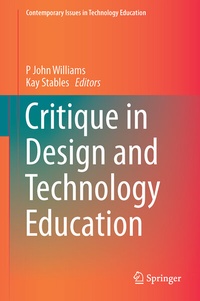
Critique in Design and Technology Education
Published on 21. February 2017
XIV, 320 pages
978-981-10-3106-9 (ISBN)
Description

This book addresses notions of critique in Design and Technology Education, facilitating a conceptual and practical understanding of critique, and enabling both a personal and pedagogical application to practice.
Critique can be a frame of mind, and may be related to a technology, product, process or material. In a holistic sense, critique is an element of a person's technological literacy, a fundamentally critical disposition brought to bear on all things technological. This book provides a reasoned conceptual framework within which to develop critique, and examples of applying the framework to Design and Technology Education. The book builds on The Future of Technology Education published by Springer as the first in the series Contemporary Issues in Technology Education.
In the 21st century, an 'age of knowledge', students are called upon to access, analyse and evaluate constantly changing information to support personal and workplace decision making and on-going innovation. A critical Design and Technology Education has an important role to play, providing students with opportunities to integrate economic, environmental, social and technological worlds as they develop and refine their technological literacy. Through the design and development of technology, they collaborate, evaluate and critically apply information, developing cognitive and manipulative skills appropriate to the 21st century. Critique goes beyond review or analysis, addressing positive and negative technological development. This book discusses and applies this deeper perspective, identifying a clear role for critique in the context of Design and Technology Education.
Critique can be a frame of mind, and may be related to a technology, product, process or material. In a holistic sense, critique is an element of a person's technological literacy, a fundamentally critical disposition brought to bear on all things technological. This book provides a reasoned conceptual framework within which to develop critique, and examples of applying the framework to Design and Technology Education. The book builds on The Future of Technology Education published by Springer as the first in the series Contemporary Issues in Technology Education.
In the 21st century, an 'age of knowledge', students are called upon to access, analyse and evaluate constantly changing information to support personal and workplace decision making and on-going innovation. A critical Design and Technology Education has an important role to play, providing students with opportunities to integrate economic, environmental, social and technological worlds as they develop and refine their technological literacy. Through the design and development of technology, they collaborate, evaluate and critically apply information, developing cognitive and manipulative skills appropriate to the 21st century. Critique goes beyond review or analysis, addressing positive and negative technological development. This book discusses and applies this deeper perspective, identifying a clear role for critique in the context of Design and Technology Education.
Reviews / Votes
"The authors present a wide range of perspectives around design and technology activity stretching and challenging in roughly equal measure; thus espousing the ideas of critical theory. . This is an essential read for the thinking design and technology teacher, teacher educator or researcher. Prepare to be challenged. Prepare to be bamboozled. Prepare to think. But read it nonetheless." (Matt McLain, Design and Technology Education, Vol. 22 (3), December, 2017)More details
Other editions
Additional editions
P. John Williams | Kay Stables
Critique in Design and Technology Education
Book
02/2017
Springer
€171.19
Shipment within 15-20 days
Persons
Professor P John Williams is the Director of the STEM Education Research Group in the School of Education at Curtin University, Australia, where he teaches and supervises research students in technology education. Apart from New Zealand, he has worked and studied in a number of African and Indian Ocean countries, as well as Australia and the United States. He directed the nationally funded Investigation into the Status of Technology Education in Australian Schools. His current research interests include mentoring beginning teachers, PCK and electronic assessment of performance.
Professor Kay Stables is Emeritus Professor of Design Education at Goldsmiths, University of London. A founder member of the Technology Education Research Unit (TERU), she has directed and contributed to projects in primary and secondary education in the UK and abroad. With Richard Kimbell, she authored the TERU retrospective, Research Design Learning (2007). More recently, together with Steve Keirl, she published Environment, Ethics and Cultures: Design and Technology Education's contribution to sustainable global futures (2015), an edited collection of theoretical and practice based approaches. Her recent research has focused on design, creativity and sustainable development, digital tools in assessment (the e-scape project) and designer well-being, as well as creating dialogic frameworks to support the development of D&T capability, including in digital environments.
Professor Kay Stables is Emeritus Professor of Design Education at Goldsmiths, University of London. A founder member of the Technology Education Research Unit (TERU), she has directed and contributed to projects in primary and secondary education in the UK and abroad. With Richard Kimbell, she authored the TERU retrospective, Research Design Learning (2007). More recently, together with Steve Keirl, she published Environment, Ethics and Cultures: Design and Technology Education's contribution to sustainable global futures (2015), an edited collection of theoretical and practice based approaches. Her recent research has focused on design, creativity and sustainable development, digital tools in assessment (the e-scape project) and designer well-being, as well as creating dialogic frameworks to support the development of D&T capability, including in digital environments.
Content
Chapter 1 Philosophy as Critique.- Chapter 2 Critique of Technology.- Chapter 3 Critiquing Design: Perspectives and World Views on Design, and Design and Technology Education, for the Common Good.- Chapter 4 The Identification and Location of Critical Thinking and Critiquing in Design and Technology Education.- Chapter 5 Alternative Knowledge Systems.- Chapter 6 Critiquing as Design and Technology Curriculum Journey: History, Theory, Politics, and Potential.- Chapter 7 Critique as Disposition.- Chapter 8 Empathy as an Aspect for Critical Thought and Action in Design and Technology.- Chapter 9 Critiquing Teaching: Developing Critique through Critical Reflection and Reflexive Practice.- Chapter 10 A Critique of Technology Education for All in a Social and Cultural Environment.- Chapter 11 Disruptive Technologies.- Chapter 12 Critiquing Literature: Children's Literature as a Learning Tool for Critical Awareness.- Chapter 13 Modelling as a Form of Critique.- Chapter 14 Politicizing the Discourse of Consumerism: Reflections on the Story of Stuff.- Chapter 15 Hyper Design Thinking: Critique, Praxis and Reflection.
