

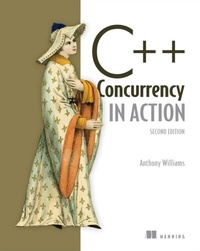
C++ Concurrency in Action
1st Edition
Published on 7. February 2019
592 pages
978-1-63835-635-6 (ISBN)
Description

"This book should be on every C++ programmer's desk. It's clear, concise, and valuable." - Rob Green, Bowling Green State University
This bestseller has been updated and revised to cover all the latest changes to C++ 14 and 17! C++ Concurrency in Action, Second Edition teaches you everything you need to write robust and elegant multithreaded applications in C++17.
Purchase of the print book includes a free eBook in PDF, Kindle, and ePub formats from Manning Publications.
About the Technology
You choose C++ when your applications need to run fast. Well-designed concurrency makes them go even faster. C++ 17 delivers strong support for the multithreaded, multiprocessor programming required for fast graphic processing, machine learning, and other performance-sensitive tasks. This exceptional book unpacks the features, patterns, and best practices of production-grade C++ concurrency.
About the Book
C++ Concurrency in Action, Second Edition is the definitive guide to writing elegant multithreaded applications in C++. Updated for C++ 17, it carefully addresses every aspect of concurrent development, from starting new threads to designing fully functional multithreaded algorithms and data structures. Concurrency master Anthony Williams presents examples and practical tasks in every chapter, including insights that will delight even the most experienced developer.
What's inside
- Full coverage of new C++ 17 features
- Starting and managing threads
- Synchronizing concurrent operations
- Designing concurrent code
- Debugging multithreaded applications
- Hello, world of concurrency in C++!
- Managing threads
- Sharing data between threads
- Synchronizing concurrent operations
- The C++ memory model and operations on atomic types
- Designing lock-based concurrent data structures
- Designing lock-free concurrent data structures
- Designing concurrent code
- Advanced thread management
- Parallel algorithms
- Testing and debugging multithreaded applications
More details
Other editions
Additional editions
Anthony Williams
C++ Concurrency in Action,2E
Book
03/2019
2nd Edition
Manning Publications
€76.00
Shipment within 10-20 days
Person
Anthony Williams has been an active member of the BSI C++ Panel since 2001 and is the developer of the just::thread Pro extensions to the C++ 11 thread library.
Content
- Intro
- Copyright
- Dedication
- Brief Table of Contents
- Table of Contents
- Praise for the first edition
- Preface
- Acknowledgments
- About this book
- Roadmap
- Who should read this book
- How to use this book
- Code conventions and downloads
- Software requirements
- Book forum
- About the author
- About the cover illustration
- Chapter 1. Hello, world of concurrency in C++!
- 1.1. What is concurrency?
- 1.2. Why use concurrency?
- 1.3. Concurrency and multithreading in C++
- 1.4. Getting started
- Summary
- Chapter 2. Managing threads
- 2.1. Basic thread management
- 2.2. Passing arguments to a thread function
- 2.3. Transferring ownership of a thread
- 2.4. Choosing the number of threads at runtime
- 2.5. Identifying threads
- Summary
- Chapter 3. Sharing data between threads
- 3.1. Problems with sharing data between threads
- 3.2. Protecting shared data with mutexes
- 3.3. Alternative facilities for protecting shared data
- Summary
- Chapter 4. Synchronizing concurrent operations
- 4.1. Waiting for an event or other condition
- 4.2. Waiting for one-off events with futures
- 4.3. Waiting with a time limit
- 4.4. Using synchronization of operations to simplify code
- Summary
- Chapter 5. The C++ memory model and operations on atomic types
- 5.1. Memory model basics
- 5.2. Atomic operations and types in C++
- 5.3. Synchronizing operations and enforcing ordering
- Summary
- Chapter 6. Designing lock-based concurrent data structures
- 6.1. What does it mean to design for concurrency?
- 6.2. Lock-based concurrent data structures
- 6.3. Designing more complex lock-based data structures
- Summary
- Chapter 7. Designing lock-free concurrent data structures
- 7.1. Definitions and consequences
- 7.2. Examples of lock-free data structures
- 7.3. Guidelines for writing lock-free data structures
- Summary
- Chapter 8. Designing concurrent code
- 8.1. Techniques for dividing work between threads
- 8.2. Factors affecting the performance of concurrent code
- 8.3. Designing data structures for multithreaded performance
- 8.4. Additional considerations when designing for concurrency
- 8.5. Designing concurrent code in practice
- Summary
- Chapter 9. Advanced thread management
- 9.1. Thread pools
- 9.2. Interrupting threads
- Summary
- Chapter 10. Parallel algorithms
- 10.1. Parallelizing the standard library algorithms
- 10.2. Execution policies
- 10.3. The parallel algorithms from the C++ Standard Library
- Summary
- Chapter 11. Testing and debugging multithreaded applications
- 11.1. Types of concurrency-related bugs
- 11.2. Techniques for locating concurrency-related bugs
- Summary
- Appendix A. Brief reference for some C++11 language features
- A.1. Rvalue references
- A.2. Deleted functions
- A.3. Defaulted functions
- A.4. constexpr functions
- A.5. Lambda functions
- A.6. Variadic templates
- A.7. Automatically deducing the type of a variable
- A.8. Thread-local variables
- A.9. Class Template Argument Deduction
- Summary
- Appendix B. Brief comparison of concurrency libraries
- Appendix C. A message-passing framework and complete ATM example
- Appendix D. C++ Thread Library reference
- D.1. The &chrono& header
- D.2. &condition_variable& header
- D.3. &atomic& header
- D.4. &future& header
- D.5. &mutex& header
- D.6. ∶& header
- D.7. &thread& header
- Index
- List of Figures
- List of Tables
- List of Listings
