

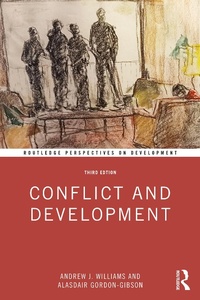
Conflict and Development
3rd Edition
Published on 26. September 2024
310 pages
978-1-040-11154-3 (ISBN)
Description

Fully revised and updated in its third edition, this timely book brings together the study of conflict and war and the problems surrounding the economic development of developing societies that are most prone to experiencing problems in moving on after war.
The book does so by reflecting on the issues surrounding war as it unfolds and after it has (in principle) 'ended', within the context of the history, present-day problems and future prospects. The book aims to highlight the possibilities, successes and failures of past and present policies that bring 'development' to countries and peoples that want to be more involved in deciding their own futures after conflict and war, and often find themselves subject to what can be seen as arbitrary and even alien ways of thinking and acting by institutions in which they theoretically have membership and agency but often do not in practice. The case studies have been fully updated to reflect changes and developments since the second edition of this text, and there are questions at the end of each chapter to promote reflection. This new edition presents a deeper dive into the history of conflict and the emergence of new theories and policy guidance about present and future options in the fields of conflict and development.
Accessible and engaging, this textbook is a pivotal resource for a nexus of subjects related to the often separated fields of conflict and development studies, as well as practitioners in this area.
The book does so by reflecting on the issues surrounding war as it unfolds and after it has (in principle) 'ended', within the context of the history, present-day problems and future prospects. The book aims to highlight the possibilities, successes and failures of past and present policies that bring 'development' to countries and peoples that want to be more involved in deciding their own futures after conflict and war, and often find themselves subject to what can be seen as arbitrary and even alien ways of thinking and acting by institutions in which they theoretically have membership and agency but often do not in practice. The case studies have been fully updated to reflect changes and developments since the second edition of this text, and there are questions at the end of each chapter to promote reflection. This new edition presents a deeper dive into the history of conflict and the emergence of new theories and policy guidance about present and future options in the fields of conflict and development.
Accessible and engaging, this textbook is a pivotal resource for a nexus of subjects related to the often separated fields of conflict and development studies, as well as practitioners in this area.
Reviews / Votes
"Conflict and Development has been a key textbook for my teaching over the past years, with its balanced blend of critical perspectives, good examples, and accessible presentation. This new edition enhances its usefulness by being more contextual in analysis, more practice-oriented in its discussion, and more nuanced in its approaches to the post-Cold War peacebuilding. It is an excellent reference not only for students but for field practitioners and policymakers."SungYong Lee, Professor, Soka University
"This book is an excellent critical introduction to the subject area. The wide-ranging use of practical examples and case studies makes this invaluable for those who have a general interest in conflict and development as well as students. This 3rd edition adds Alasdair Gordon-Gibson as an author, who has had more than 20 years of experience delivering aid and development assistance with the Red Cross and Red Crescent Movement, the United Nations and others. This brings a more subtle analysis of aid and the humanitarian question to what is already an excellent book."Paul Jackson, Professor of African Politics and Director of Research for the College of Social Sciences, University of Birmingham
"With the growth of international efforts around the humanitarian, development and peace triple nexus, this classic volume on conflict and development is more relevant than ever before. The 3rd edition of Conflict and Development is an accessible volume, appropriate for learning in depth about how international development and humanitarian actors respond to conflicts. It includes helpful chapter summaries and discussion questions to stimulate debate around the many of the important questions being asked in international cooperation today."
Pamina Firchow, Associate Professor of Coexistence and Conflict, Brandeis University, and author of Reclaiming Everyday Peace: Local Voices in Measurement and Evaluation After War
More details
Series
Edition
3rd edition
Language
English
Place of publication
London
United Kingdom
Publishing group
Taylor & Francis Ltd
Target group
College/higher education
Illustrations
13 Halftones, color; 4 Halftones, black and white; 13 Illustrations, color; 4 Illustrations, black and white
ISBN-13
978-1-040-11154-3 (9781040111543)
Copyright in bibliographic data and cover images is held by Nielsen Book Services Limited or by the publishers or by their respective licensors: all rights reserved.
Schweitzer Classification
Other editions
Additional editions
Andrew J. Williams | Alasdair Gordon-Gibson
Conflict and Development
Book
09/2024
3rd Edition
Routledge
€83.80
Shipment within 10-20 days
Andrew J. Williams | Alasdair Gordon-Gibson
Conflict and Development
Book
09/2024
3rd Edition
Routledge
€209.70
Shipment within 10-20 days

Andrew J. Williams | Alasdair Gordon-Gibson
Conflict and Development
Book
09/2024
Taylor & Francis
Unfortunately, price unknown
Article exhausted; check different version
Persons
Andrew J. Williams is Professor of International Relations (Emeritus) at the University of St Andrews. He specializes in the study of conflict and international history. His main current research interests include international conflict analysis and the international history of France. He has experience in the practice of conflict resolution and has worked as a consultant for United Nations organizations, including United Nations Development Programme (UNDP) and UNITAR. He has published widely in key journals. His book Liberalism and War was published by Routledge in 2006 (second edition forthcoming 2024).
Alasdair Gordon-Gibson is an Honorary Lecturer with the University of St Andrews and has worked for over 20 years with the International Red Cross and Red Crescent Movement. He holds a PhD from the University of St Andrews with research focusing on examination of how the discourse around humanitarian principles and practice can be re-cast in the contemporary political environment. Publications include the book Humanitarians on the Frontier: Identity and Access along the Borders of Power (2021), which looks at the changing discourse around the aid and development sectors in contemporary conflicts.
Alasdair Gordon-Gibson is an Honorary Lecturer with the University of St Andrews and has worked for over 20 years with the International Red Cross and Red Crescent Movement. He holds a PhD from the University of St Andrews with research focusing on examination of how the discourse around humanitarian principles and practice can be re-cast in the contemporary political environment. Publications include the book Humanitarians on the Frontier: Identity and Access along the Borders of Power (2021), which looks at the changing discourse around the aid and development sectors in contemporary conflicts.
Content
Introduction. 1. Poverty, Profit and the Political Economy of Violent Conflict. 2. Institutions: Hardware and Software. 3. People: Participation, Civil Society and Gender. 4. Conflict Transformation and Development. 5. Post-conflict Reconstruction, Democratization and Development. 6. Development, Aid and Violent Conflict. Conclusion.
