

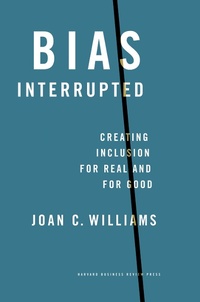
Bias Interrupted
Description

A cutting-edge, relentless, objective approach to inclusion.
Companies spend billions of dollars annually on diversity efforts with remarkably few results. Too often diversity efforts rest on the assumption that all that's needed is an earnest conversation about "privilege." That's not enough. To truly make progress we need to stop celebrating the problem and instead take effective steps to solve it.
In Bias Interrupted, Joan C. Williams shows how it's done, and, reassuringly, how easy it is to get started. One of today's preeminent voices on inclusive workplaces, Williams explains how leaders can use standard business tools—data, metrics, and persistence—to interrupt the bias that is continually transmitted through formal systems like performance appraisals, as well as the informal systems that control access to career-enhancing opportunities. The book presents fresh evidence, based on Williams's exhaustive research and work with companies, that interrupting bias helps every group—including white men.
Comprehensive, though compact and straightforward, Bias Interrupted delivers real, practical value in an efficient and accessible manner to an audience that has never needed it more. It's possible to interrupt bias. Here's where you start.
More details
Other editions
Additional editions
Person
Joan C. Williams is Distinguished Professor of Law, Hastings Foundation Chair and Director of the Center for WorkLife Law at the University of California, Hastings Law. Described as having "something approaching rock star status" in her field by the New York Times Magazine, she has played a central role in debates over workplace bias for decades. She has received prestigious honors in several different fields, including academia (Massey Lectures in American Civilization at Harvard), legal (both the Margaret Brent Prize for Women Lawyers of Achievement and the American Bar Foundation's Outstanding Scholar Award), engineering (the Society of Women Engineers President's Award), and psychology (an honorary degree, and the Distinguished Publication Award of the Association of Women in Psychology). Her 2014 co-written book What Works for Women at Work was praised by the New York Times Book Review as "deftly combining sociological research with a more casual narrative style...[that] offers unabashedly straightforward advice in a how-to primer for ambitious women." Her 2017 book White Working Class was called by the Washington Post "a good-faith effort at cultural and class introspection."
You can find Joan C. Williams at:
biasinterrupted.org
joancwilliams.com
Content
- Intro
- Contents
- 1. What's the path forward?
- 2. Is bias training worthless?
- 3. We're a meritocracy. Are you asking us to change that?
- 4. Why do some groups need to be politically savvier to succeed?
- 5. Are you saying that white men have it easy? I don't feel privileged
- 6. We cherish our culture. Can we retain that and still achieve DEI goals?
- 7. Can we make progress on DEI without getting all rigid and bureaucratic?
- 8. Women's priorities change after having kids. Are you saying I should ignore that?
- 9. Isn't it natural-and inevitable-that people who work harder go further?
- 10. If we hire more women and people of color, won't the DEI problem take care of itself?
- 11. What does the CEO need to do to finally deliver on DEI goals?
- 12. How can a company change who gets access to opportunities? (Hint: Only the CEO can)
- 13. How can CDOs and HR get buy-in-and deliver-on DEI goals?
- 14. How can HR and DEI departments work together to interrupt bias in basic business systems?
- 15. How can individual managers help move the needle-and manage more effectively?
- Conclusion
- Appendix: Methodology
- Notes
- Index
- Acknowledgments
- About the Author
