

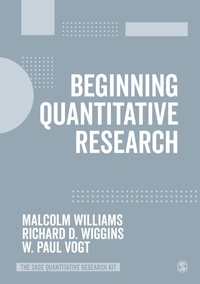
Beginning Quantitative Research
1st Edition
Published on 1. March 2022
200 pages
978-1-5297-1076-2 (ISBN)
Description

This concise text provides a clear and digestible introduction to completing quantitative research. Taking you step-by-step through the process of completing your quantitative research project, it offers guidance on:
? Formulating your research question
? Completing literature reviews and meta-analysis
? Formulating a research design and specifying your target population and data source
? Choosing an appropriate method and analysing your findings
Part of The SAGE Quantitative Research Kit, this book will give you the know-how and confidence needed to succeed on your quantitative research journey.
? Formulating your research question
? Completing literature reviews and meta-analysis
? Formulating a research design and specifying your target population and data source
? Choosing an appropriate method and analysing your findings
Part of The SAGE Quantitative Research Kit, this book will give you the know-how and confidence needed to succeed on your quantitative research journey.
More details
Series
Edition
1. Auflage
Language
English
Place of publication
London
United Kingdom
Publishing group
Sage Publications Ltd (Digital)
Target group
College/higher education
Product notice
Reflowable
File size
4,12 MB
ISBN-13
978-1-5297-1076-2 (9781529710762)
Copyright in bibliographic data and cover images is held by Nielsen Book Services Limited or by the publishers or by their respective licensors: all rights reserved.
Schweitzer Classification
Other editions
Additional editions
Malcolm Williams | Richard D. Wiggins | W.P. Vogt
Beginning Quantitative Research
Book
03/2022
1st Edition
SAGE Publications Ltd
€69.20
Shipment within 15-20 days
Persons
Malcolm Williams is Professor and Codirector of the Cardiff Q-Step Centre for Quantitative Methods pedagogy. Until July 2014, he was the Director of the School of Social Sciences, at Cardiff, and prior to this Professor of Social Research Methodology at Plymouth University. He is the author/editor of nine books and over a hundred articles/chapters. His primary research interest has been around methodological and philosophical issues in social research, particularly objectivity, probability, causality, and representation. His most recent book Key Concepts in the Philosophy of Social Research was published by SAGE in 2017. His past empirical research has included the measurement of homeless populations (using capture-recapture) and the analysis of longitudinal census data to explore household formation/dissolution and counterurbanisation migration. In the last few years, his primary research interest has been in the pedagogy of quantitative methods.
Richard D. Wiggins is an Emeritus Professor in the Centre for Longitudinal Studies, which is part of the newly formed UCL Social Research Institute. He joined the Institute of Education, University of London as Chair of Quantitative Social Science in 2007 and Head of the Department Quantitative Social Science.
From 2011 until 2013 he was Director of Methodology in the Centre for Longitudinal Studies, thereafter returning to his work as a researcher, doctoral supervisor and teacher. Prior to joining the Institute he ran a successful Master's programme in Social Research Methods and Statistics at City University, London. His early career included working in local and central government, epidemiological psychiatry and community medicine.
His methodological interests include the longitudinal analysis of secondary data, survey design, attitude measurement and sampling methodology. His substantive research covers the impact of secondary schooling on adult outcomes, political trust, ageing and well-being. W.P. Vogt was an Emeritus Professor of Research Methods and Evaluation at Illinois State University, where he won both teaching and research awards. He specialized in methodological choice and program evaluation and was particularly interested in ways to integrate multiple methods.
His other books include: Tolerance & Education: Learning to Live with Diversity and Difference (Sage Publications, 1998); Quantitative Research Methods for Professionals (Allyn & Bacon, 2007); Education Programs for Improving Intergroup Relations (coedited with Walter Stephan, Teachers College Press, 2004). He was also editor of four 4-volume sets in the series 'Sage Benchmarks in Social Research Methods': Selecting Research Methods (2008); Data Collection (2010); Quantitative Research Methods (2011); and, with Burke Johnson, Correlation and Regression Analysis (2012). His most recent publications include the co-authored When to Use What Research Design (2012) and Selecting the Right Analyses for Your Data: Quantitative, Qualitative, and Mixed Methods Approaches (2014).
Richard D. Wiggins is an Emeritus Professor in the Centre for Longitudinal Studies, which is part of the newly formed UCL Social Research Institute. He joined the Institute of Education, University of London as Chair of Quantitative Social Science in 2007 and Head of the Department Quantitative Social Science.
From 2011 until 2013 he was Director of Methodology in the Centre for Longitudinal Studies, thereafter returning to his work as a researcher, doctoral supervisor and teacher. Prior to joining the Institute he ran a successful Master's programme in Social Research Methods and Statistics at City University, London. His early career included working in local and central government, epidemiological psychiatry and community medicine.
His methodological interests include the longitudinal analysis of secondary data, survey design, attitude measurement and sampling methodology. His substantive research covers the impact of secondary schooling on adult outcomes, political trust, ageing and well-being. W.P. Vogt was an Emeritus Professor of Research Methods and Evaluation at Illinois State University, where he won both teaching and research awards. He specialized in methodological choice and program evaluation and was particularly interested in ways to integrate multiple methods.
His other books include: Tolerance & Education: Learning to Live with Diversity and Difference (Sage Publications, 1998); Quantitative Research Methods for Professionals (Allyn & Bacon, 2007); Education Programs for Improving Intergroup Relations (coedited with Walter Stephan, Teachers College Press, 2004). He was also editor of four 4-volume sets in the series 'Sage Benchmarks in Social Research Methods': Selecting Research Methods (2008); Data Collection (2010); Quantitative Research Methods (2011); and, with Burke Johnson, Correlation and Regression Analysis (2012). His most recent publications include the co-authored When to Use What Research Design (2012) and Selecting the Right Analyses for Your Data: Quantitative, Qualitative, and Mixed Methods Approaches (2014).
Content
A General Introduction To This Kit.
Starting With The Basics: From Research Problem To Variables
Literature Reviews and Meta-Analyses
Research Design and Research Resources
Sampling
Creating Data: An Introduction To Surveys And Questionnaires
Secondary Analysis and Data Manipulation
The Social Context Of Quantitative Research
Conclusion and Future Directions
Starting With The Basics: From Research Problem To Variables
Literature Reviews and Meta-Analyses
Research Design and Research Resources
Sampling
Creating Data: An Introduction To Surveys And Questionnaires
Secondary Analysis and Data Manipulation
The Social Context Of Quantitative Research
Conclusion and Future Directions
