

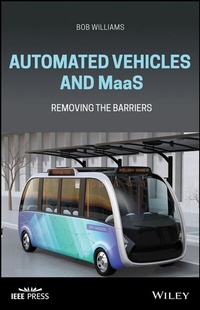
Automated Vehicles and MaaS
Description

A topical overview of the issues facing automated driving systems and Mobility as a Service, identifies the obstacles to implementation and offers potential solutions
Advances in cooperative and automated vehicle (CAV) technologies, cultural and socio-economic shifts, measures to combat climate change, social pressures to reduce road deaths and injuries, and changing attitudes toward self-driving cars, are creating new and exciting mobility scenarios worldwide. However, many obstacles remain and are compounded by the consequences of COVID-19. Mobility as a Service (MaaS) integrates various forms of public and private transport services into a single on-demand mobility service. Combining trains, cars, buses, bicycles, and other forms of transport, MaaS promises a convenient, cost-effective, and eco-friendly alternative to private automobiles.
Automated Vehicles and MaaS: Removing the Barriers is an up-to-date overview of the contemporary challenges facing CAVs and MaaS. Written in a clear and accessible style, this timely volume summarizes recent research studies, describes the evolution of automated driving systems and MaaS, identifies the barriers to their widespread adoption, and proposes potential solutions to overcome and remove these barriers. The text focuses on the claims, realities, politics, new organizational roles, and implementation problems associated with CAVs and MaaS--providing industry professionals, policymakers, planners, administrators, and investors with a clear understanding of the issues facing the introduction of automated driving systems and MaaS. This important guide and reference:
* Provides an overview of recent progress, the current state of the art, and discussion of future objectives
* Presents both technical background and general overview of automated driving systems and MaaS
* Covers political, commercial, and practical issues, as well as technical and research content, yet suitable for non-specialists
* Helps readers make informed decisions and realistic estimates for implementing mobility solutions and new business models for transport services
* Includes an extensive bibliography with direct links to in-depth technical engineering and research information
Automated Vehicles and MaaS: Removing the Barriers is an essential resource for transport providers, vehicle manufacturers, urban and transport planners, students of transportation, vehicle technology, and urban planning, and transport policy and strategy managers, advisors, and reviewers.
More details
Other editions
Additional editions
Person
Content
Preface xiii
Acknowledgements xv
Table of Abbreviations xvii
1 The Promise and Hype Regarding Automated Driving and MaaS 1
1.1 The Promise 1
1.2 What Do We Mean by the Term 'Automated Driving'? 4
1.3 The Hype 5
2 Automated Driving Levels 19
2.1 SAE J3016 19
2.2 The Significance of Operational Design Domain (ODD) 30
2.3 Deprecated Terms 30
2.4 No Relative Merit 31
2.5 Mutually Exclusive Levels 31
2.6 J3016 Limitations 32
2.7 Actors in the Automated Vehicle Paradigm 33
2.8 Other Functions 40
3 The Current Reality 43
3.1 UNECEWP 29 43
3.2 Social Acceptance 45
.3 SMMT 45
3.4 Other Observations 46
3.5 The European Commission 47
3.6 Legislation 48
3.7 Subsidiarity 49
3.8 Viewpoints 49
4 Automated Driving Paradigms 51
4.1 OECD 51
4.2 Communications Evolution 51
4.2.1 21-10-2019 Supporters 56
4.3 Cooperative ITS 56
4.4 The C-ITS Platform 57
4.5 Holistic Approach 59
4.6 It Won't Happen Quickly 60
4.7 Implications of Fully Automated Vehicles 61
5 The MaaS Paradigm 71
5.1 Purist Definition for MaaS 71
5.2 Vehicle Manufacturer Perspective for MaaS 71
5.3 Traditional Transport Service Provider Perspective for MaaS 72
5.4 MaaS from the Perspective of the MaaS Broker 72
5.5 MaaS as a Tool for Social Engineering 77
5.6 MaaS Experience to Date 79
5.7 MaaS and Covid-19 80
6 Challenges Facing Automated Driving 83
7 Potential Problems Hindering the Instantiation of MaaS 87
7.1 Root Causes of Obstacles 87
7.2 Level of Community Readiness 87
7.3 Level of Social Engineering Readiness 88
7.4 Perception of Risks 89
7.5 Level of Market Readiness 90
7.6 Level of Software Solution Readiness 91
7.7 Training 91
7.8 Timing 91
7.9 Institutional and Governance 92
8 Potential Solutions to Overcoming Barriers to Automated Driving 95
8.1 Vehicle Manufacturers Flawed Paradigm of the Automated Vehicle 95
8.2 Vehicle Manufacturers Using Different Paradigms for Competitive Advantage 96
8.3 Road Operator's Responsibilities 99
8.4 New Modes of Transport and New Mobility Services Must Be Safe and Secure by Design 106
8.5 How Other Road Users Interact with AVs 107
8.6 Automated Vehicles Will Have to Be Able to Identify and Consistently Respond to Different Forms of Communication 108
8.7 AVs by Themselves Will Not Necessarily Be Smarter than Conventional Vehicles 110
8.8 Congestion Levels Will Not Drop Significantly 112
8.9 Automated Vehicles Will Release Unsatiated Demand 113
8.10 Safety and Some Operational Data Must Be Freely Shared 115
8.11 Mixed AV and Conventional Traffic 115
8.12 AV Acceptability 116
8.13 Low Latency Communication 117
8.14 Roads Could Be Allocated Exclusively to AVs 120
8.15 Automated and Connected Vehicles Bring New Requirements 121
8.16 Cybersecurity 122
8.17 Changing Speed Limits and Even Getting Signs Put Up Can Take Years 126
8.18 Political Decisions Needed 127
8.19 Role of Government 128
8.20 Fallback to Driver 132
8.21 Range of Services Supported 138
8.22 Young Drivers and Experience 179
8.23 Liability 180
8.24 Level 5 May Take a Long Time to Instantiate 184
9 Potential Solutions to Overcoming Barriers to MaaS 185
9.1 Addressing General Issues 185
9.2 Essentials to Enable MaaS 186
9.3 Removing Obstacles to MaaS 197
9.4 Innovative Enablers for MaaS 198
10 The C-ART Innovation 199
10.1 Overview 199
10.2 Policy Context 199
10.3 Key Conclusions 200
10.4 C-ART Scenarios 202
11 Potential Solutions to Instantiate AVs and MaaS: Managed Optimisation Architecture for Transportation (MOAT) 211
11.1 Managed Not Controlled 211
11.2 High Level Actors in the MOAT Architecture 213
11.3 MOAT from the Subscriber/User Perspective 215
11.4 MOAT from the Travel Service Provider Perspective 216
11.5 MOAT from the Road Operator Perspective 218
11.6 MOAT from the AV Operator (AVO) Perspective 219
11.7 MOAT from the Travel Optimisation Service (TOS) Perspective 220
11.8 MOAT from the Traffic Management Centre (TMC) Perspective 220
11.9 MOAT from the Travel Information Provider (TIP) Perspective 221
11.10 MOAT and Privacy 221
11.11 The MOAT Overview Architecture 221
11.12 The MOAT Systems Architecture 221
12 The Business Case for MaaS 225
12.1 The Challenge 225
12.2 The Solution 225
12.3 The Outlook 226
13 The Business Case for Automated Vehicles 227
13.1 The Challenge 227
13.2 The Solution 228
13.3 The Outlook 228
14 Timescales to Successful Implementation 231
14.1 Caveat 231
14.2 Phased MOAT 232
14.3 Timescales MaaS 233
14.4 Timescales for Automated Vehicles 233
14.5 The First Half of the Twentieth Century 236
14.6 The Second Half of the Twentieth Century 236
14.7 2000-2009 237
14.8 2010-2019 237
14.9 2020-2029 239
14.10 2030-2039 240
14.11 2040-2050 240
14.12 2050-2060 241
14.13 In Summary 241
Bibliography 243
Index 251
Table of Abbreviations
E & OE, abbreviations/acronyms in this book that are not detailed below may generally be understood to be the names of companies or trading entities. Abbreviations/acronyms used in this book are to be interpreted as follows:
2D 2 Dimension/2 Dimensional 3D 3 Dimension/3 Dimensional 3G 3rd Generation 3GPP 3rd Generation Partnership Project 4G 4th Generation 5G 5th Generation AAM Alliance of Automobile Manufacturers ACC adaptive cruise control ACM Association for Computing Machinery (USA) ADAS advanced driver assistance system ADS automated driving system AEB(s) automated emergency braking (system) AEF Association d'Economie Financière AEV automated and electric vehicles AI artificial intelligence AMC American Motor Company (American Motors) (USA). APEC Asia-Pacific Economic Cooperation (Organisation) API application program interface ARK-Invest (Company name ARC-IT Architecture Reference for Cooperative and Intelligent Transport ASEAN association of south east asian nations ASN.1 abstract syntax notation 1 Auto ISAC automotive information sharing and analysis centre AV automated vehicle AVO AV operator BAST Bundesanstalt für Straßenwesen (German: Federal Highway Research Institute) BMW Bayerische Motoren Werke GmbH BSM basic safety message CA certificate authority CALM communications architecture for land mobiles CAM cooperative awareness message C-ART Name of JRC project (Coordinated Automated Road Transport) CAMP Crash Avoidance Metrics Partnership CAV connected and automated vehicle(s) CCAM cooperative connected automated mobility CCMS C-ITS credential management system (EU) CES Consumer Electronics Show (Consumer Technology Association trade show) CEO chief executive officer C-ITS cooperative-ITS CMS credential management system CNECT Name of European Commission Directorate General (DG) for Communications Networks, Content and Technology. CONVERGE Communication Network Vehicle Road Global Extension (EC Project) C-ROADS connected-roads (EC DG MOVE Initiative) CRL certificate revocation list CVT continuously variable transmission C=V2X communications - vehicle to anything DARPA Defense Advanced Research Projects Agency (USA) DAS driving automation system (sae) or driving assistance system (others) DATEX data exchange standard for exchanging traffic information between traffic management centres, traffic service providers, traffic operators and media partners DDT dynamic driving task DENM decentralized environmental notification message DfT Department for Transport (UK) DoT Department of Transport (USA and others) DG Directorate General (European Commission) DG-CNECT DG- Communications Networks, Content and Technology (EC) DG-GROW DG- for Internal Market, Industry, Entrepreneurship and SMEs (EC) DG-INFSO DG- Information society and Media (EC: Now DG-CNECT) DG-MOVE DG- Mobility and Transport (EC) DSRC dedicated short range communication DSS driver support system DSSAD data storage system for automated driving vehicles EC European Commission ECTL European certificate trust list ECU electronic communications unit EDR event data recorder EEA European Economic Area EFTA European Free Trade Agreement ENISA European Union Agency for Networks and Communication ESC electronic stability control ETSC European Transport Safety Council ETSI European Telecommunications Standards Institute ETRAC European Road Transport Research Advisory Council EU European Union ExVe extended vehicle EZ-GO (Trade name [Renault]) FHWA Federal Highway Administration (USA) FRAV functional requirements for automated vehicles FSD Full Self-Driving (Tesla product name) GAD (UK) Government Actuaries Dept GDP gross domestic product GDPR General Data Protection Regulation (EU) GEAR 2030 name of high-level group on the competitiveness and sustainable growth of the automotive industry in the European Union (EC) GLOSA green light optimal speed advisory GM General Motors GMC governance management committee GNSS global navigation satellite system GPS global positioning system (US Department of Defence GNSS) GRB UNECE WP 29 former name of working party subcommittee on noise and tyres GRBP UNECE WP29 Working Party on Noise and Tyres (Groupe Rapporteur Bruit et Pneumatiques) GRE UNECE WP 29 Working Party on Lighting and Light-Signalling (Groupe Rapporteur Electrique) GRPE UNECE WP 29 Working Party on Pollution and Energy (Groupe Rapporteur pollution et énergie) GRRF, UNECE WP 29 Working Party on Brakes and Running Gear (Groupe Rapporteur Freins & roulants) GRSG UNECE WP 29 Working Party on General Safety Provisions (Groupe Rapporteur Securite Generale) GRSP UNECE WP 29 Working Party on Passive Safety (Groupe Rapporteur sécurité passive) GRVA, UNECE WP 29 Working Party of automated vehicles (Groupe de Rapporteurs pour les Véhicules Autonomes) HARTS Harmonised Architecture for Transport Systems (HTG initiative) HMI human >< machine interface HOV high occupancy vehicle HP Hewlett Packard HTG Harmonization Task Group (a collaboration of US DOT, the EU Joint Research Council (JRC), EC DG CNECT and the Transport Certification Authority (TCA) of Australia), ICT Information and Communications Technologies ... IEEE Institute of Electrical and Electronics Engineers