

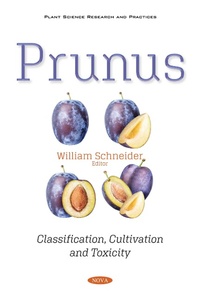
Prunus: Classification, Cultivation and Toxicity
Published on 30. April 2020
203 pages
978-1-5361-7756-5 (ISBN)
Description

Prunus: Classification, Cultivation and Toxicity opens with a study wherein functional components of prunes such as caffeoylquinic acid isomers and quinic acid are quantified by means of high-performance liquid chromatographyanalysis. Prunus avium L is examined, particularly focusing on their profile of bioactive compounds, the health benefits associated with their consumption, as well as their potential therapeutic properties. Also examined in this collection is Prunus serotina Ehrh., a tree species native to North America, appreciated for its valuable wood and ornamental leaves and flowers. The classification, toxicity, and techniques used to propagate and disseminate the endangered Prunus africana are assessed in an effort to improve its medicinal utilization and sustainable conservation.
More details
Other editions
Additional editions
Book
04/2020
Nova Science Publishers Inc
€126.47
Shipment within 15-20 days
Content
- Intro
- Contents
- Preface
- Chapter 1
- Phytochemicals in Prunes (Prunus domestica L.)
- Abstract
- Introduction
- Materials and Methods
- Apparatus
- Plant Materials
- Standards and Chemicals
- HPLC Analysis
- Phenolic Compounds
- Organic Acids
- Total Phenolics Assay
- Proantocyanidin Assay
- Extraction, Fractionation, and Isolation
- Acetylation
- Spectral Data of Conformational Isomers of 3-CQA and Novel Compounds
- Compound 1
- Compound 2
- Compound 18
- Compound 22
- Compound 23
- Compound 24
- Compound 25
- Compound 30
- Compound 31
- Compound 32
- Compound 37
- Antioxidant Assay
- Oil Stability Index Method
- O2 Scavenging Activity
- Ferric Thiocyanate Method
- Oxygen Radical Absorbance Capacity (ORAC)
- Quantification of Functional Components in Prunes by HPLC Analysis
- Caffeoylquinic Acid Isomers
- Organic Acids
- Examination of Extracting Conditions
- Quantification of Quinic Acid in Prunes and Other Fruits
- Quantitative Evaluation of Antioxidant Components in Prunes
- Contribution of Caffeoylquinic Acid Isomers to Antioxidant Activity of Prunes
- Properties of Antioxidant Components in H2O Layer Fractions
- Antioxidant Activity of Hydrolyzed Residue
- Isolation and Structural Elucidation of Phytochemicals in Prunes
- Extraction, Fractionation, and Isolation
- Structural Elucidation of Conformational Isomers of 3-CQA and Novel Compounds
- Conformational Isomers of 3-CQA
- Novel Compounds
- Antioxidant Activity of Isolated Compounds
- Caffeoylquinic Acid Isomers
- Oil Stability Index Method
- O2- Scavenging Activity and ORAC
- Conformational Isomers of 3-CQA
- ORAC and Ferric Thiocyanate Method
- Other Isolated Compounds
- ORAC
- Synergistic Effect of Compound 18 on ORAC of Caffeoylquinic Acid Isomers
- Discussion
- References
- Biographical Sketch
- Chapter 2
- Prunus avium L.: Composition, Analysis and Health Benefits
- Abstract
- Introduction: Chemical Composition and Cultivars
- Bioaccessibility and Bioavailability
- Biological Properties
- Antioxidant
- Neuroprotective
- Anticancer
- Anti-Inflammatory
- Antimicrobial
- Antidiabetic and Cardiovascular
- Other Health Benefits
- Analytical Methods to Determine the Composition of Prunus avium L.
- Conclusion
- Acknowledgments
- References
- Chapter 3
- Ecophysiological Mechanisms of the Invasion of Black Cherry in European Forests
- Abstract
- 1. Taxonomy and Characteristics
- 2. Geographical Distribution
- 3. Ecology
- 3.1. Reproduction
- 3.2. Light Requirements
- 3.3. Temperature and Precipitation
- 3.4. Soil Conditions
- 4. Growth Strategy and Biomass Allocation
- 5. Leaf Structure and Gas Exchange
- 6. Why Has the Prunus serotina Invasion Been Successful?
- 7. Prunus serotina and Global Climate Change
- Acknowledgments
- References
- Biographical Sketch
- Chapter 4
- A Review of the Classification, Propagation Techniques and Toxicity of Endangered Prunus africana
- (Hook f.) Kalkman for Its Improved Domestication and Conservation
- Abstract
- 1. Introduction
- 2. Origin and Classification of Prunus africana
- 2.1. Genus Prunus
- 2.2. Origin and Geographical Distribution of Prunus africana
- 2.3. Classification
- 2.4. Populations of Prunus africana
- 3. Importance of Prunus africana
- 4. Pharmaceutical Impacts
- 5. Mechanisms of Action of Active Components
- 6. Toxicity Effects
- 7. Domestication and Propagation Technique
- Conclusion
- References
- Index
- Blank Page
