

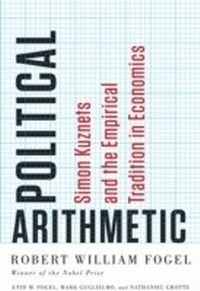
Political Arithmetic
Simon Kuznets and the Empirical Tradition in Economics
1st Edition
Published on 31. May 2024
163 pages
978-0-226-02072-3 (ISBN)
Description

We take for granted today that the assessments, measurements, and forecasts of economists are crucial to the decision-making of governments and businesses alike. But less than a century ago that wasn't the case-economists simply didn't have the necessary information or statistical tools to understand the ever more complicated modern economy.
With Political Arithmetic, Nobel Prize-winning economist Robert Fogel and his collaborators tell the story of economist Simon Kuznets, the founding of the National Bureau of Economic Research, and the creation of the concept of GNP, which for the first time enabled us to measure the performance of entire economies. The book weaves together the many strands of political and economic thought and historical pressures that together created the demand for more detailed economic thinking-Progressive-era hopes for activist government, the production demands of World War I, Herbert Hoover's interest in business cycles as President Harding's commerce secretary, and the catastrophic economic failures of the Great Depression-and shows how, through trial and error, measurement and analysis, economists such as Kuznets rose to the occasion and in the process built a discipline whose knowledge could be put to practical use in everyday decision-making.
The product of a lifetime of studying the workings of economies and skillfully employing the tools of economics, Political Arithmetic is simultaneously a history of a key period of economic thought and a testament to the power of applied ideas.
With Political Arithmetic, Nobel Prize-winning economist Robert Fogel and his collaborators tell the story of economist Simon Kuznets, the founding of the National Bureau of Economic Research, and the creation of the concept of GNP, which for the first time enabled us to measure the performance of entire economies. The book weaves together the many strands of political and economic thought and historical pressures that together created the demand for more detailed economic thinking-Progressive-era hopes for activist government, the production demands of World War I, Herbert Hoover's interest in business cycles as President Harding's commerce secretary, and the catastrophic economic failures of the Great Depression-and shows how, through trial and error, measurement and analysis, economists such as Kuznets rose to the occasion and in the process built a discipline whose knowledge could be put to practical use in everyday decision-making.
The product of a lifetime of studying the workings of economies and skillfully employing the tools of economics, Political Arithmetic is simultaneously a history of a key period of economic thought and a testament to the power of applied ideas.
All prices
More details
Other editions
Additional editions
Robert William Fogel | Enid M. Fogel | Mark Guglielmo
Political Arithmetic
Simon Kuznets and the Empirical Tradition in Economics
Book
04/2013
University of Chicago Press
€34.72
Article not available at the moment
Persons
Winner of the 1993 Nobel Prize for Economics,
Robert William Fogel is the Charles R. Walgreen Distinguished Service Professor of American Institutions at the Booth School of Business, director of the Center for Population Economics, and a member of the Department of Economics and of the Committee on Social Thought at the University of Chicago.
Enid M. Fogel (1923-2007) was associate dean of students at Booth School of Business..
Mark Guglielmo is assistant professor of economics at Bentley University.
Nathaniel Grotte is associate director of the Center for Population Economics.
Content
- Intro
- Contents
- Preface
- Introduction: The Amazing Twentieth Century
- 1. The Rise of Academic Economists before World War I
- 2. The Early History of the NBER
- 3. The Emergence of National Income Accounting as a Tool of Economic Policy
- 4. The Use of National Income Accounting to Study Comparative Economic Growth
- 5. The Scientific Methods of Simon Kuznets
- 6. Further Aspects of the Legacy of Simon Kuznets
- 7. The Quarter Century since the Death of Simon Kuznets
- Acknowledgments
- References
- Index

