

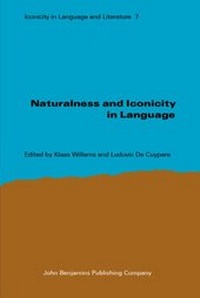
Naturalness and Iconicity in Language
1st Edition
Published on 10. December 2008
IX, 249 pages
978-90-272-9076-2 (ISBN)
Description

Iconicity and naturalness remain controversial concepts in recent linguistic research. The present volume aims to scrutinize unresolved issues of iconicity and naturalness in language. The studies discuss topics such as naturalism in the philosophy of language and the epistemology of linguistics, linguistic iconicity in semiotics, iconic structures in Sign Languages, natural and unnatural sound patterns, the iconic nature of parts of speech, the relation between (un)markedness and naturalness, and lexical and syntactic iconicity. The research conducted is based on sound (meta)theoretical analyses and/or original empirical research. The data and innovative views presented are bound to spark discussion in an age-old debate that has lost nothing of its significance.
More details
Other editions
Additional editions
Klaas Willems | Ludovic De Cuypere
Naturalness and Iconicity in Language
Book
12/2008
John Benjamins Publishing Co
€111.30
Shipment within 10-15 days
Persons
Content
- Naturalness and Iconicity in Language
- Editorial page
- Title page
- LCC data
- Table of contents
- Contributors
- Editors
- Introduction
- Preliminary remarks
- Iconicity
- Naturalness
- An overview of the contributions in this volume
- Concluding remarks
- References
- Philosophical naturalism and linguistic epistemology
- 1. Models of naturalism
- 2. Naturalism and the problem of the a priori
- 3. Naturalizing the a priori: Chomsky's way
- 4. Naturalizing the a priori: Darwin's way
- 5. Naturalizing the a priori: Piaget's way
- 6. Conclusions
- References
- Prolegomena to a general theory of iconicity considerations on language, gesture, and pictures
- 1. Introduction
- 2. Iconicity as a phenomenon, and semiosis
- 3. Icons and iconicity
- 4. The case against pictoriality
- 5. The multiple iconicities of words and pictures
- 6. The resources of verbal and visual semiosis
- 7. Iconicity in gesture
- 8. Partitioning the world in language and gesture
- 9. Conclusions
- References
- Semiotic foundations of natural linguistics and diagrammatic iconicity
- 1. Cratylus's echoes
- 2. The verbal sign and its object: correlates of iconicity
- 2.1 Similarity: a matter of reference or of meaning?
- 2.2 Peirce's Object as the correlate of an Icon
- 3. The natural substratum of language from the perspective of Peirce's semiotics
- 3.1 The naturalness of the symbol: habit, self-replication, and autopoiesis
- 3.2 The icon and its naturalness in itself
- 3.3 The index and its naturalness in an existential relation
- 4. Natural linguistics as a semiotic linguistics
- 5. Diagrammatic iconicity
- 6. The general diagrammatic iconicity of language structure
- 7. Verbal diagrams and their need for images, indices, and symbols
- 8. Language as a hybrid diagrammatic Legisign
- 9. The cognitive naturalness and semiotic advantages of diagrams in verbal semiosis
- References
- Naturalness and markedness
- 1. Introduction
- 2. Naturalness theory and markedness theory contrasted
- 2.1 Naturalness scales
- 2.2 Markedness relations
- 2.3 Scales and relations
- 3. Values
- 3.1 Naturalness values
- 3.2 Markedness values
- 4. The syntax of values
- 4.1 'Natural' Naturalness syntax
- 4.1.1 The approach in Oresnik (2001)
- 4.1.2 Oresnik's (2004) approach
- 4.2 Markedness syntax
- 4.2.1 Asymmetric mappings
- 4.2.2 Markedness agreement
- 4.2.3 Markedness reversal and Markedness complementarity
- 5. Variation and change
- 5.1 Naturalness: static systems and diachronic correspondences
- 5.2 Markedness: actuation and actualization
- 5.2.1 A system-motivated change
- 5.2.2 A type-motivated change
- 6. Naturalness as a kind of markedness
- 6.1 Naturalness scales vs. Markedness relations
- 6.2 Symmetry vs. asymmetry
- 6.3 Asymmetry and substitution
- 7. Conclusion
- References
- Natural and unnatural sound patterns
- 1. Introduction: the study of sound patterns
- 2. Natural sound patterns
- 2.1 What are natural sound patterns?
- 2.2 A sampler of natural sound patterns
- 3. Unnatural sound patterns
- 3.1 What are unnatural sound patterns?
- 3.2 A sampler of unnatural sound patterns
- 4. Naturalness and synchronic grammars
- conclusions
- References
- The iconic function of full inversion in English
- 1. Introduction
- 2. Prepositional phrase inversion in fictional and non-fictional written English discourse
- 2.1 Distribution of the construction
- 2.2 The clause-initial constituent in fictional and non-fictional prepositional phrase inversions
- 3. Spatial experiential iconic markers and text-structuring devices
- 4. Conclusions
- References
- What is iconic about polysemy?
- 1. Introduction
- 2. How polysemy contributes to iconicity in the lexicon
- 2.1 Peirce's definition of iconicity
- 2.2 Polysemy and diagrammatic iconicity
- 2.3 Polysemy and the icon type of metaphors
- 2.4 Polysemy and the icon type of images
- 3. Polysemy and scales of diagrammatic transparency
- 3.1 Where to place polysemy on scales of diagrammatic transparency
- 3.2 The impact of semantics on diagrammatic transparency: a questionnaire study
- 4. Conclusion
- References
- Iconicity in sign languages
- 1. Introduction
- 2. The analogue building model of linguistic iconicity (Taub 2001)
- 3. Iconicity as structuring principle in sign languages
- 4. The Dependency Model: Sign language phonology and iconicity reconciled
- 5. Proposing an "iconic superstructure"
- 6. Conclusion
- Acknowledgements
- References
- Arbitrary structure, cognitive grammar, and the partes orationis
- 1. Introduction: Iconic motivation in cognitive grammar
- 1.1 The meaning of a lexical class
- 9.1.2 Frequency-entrenchment and salience-construal
- 2. Polish 'rain' and 'snow'. A lexical field and its parts-of-speech
- 2.1 The lexical field
- 2.2 The lexical classes and grammatical categories
- 3. Class-lexeme productivity. Iconic motivation or arbitrary grammar
- 4. Conclusion
- References
- Name index
- Subject index
- The series Iconicity in Language and Literature
