

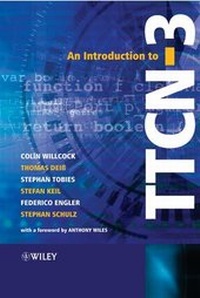
An Introduction to TTCN-3
Published on 5. August 2005
282 pages
978-0-470-01730-2 (ISBN)
Description

Looking for a solid introduction to the TTCN-3 language and itsuse? An Introduction to TTCN-3 is just what you need. Allthe important concepts and constructs of the language are explainedin a tutorial style with the emphasis on extensive examples.Throughout the author also addresses the larger picture of how thetesting language is related to the overall test systemimplementation.
* A complete tutorial reference on TTCN-3 with real-worldexamples and expert advice based on author's practicalindustrial experience using the standard.
* Offering a unique insider perspective: Nokia has beeninstrumental in the development of both the language and toolsassociated with TTCN-3 and the author is in a unique position todocument this experience to help and guide new users.
* And an associated web site that contains code samples from thebook and links to the relevant standards documents.
This book provides the perfect companion to the available TTCN-3language standards filling the gaps in areas such as style guide,structuring, and pointing out the dangers or pitfalls based on theauthor's personal TTCN-3 experience from languagestandardization, tool implementation and applying TTCN-3 for anumber of years in the real world. The style and level ofthe book make it suitable for both engineers learning and applyingthe language in the real world and students learning TTCN-3 as partof their studies.
* A complete tutorial reference on TTCN-3 with real-worldexamples and expert advice based on author's practicalindustrial experience using the standard.
* Offering a unique insider perspective: Nokia has beeninstrumental in the development of both the language and toolsassociated with TTCN-3 and the author is in a unique position todocument this experience to help and guide new users.
* And an associated web site that contains code samples from thebook and links to the relevant standards documents.
This book provides the perfect companion to the available TTCN-3language standards filling the gaps in areas such as style guide,structuring, and pointing out the dangers or pitfalls based on theauthor's personal TTCN-3 experience from languagestandardization, tool implementation and applying TTCN-3 for anumber of years in the real world. The style and level ofthe book make it suitable for both engineers learning and applyingthe language in the real world and students learning TTCN-3 as partof their studies.
More details
Other editions
New editions
Colin Willcock | Thomas Deiß | Stephan Tobies
An Introduction to TTCN-3
E-Book
12/2010
2nd Edition
Wiley
€88.99
Available for download
Additional editions

Colin Willcock | Thomas Deis | Stephan Tobies
An Introduction to TTCN-3
Software
06/2005
Wiley
€90.87
Article exhausted; check different version
Colin Willcock | Thomas Deiss | Stephan Tobies
An Introduction to TTCN-3
Book
04/2005
1st Edition
Wiley
€79.90
Article exhausted; check for reprint
Persons
Colin Willcock is a Senior Research Manager at NokiaResearch Center. He received a BSc from Sheffield University in1986, an MSc from Edinburgh University in 1987, and a PhD inparallel computation from the University of Kent in 1992. Colin waspart of the core ETSI team that developed the TTCN-3 language andis currently participating in TTCN-3 language maintenance. In thepast, he has worked on numerous standardization efforts at ETSI,ITU-T, and 3GPP, focusing on various aspects of formalspecification languages. He is currently leading the EuropeanTT-medal project, which strives to improve test methodology andlanguages for software-intensive systems. Within Nokia, he works ascompetence area manager for modelling and engineering methods.
Thomas Deiß is a Principal Scientist at NokiaResearch Center. He received an MSc in Computer Science and a PhDin Natural Sciences from the University of Kaiserslautern in 1990and 1999. He is currently working in the area of testingmobilecommunication systems with TTCN-2 and TTCN-3. Thomas has beendeveloping TTCN-3-based test systems, has developed coursematerials and taught courses about TTCN-3, and has contributed toTTCN-3 standardization. He is a contributor to the EuropeanTT-medal project, which strives to improve test methodology andlanguages for software-intensive systems.
Until March 2005, Stephan Tobies has worked as a SeniorResearch Engineer at Nokia Research Center. He received an MSc inComputer Science and a PhD in Natural Sciences from the Universityof Technology in Aachen in 1998 and 2001. He has been a member ofETSI Strategic Task Force 253, which is responsible for themaintenance and extension of the TTCN-3 standard. He has been aleading developer of an industry-grade TTCN-3 tool and has beenworking in the area of TTCN-3 language development and test systemimplementation. Stephan is now working for the European MicrosoftInnovation Center.
Stefan Keil is a Research Engineer at Nokia ResearchCenter. He received an MSc in Electrical Engineering from the RuhrUniversity in Bochum in 1996. Stefan has worked for Alcatel as aprogrammer in the field of fixed line communications and atechnical trainer for broadband communication fibre technology.Since 2000 he has been working for Nokia in the area of test systemimplementation, TTCN-3 tool development, and training.
Until December 2004, Federico Engler has been a PrincipalEngineer at Nokia Research Center. He studied computer science atUppsala University from 1989 till 1993. After that, he startedworking for Telelogic, where he was involved in standardizationissues around TTCN-2, TTCN-3, and ASN.1, as well as TTCN-3 tooldevelopment. In January 2003, Federico started working for Nokia inthe area of automated test solutions, which involved the mapping,documentation, and synchronization of testrelated activities at aNokia-wide level.He has also been involved in activities aroundimproved visualization and documentation of tests and test resultswithin Nokia.
Stephan Schulz is a Senior Research Engineer at NokiaResearch Center. He received a BSc in Electrical Engineering fromState University of New York at Binghamton in 1995 and an MSc andPhD in Computer Engineering from University of Arizona at Tucson in1997 and 2001. He has been an editor of the TTCN-3 RuntimeInterface (TRI) standard and hasmade a number of contributions inthe field of TTCN-3-based text-based protocol testing. Stephan hasbeen developing and teaching TTCN-3 courses for Nokia engineers.Currently, he is one of the main architects in the ETSI design teamof a TTCN-3 IPv6 testing library.
Thomas Deiß is a Principal Scientist at NokiaResearch Center. He received an MSc in Computer Science and a PhDin Natural Sciences from the University of Kaiserslautern in 1990and 1999. He is currently working in the area of testingmobilecommunication systems with TTCN-2 and TTCN-3. Thomas has beendeveloping TTCN-3-based test systems, has developed coursematerials and taught courses about TTCN-3, and has contributed toTTCN-3 standardization. He is a contributor to the EuropeanTT-medal project, which strives to improve test methodology andlanguages for software-intensive systems.
Until March 2005, Stephan Tobies has worked as a SeniorResearch Engineer at Nokia Research Center. He received an MSc inComputer Science and a PhD in Natural Sciences from the Universityof Technology in Aachen in 1998 and 2001. He has been a member ofETSI Strategic Task Force 253, which is responsible for themaintenance and extension of the TTCN-3 standard. He has been aleading developer of an industry-grade TTCN-3 tool and has beenworking in the area of TTCN-3 language development and test systemimplementation. Stephan is now working for the European MicrosoftInnovation Center.
Stefan Keil is a Research Engineer at Nokia ResearchCenter. He received an MSc in Electrical Engineering from the RuhrUniversity in Bochum in 1996. Stefan has worked for Alcatel as aprogrammer in the field of fixed line communications and atechnical trainer for broadband communication fibre technology.Since 2000 he has been working for Nokia in the area of test systemimplementation, TTCN-3 tool development, and training.
Until December 2004, Federico Engler has been a PrincipalEngineer at Nokia Research Center. He studied computer science atUppsala University from 1989 till 1993. After that, he startedworking for Telelogic, where he was involved in standardizationissues around TTCN-2, TTCN-3, and ASN.1, as well as TTCN-3 tooldevelopment. In January 2003, Federico started working for Nokia inthe area of automated test solutions, which involved the mapping,documentation, and synchronization of testrelated activities at aNokia-wide level.He has also been involved in activities aroundimproved visualization and documentation of tests and test resultswithin Nokia.
Stephan Schulz is a Senior Research Engineer at NokiaResearch Center. He received a BSc in Electrical Engineering fromState University of New York at Binghamton in 1995 and an MSc andPhD in Computer Engineering from University of Arizona at Tucson in1997 and 2001. He has been an editor of the TTCN-3 RuntimeInterface (TRI) standard and hasmade a number of contributions inthe field of TTCN-3-based text-based protocol testing. Stephan hasbeen developing and teaching TTCN-3 courses for Nokia engineers.Currently, he is one of the main architects in the ETSI design teamof a TTCN-3 IPv6 testing library.
Content
About the Authors.
Foreword.
Acknowledgements.
List of Figures.
List of Tables.
Abbreviations and Acronyms.
1 Introduction.
1.1 TTCN-3 as a Language.
1.2 The Development of TTCN-3.
1.3 Summary.
2 TTCN-3 by Example.
2.1 TTCN-3 Test Suite.
2.2 TTCN-3 Test Systems.
2.3 Summary.
3 Basic TTCN-3.
3.1 Basic Constructs.
3.2 Basic Statements.
3.3 Summary.
4 Non-concurrent TTCN-3.
4.1 Ports.
4.2 Components.
4.3 Test Cases.
4.4 Templates.
4.5 Message-based Communication.
4.6 Timers.
4.7 Alt Statement.
4.8 Altsteps.
4.9 Default Altsteps.
4.10 Functions.
4.11 Summary.
5 Concurrent TTCN-3.
5.1 Concurrent Test Case Example.
5.2 Test Components.
5.3 Mappings and Connections.
5.4 Miscellaneous Port Operations.
5.5 SUT Addresses.
5.6 Summary.
6 Procedure-based Communication.
6.1 Procedure-Versus Message-based Communication.
6.2 An Example - the Directory Service.
6.3 Procedure-based Communication in TTCN-3.
6.4 Communication Operations.
6.5 Procedure-based Communication on the Client Side.
6.6 Procedure-based Communication on the Server Side.
6.7 Addressing.
6.8 Summary.
7 Modular TTCN-3.
7.1 Modules.
7.2 Group Definitions.
7.3 Importing.
7.4 Module Parameters.
7.5 Attributes.
7.6 Summary.
8 TTCN-3 Data Types.
8.1 The Session Initiation Protocol.
8.2 Subtyping.
8.3 TTCN-3 Built-in Types.
8.4 User-defined Types.
8.5 Summary.
9 Advanced Type Topics.
9.1 Type Compatibility.
9.2 The Anytype Type.
9.3 The Address Type.
9.4 Recursive Type Definitions.
9.5 Foreign Type Systems.
9.6 Summary.
10 Templates.
10.1 A First Look at TTCN-3 Templates.
10.2 The TTCN-3 Match Operation.
10.3 Template Definition for One Specific Value.
10.4 Template Definitions with Matching Expressions.
10.5 Template Definitions for Signatures.
10.6 About Assignment, Access of Templates, and the ValueofOperation.
10.7 Summary.
11 Advanced Templates.
11.1 Template Definitions for Complex Type Structures.
11.2 Template References.
11.3 Template Parameterization.
11.4 Selective Modification of Other Templates.
11.5 Explicit Versus Implicit Template Definitions.
11.6 Structuring of Template Definitions for Complex Types.
11.7 Summary.
12 TTCN-3 Test Systems in Practice.
12.1 The Anatomy of a TTCN-3 Test System.
12.2 Test System Execution of a Simple Test Case.
12.3 More About The SUT Adapter.
12.4 More About The Platform Adapter.
12.5 More About External Codecs.
12.6 Conclusion.
13 Advice and Examples.
13.1 TTCN-3 Style Guide.
13.2 Suggestions for Modularization.
13.3 Template Specification for Complex Message Definitions.
13.4 Useful Behaviour.
13.5 Synchronizing Parallel Test Components.
14 Closing Thoughts and Future Directions.
References.
Index.
Foreword.
Acknowledgements.
List of Figures.
List of Tables.
Abbreviations and Acronyms.
1 Introduction.
1.1 TTCN-3 as a Language.
1.2 The Development of TTCN-3.
1.3 Summary.
2 TTCN-3 by Example.
2.1 TTCN-3 Test Suite.
2.2 TTCN-3 Test Systems.
2.3 Summary.
3 Basic TTCN-3.
3.1 Basic Constructs.
3.2 Basic Statements.
3.3 Summary.
4 Non-concurrent TTCN-3.
4.1 Ports.
4.2 Components.
4.3 Test Cases.
4.4 Templates.
4.5 Message-based Communication.
4.6 Timers.
4.7 Alt Statement.
4.8 Altsteps.
4.9 Default Altsteps.
4.10 Functions.
4.11 Summary.
5 Concurrent TTCN-3.
5.1 Concurrent Test Case Example.
5.2 Test Components.
5.3 Mappings and Connections.
5.4 Miscellaneous Port Operations.
5.5 SUT Addresses.
5.6 Summary.
6 Procedure-based Communication.
6.1 Procedure-Versus Message-based Communication.
6.2 An Example - the Directory Service.
6.3 Procedure-based Communication in TTCN-3.
6.4 Communication Operations.
6.5 Procedure-based Communication on the Client Side.
6.6 Procedure-based Communication on the Server Side.
6.7 Addressing.
6.8 Summary.
7 Modular TTCN-3.
7.1 Modules.
7.2 Group Definitions.
7.3 Importing.
7.4 Module Parameters.
7.5 Attributes.
7.6 Summary.
8 TTCN-3 Data Types.
8.1 The Session Initiation Protocol.
8.2 Subtyping.
8.3 TTCN-3 Built-in Types.
8.4 User-defined Types.
8.5 Summary.
9 Advanced Type Topics.
9.1 Type Compatibility.
9.2 The Anytype Type.
9.3 The Address Type.
9.4 Recursive Type Definitions.
9.5 Foreign Type Systems.
9.6 Summary.
10 Templates.
10.1 A First Look at TTCN-3 Templates.
10.2 The TTCN-3 Match Operation.
10.3 Template Definition for One Specific Value.
10.4 Template Definitions with Matching Expressions.
10.5 Template Definitions for Signatures.
10.6 About Assignment, Access of Templates, and the ValueofOperation.
10.7 Summary.
11 Advanced Templates.
11.1 Template Definitions for Complex Type Structures.
11.2 Template References.
11.3 Template Parameterization.
11.4 Selective Modification of Other Templates.
11.5 Explicit Versus Implicit Template Definitions.
11.6 Structuring of Template Definitions for Complex Types.
11.7 Summary.
12 TTCN-3 Test Systems in Practice.
12.1 The Anatomy of a TTCN-3 Test System.
12.2 Test System Execution of a Simple Test Case.
12.3 More About The SUT Adapter.
12.4 More About The Platform Adapter.
12.5 More About External Codecs.
12.6 Conclusion.
13 Advice and Examples.
13.1 TTCN-3 Style Guide.
13.2 Suggestions for Modularization.
13.3 Template Specification for Complex Message Definitions.
13.4 Useful Behaviour.
13.5 Synchronizing Parallel Test Components.
14 Closing Thoughts and Future Directions.
References.
Index.
