

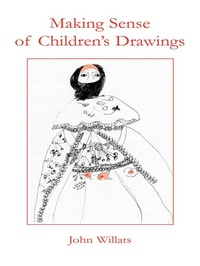
Making Sense of Children's Drawings
Published on 21. April 2006
274 pages
978-1-135-62498-9 (ISBN)
Description

The message of this book is a simple one: children learn to draw by acquiring increasingly complex and effective drawing rules. In this regard, learning to draw is like learning a language, and as with language children use these rules creatively, making infinite use of finite means. Learning to draw is thus, like learning a language, one of the major achievements of the human mind.
Theories of perception developed in the second half of the 20th century enable us to construct a new theory of children's drawings that can account for their many strange features. Earlier accounts contained valuable insights, but recent advances in the fields of language, vision, philosophy, and artificial intelligence now make it possible to resolve the many contradictions and confusions inherent in these early writings.
John Willats has written a book that is accessible to psychologists, artists, primary and junior schoolteachers, and parents of both gifted and normal children.
Theories of perception developed in the second half of the 20th century enable us to construct a new theory of children's drawings that can account for their many strange features. Earlier accounts contained valuable insights, but recent advances in the fields of language, vision, philosophy, and artificial intelligence now make it possible to resolve the many contradictions and confusions inherent in these early writings.
John Willats has written a book that is accessible to psychologists, artists, primary and junior schoolteachers, and parents of both gifted and normal children.
Reviews / Votes
"This new, pioneering book addresses the typical questions about this complex research area, but does it in a way that feels more convincing than most other writings on the subject. It is an especially rigorous look, which takes nothing for granted and does not hesitate to doubt even the most sacred assumptions about children's drawings."-Leonardo Digital Reviews "This new, pioneering book addresses the typical questions about this complex research area, but does it in a way that feels more convincing than most other writings on the subject. It is an especially rigorous look, which takes nothing for granted and does not hesitate to doubt even the most sacred assumptions about children's drawings."
-Leonardo Digital Reviews
More details
Language
English
Place of publication
London
United Kingdom
Publishing group
Taylor & Francis Ltd
Target group
Professional and scholarly
File size
4,13 MB
ISBN-13
978-1-135-62498-9 (9781135624989)
Copyright in bibliographic data and cover images is held by Nielsen Book Services Limited or by the publishers or by their respective licensors: all rights reserved.
Schweitzer Classification
Other editions
Additional editions
John Willats
Making Sense of Children's Drawings
Book
05/2005
1st Edition
Psychology Press
€71.60
Shipment within 10-20 days
John Willats
Making Sense of Children's Drawings
Book
05/2005
1st Edition
Psychology Press
€206.60
Shipment within 10-20 days
Content
Contents: Preface. Introduction. Part I: Studying Children's Drawings. Contradictions and Confusions. In the Beginning. The Early Years. Where Do We Go From Here? Regions. Lines, Line Junctions, and Perspective. Part II: Mental Processes. "Seeing in" and the Mechanism of Development. The Drawing Process. Part III: Child Art. Children as Artists. Art Education. Summing Up. Appendix.
