

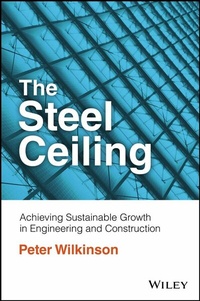
The Steel Ceiling
Description

The engineering and construction industry is at a tipping point: How can we foster long-term growth in uncertain times? How do we navigate technology-driven disruption and meet the challenge of net zero emissions? And how do we create a more inclusive, collaborative, and sustainable industry for the future? The Steel Ceiling: Achieving Sustainable Growth in Engineering and Construction highlights current issues facing businesses in the engineering and construction sector in Australia--and outlines what it takes for your business to withstand the economic test of time.
This book gives you the strategic plan you need to break through the "steel ceiling" holding you back. In clear and actionable terms, with examples and stories from the industry, it outlines an effective methodology you can use to grow your enterprise sustainably--from a small business to megaproject capability.
* Develop a clear understanding of the economic forces impacting the infrastructure sector in Australia
* Craft a roadmap for evolving your business and remaining competitive in today's landscape
* Build leadership skills and hone the vision, values and culture that drive your business
* Learn how to better manage precious time, increase revenue, and improve returns on equity
* Implement the four pillars that are the foundation for a thriving, sustainable business
Author Peter Wilkinson has more than 30 years' experience in transforming industry business capability, from small business to large-scale government projects. In this book, he provides you with the knowledge and the game plan you need to build a thriving business ready to compete in today's industry environment.
More details
Other editions
Additional editions
Person
Content
Preface: My story xv
Introduction: What needs to change for your business to grow sustainably? xxi
Part I: The Context 1
1 Infrastructure engineering and construction in Australia 7
2 The economics of boom and bust 21
3 External forces and industry consolidation 33
4 Analysing shifting demand, needs, and investment imperatives 61
5 The evolving role of government in infrastructure 87
Part II: The Why 105
6 Personal lessons in business 111
7 Business vision and values 135
8 Effective leadership 157
Part III: The What 177
9 What is strategy? 181
10 The roadmap 205
Part IV: The How 223
11 Pillar 1: Product capability and fit 229
12 Pillar 2: Revenue channels and sales processes 247
13 Pillar 3: Operational functions 265
14 Pillar 4: Business assets 297
Conclusion: Embedding business improvement 315
The power of action 327
References 329
Index 359
Preface
My story
Every author, whether explicitly acknowledged or not, brings their personal experience to the story they tell. I've certainly found that learning about a business owner's story is an extremely effective - and enjoyable - way to start a conversation that leads to a better understanding of why business is showing up for the owner in the way it does. How business owners interact with their enterprises, and what they do in reaction to the situations they face, is a source of endless fascination for me. Accordingly, I've interspersed relevant elements of my story throughout the book in the interest of hopefully providing you, the reader, with a deeper understanding of what lies behind my approach.
I certainly have had a great deal of luck over the course of my working life. Not the least of which was the influence of my father, who took the time and interest to encourage a reasonably good (but not particularly well-motivated) higher school certificate holder in the direction of what was then known as the NSW State Rail Authority. I successfully applied for a cadetship, which, like other government sector programs around at that time, comprised sponsored education semesters interspersed with paid work experience. This set me on a career path in an industry that has been very good to me over 30-plus years.
The value of practical education
The terms of my cadetship required simultaneous enrolment in the NSW Institute of Technology (later to become the University of Technology Sydney) as an undergraduate mechanical engineer. The highlight of my university years was the final year project, culminating in submission of the UTS equivalent of an undergraduate thesis. In my case, I collaborated with three colleagues on an inherited project that had been taken on by UTS student teams in previous years. The Shell Mileage Marathon event was held annually at Amaroo Park Raceway in Annangrove (eventually closed in 1998 to make way for a housing development). The race involved vehicles powered by 50cc internal combustion engines specifically designed to travel the maximum possible distance on as little fuel as possible. Our team inherited a vehicle that had been constructed and entered by past UTS student teams, and we set about improving upon previous years' performance. In our case, this consisted of:
- casting aside the previous spine-based vehicle chassis - which appeared to be old and broken - and replacing it with a new aluminium vehicle manufactured with the assistance of an Australian Defence Industries (ADI) colleague in their Rosebery workshops
- optimising rolling resistance for the bicycle wheels used for the new vehicle
- improving on engine performance by optimising the set-up via bench dynamometer testing.
What we didn't know at the time was (a) the 'old and broken' spine chassis had just the right degree of flexibility, enabling it to ride the bumps and undulations of the Amaroo Park track in an efficient manner, and (b) the engine needed to be carefully managed during bench testing to ensure it didn't overheat and seize (which it did).
We co-opted a driver (the girlfriend of a fellow student) whose size enabled her to squeeze into the small cockpit of the vehicle. Her driving skills and ability to withstand the heat generated within the vehicle (essentially a plastic-wrapped shell sat out in the hot sun) were most admirably up to the task. We turned up at Amaroo Park on race day, decked out in white UTS and ADI badged overalls, and placed third. First place went to a Nulon Australia-sponsored vehicle with a larger budget than ours, with second place taken by a vehicle by regular competitor and privateer racing driver Moss Angliss.
I'm, even now, acutely reminded of the seemingly relentless stress associated with the entire experience. The UTS team had won the event the two prior years, and expectations were high. The idea of co-opting students for a group project was extra work that no-one was keen to own. If I recall correctly, our team took on a significant mission in replacing the old, successful chassis without much university advice or support. The engine overheating debacle referred to earlier also did not go down well with UTS staff. Ultimately, getting to the line on competition day was a close-run thing.
At the time, I managed the situation by concentrating on my part of the project - rolling resistance optimisation - and achieved a distinction for my undergraduate thesis (my first published book!). Hindsight eventually dawned upon me as I realised that my reluctance to take on more responsibility for the overall health and direction of the project was a major failing on my part. I resolved, going forward, to either take full responsibility for the outcome of a project I'm involved in or not participate at all. It's a lesson I've only forgotten on rare occasions.
From engineering to business
Overall, though, the combination of education, project work and industry experience provided a great starting point for a career. This went some way towards making up for the fact that engineering was at that time (and, to a rather disappointing extent, still is) an overwhelmingly male-dominated profession. This is despite concerted efforts by the profession to encourage more diversity in the field. Where I believe this lack of diversity and balance shows up most acutely is in the typical engineering-based approach to problem-solving. Well-trained engineers are excellent at solving 'bounded' problems, but can struggle to deal with the less structured, humanistic environment, in which more complex problems exist. I suspect this bias aligns with the 'thinker' orientation of many engineers, manifesting itself in the need to solve the problem at hand. A more 'feeler' and 'knower' oriented, contextual approach that could be introduced with a broader demographic typically results in greater insight into the nature of the problem faced, thereby improving the odds of solving the right problem. The linear mindset-based approach to problem-solving creates business risks, which can be effectively mitigated via greater diversity of thought. Refer to the Conclusion for further information regarding our differing preferences for processing and communicating information.
After graduating from UTS in 1990, I was appointed to State Rail's Flemington Maintenance Centre in Sydney's western suburbs as a passenger railcar maintenance engineer. I learnt a great deal over these four years, working with a more experienced (if a little eccentric) electrical engineer with a real talent for fault diagnosis. Eventually though, I realised I was not heading in the right direction career-wise. This, allied with my aforementioned lack of skill and interest in design, resulted in me being drawn in a managerial direction. Flemington's operational management were very supportive of my interests; for example, they allowed me to relieve the depot manager whilst he was on annual leave and experience the weight of responsibility. I was also supported in my eventual decision to leave the public sector for a role with Goninan (now UGL) at Maintrain, where I learnt several valuable business lessons that will be explored in chapter 6.
In 1996, I resolved to take on an MBA with the NSW University's Australian Graduate School of Management. I signed up to the part-time course to reduce the risk of the experience living up to its unofficial label as the 'divorce course'. I recall the initial thrill of the induction session, where we were informed that our investment in the 'elite' $40 000 course would guarantee our future success!
Those who have undertaken an MBA would be familiar with the more mundane reality of dabbling in a range of business-related subjects just enough to be potentially dangerous in a number of specialist areas, such as finance, marketing and law. I found the business strategy elements of the course of great interest: the contextual anchor that brought together the various threads into a relatively coherent whole. I was also lucky enough to be able to apply the strategy theory to the corporate roles I held with Serco Asia Pacific, as a management consultant with GHD and later with Transfield Services.
Of course, the networking opportunities are what makes these courses so valuable - a reality that persists today with a great many Australian institutions offering MBA programs. My most valuable learnings arose from working with a small cohort of colleagues with diverse backgrounds and experience, where I was forced to explain myself to people, including one dear friend with drama and jazz singing in her past! Imagine my surprise when I discovered there is more than one right way - not just the linear method - of getting to a correct answer.
The experiences I've outlined stand out as being particularly influential in shaping my approach to what I now do as a business adviser and coach. It would be remiss of me, however, not to acknowledge a much broader context in which I exist. In the greater scheme of things, being a healthy, white male born in one of the richest countries on the planet, and experiencing the buoyant journey that Australia has experienced over the last 30 years, confers great privilege. And with privilege comes a responsibility to give back to the infrastructure engineering and construction industry...
