

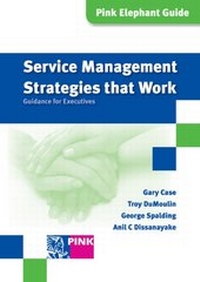
Service Management Strategies that Work
Guidance for Executives
1st Edition
Published on 9. September 2007
172 pages
978-90-8753-222-2 (ISBN)
Description

Pink Elephant is the world leader in IT management best practices, offering solutions to public and private businesses worldwide, many of them listed in the Fortune 500. The Company specializes in improving the quality of IT services through the application of recognized frameworks, including the IT Infrastructure Library (ITIL®).
More details
Other editions
Additional editions
Gary Case | Troy DuMoulin | George Spalding
Service Management Strategies That Work
Guidance for Executives
Book
11/2007
Van Haren Publishing BV
€65.79
Shipment within 10-15 days
Adam Grummitt | Troy DuMoulin
Service Management Strategies that Work
E-Book
09/2007
Van Haren Publishing
€47.99
Available for download
Content
1 - Acknowledgements [Seite 10]
2 - Foreword [Seite 12]
3 - Preface [Seite 14]
4 - 1 Introduction [Seite 16]
4.1 - Business Alignment or Business Integration? [Seite 16]
4.2 - 1.1 Organizing IT - The Traditional Manufacturing Model [Seite 17]
4.3 - 1.2 Technology vs Service Management [Seite 19]
4.4 - 1.3 Linear Service Catalogs vs. Dynamic Service Portfolios [Seite 19]
4.5 - 1.4 Technical and Professional Services: [Seite 21]
4.6 - 1.5 The New Service Orientation - Organizational Model [Seite 25]
4.7 - 1.6 Service Oriented IT Organizational Models [Seite 27]
4.8 - 1.7 The Service Owner Role [Seite 30]
4.9 - 1.8 The Process Owner Role [Seite 31]
4.10 - 1.9 Placing Ownership Within Existing Structures [Seite 33]
4.11 - 1.10 A New Organizational Construct - The IT Service Delivery Function [Seite 36]
4.12 - 1.11 Service Level Management and the Service Organization [Seite 38]
4.13 - 1.12 The Evolution of the Service Delivery Organization [Seite 39]
4.14 - 1.13 Impact on IT Outsourcing [Seite 43]
4.15 - 1.14 Global Process Governance Considerations [Seite 44]
4.16 - 1.15 Executive Sponsor [Seite 45]
4.17 - 1.16 Executive Steering Committee [Seite 45]
4.18 - 1.17 Process Governance Team [Seite 45]
4.19 - 1.18 Global Process Owners [Seite 46]
4.20 - 1.19 Local process managers and co-ordinators [Seite 47]
4.21 - 1.20 Education recommendations [Seite 48]
4.22 - 1.21 ITIL overviews [Seite 48]
4.23 - 1.22 Executive overview and executive strategic workshops [Seite 49]
4.24 - 1.23 ITIL Foundations Certification [Seite 49]
4.25 - 1.24 ITIL and ITSM Practitioners [Seite 50]
4.26 - 1.25 Summary [Seite 50]
5 - 2 IT Governance Unraveled [Seite 52]
5.1 - Introduction [Seite 52]
5.2 - 2.1 IT Governance Definition: [Seite 52]
5.3 - 2.2 Activities of IT governance [Seite 53]
5.4 - 2.3 Establishing [Seite 55]
5.5 - 2.4 Monitoring [Seite 61]
5.6 - 2.5 Directing [Seite 64]
5.7 - 2.6 Summary [Seite 64]
6 - 3 The External Managed Service Provider [Seite 66]
6.1 - 3.1 Introduction [Seite 66]
6.2 - 3.2 Background on MSPs and ITIL [Seite 67]
6.3 - 3.3 ITIL in an MSP environment [Seite 73]
6.4 - 3.4 Summary [Seite 80]
7 - 4 Process Implementation [Seite 82]
7.1 - 4.1 Objective [Seite 82]
7.2 - 4.2 Program management [Seite 82]
7.3 - 4.3 Process implementation projects [Seite 83]
7.4 - 4.4 Process, People and Technology: The Integrated Project Plan [Seite 84]
7.5 - 4.5 Implementation Roles [Seite 86]
7.6 - 4.6 Consulting Roles [Seite 87]
7.7 - 4.7 High Level Process Model Development [Seite 88]
7.8 - 4.8 Detailed design [Seite 90]
7.9 - 4.9 Process Roles and Responsibilities [Seite 93]
7.10 - 4.10 Process implementation considerations [Seite 98]
7.11 - 4.11 Applicability / Scalability [Seite 99]
7.12 - 4.12 Critical Success Factors [Seite 99]
7.13 - 4.13 Process Embedding Strategy [Seite 100]
7.14 - 4.14 Process workshops / training [Seite 101]
7.15 - 4.15 Detailed activities: Project checklist [Seite 102]
7.16 - 4.16 Communication plan [Seite 104]
7.17 - 4.17 Evaluation of the project [Seite 104]
7.18 - 4.18 Post project review [Seite 105]
7.19 - 4.19 Auditing using quality parameters [Seite 105]
7.20 - 4.20 Summary [Seite 106]
8 - 5 Defining, Modeling and Costing IT Services [Seite 108]
8.1 - 5.1 Introduction [Seite 108]
8.2 - 5.2 Defining IT services [Seite 109]
8.3 - 5.3 Service Classifications [Seite 112]
8.4 - 5.4 Steps for defining IT services [Seite 113]
8.5 - 5.5 Modeling IT services [Seite 116]
8.6 - 5.6 Configuration Management Objective [Seite 116]
8.7 - 5.7 Configuration Management IT service data modeling [Seite 117]
8.8 - 5.8 Developing a service-based cost model [Seite 118]
8.9 - 5.9 Financial management for IT services [Seite 118]
8.10 - 5.10 Understanding IT costs [Seite 119]
8.11 - 5.11 Service-based costing [Seite 121]
8.12 - 5.12 Component/Supporting services [Seite 121]
8.13 - 5.13 Service-based costing steps [Seite 122]
8.14 - 5.14 Summary [Seite 123]
9 - 6 The Federated CMDB [Seite 124]
9.1 - 6.1 Three applications of CMDB federation [Seite 124]
9.2 - 6.2 Application 1: CMDB federation is the exception, not the rule [Seite 125]
9.3 - 6.3 Application 2: CMDB federation is the rule, not the exception [Seite 128]
9.4 - 6.4 Application 3: The dynamic view from existing distributed data [Seite 129]
9.5 - 6.5 Summary [Seite 130]
10 - 7 Developing A Quality Driven Measurement Framework [Seite 132]
10.1 - 7.1 Measuring Process [Seite 132]
10.2 - 7.2 Risks [Seite 134]
10.3 - 7.3 Requirements [Seite 134]
10.4 - 7.4 Rationale For Measurement [Seite 136]
10.5 - 7.5 Implementation Strategy [Seite 140]
10.6 - 7.6 Translating A KPI Improvement To Productivity [Seite 140]
11 - 8 The Theory of Constraints and Continuous Service Improvement [Seite 150]
11.1 - 8.1 Introduction [Seite 150]
11.2 - 8.2 Eli Goldratt's The Goal [Seite 150]
11.3 - 8.3 How does TOC apply to continuous improvement? [Seite 151]
11.4 - 8.4 TOC definitions [Seite 152]
11.5 - 8.5 Identifying constraints [Seite 153]
11.6 - 8.6 Where are constraints? [Seite 154]
12 - 9 Appendices [Seite 156]
12.1 - Appendix 1: An example of a Communications Plan Matrix [Seite 156]
12.2 - Appendix 2: An example of a Process Dashboard Template [Seite 158]
12.3 - Appendix 3: Detailed Project Roles [Seite 160]
12.4 - Appendix 4 Bibliography [Seite 166]
12.5 - Appendix 5: Definitions [Seite 168]
12.6 - Appendix 6: About Pink Elephant [Seite 170]
2 - Foreword [Seite 12]
3 - Preface [Seite 14]
4 - 1 Introduction [Seite 16]
4.1 - Business Alignment or Business Integration? [Seite 16]
4.2 - 1.1 Organizing IT - The Traditional Manufacturing Model [Seite 17]
4.3 - 1.2 Technology vs Service Management [Seite 19]
4.4 - 1.3 Linear Service Catalogs vs. Dynamic Service Portfolios [Seite 19]
4.5 - 1.4 Technical and Professional Services: [Seite 21]
4.6 - 1.5 The New Service Orientation - Organizational Model [Seite 25]
4.7 - 1.6 Service Oriented IT Organizational Models [Seite 27]
4.8 - 1.7 The Service Owner Role [Seite 30]
4.9 - 1.8 The Process Owner Role [Seite 31]
4.10 - 1.9 Placing Ownership Within Existing Structures [Seite 33]
4.11 - 1.10 A New Organizational Construct - The IT Service Delivery Function [Seite 36]
4.12 - 1.11 Service Level Management and the Service Organization [Seite 38]
4.13 - 1.12 The Evolution of the Service Delivery Organization [Seite 39]
4.14 - 1.13 Impact on IT Outsourcing [Seite 43]
4.15 - 1.14 Global Process Governance Considerations [Seite 44]
4.16 - 1.15 Executive Sponsor [Seite 45]
4.17 - 1.16 Executive Steering Committee [Seite 45]
4.18 - 1.17 Process Governance Team [Seite 45]
4.19 - 1.18 Global Process Owners [Seite 46]
4.20 - 1.19 Local process managers and co-ordinators [Seite 47]
4.21 - 1.20 Education recommendations [Seite 48]
4.22 - 1.21 ITIL overviews [Seite 48]
4.23 - 1.22 Executive overview and executive strategic workshops [Seite 49]
4.24 - 1.23 ITIL Foundations Certification [Seite 49]
4.25 - 1.24 ITIL and ITSM Practitioners [Seite 50]
4.26 - 1.25 Summary [Seite 50]
5 - 2 IT Governance Unraveled [Seite 52]
5.1 - Introduction [Seite 52]
5.2 - 2.1 IT Governance Definition: [Seite 52]
5.3 - 2.2 Activities of IT governance [Seite 53]
5.4 - 2.3 Establishing [Seite 55]
5.5 - 2.4 Monitoring [Seite 61]
5.6 - 2.5 Directing [Seite 64]
5.7 - 2.6 Summary [Seite 64]
6 - 3 The External Managed Service Provider [Seite 66]
6.1 - 3.1 Introduction [Seite 66]
6.2 - 3.2 Background on MSPs and ITIL [Seite 67]
6.3 - 3.3 ITIL in an MSP environment [Seite 73]
6.4 - 3.4 Summary [Seite 80]
7 - 4 Process Implementation [Seite 82]
7.1 - 4.1 Objective [Seite 82]
7.2 - 4.2 Program management [Seite 82]
7.3 - 4.3 Process implementation projects [Seite 83]
7.4 - 4.4 Process, People and Technology: The Integrated Project Plan [Seite 84]
7.5 - 4.5 Implementation Roles [Seite 86]
7.6 - 4.6 Consulting Roles [Seite 87]
7.7 - 4.7 High Level Process Model Development [Seite 88]
7.8 - 4.8 Detailed design [Seite 90]
7.9 - 4.9 Process Roles and Responsibilities [Seite 93]
7.10 - 4.10 Process implementation considerations [Seite 98]
7.11 - 4.11 Applicability / Scalability [Seite 99]
7.12 - 4.12 Critical Success Factors [Seite 99]
7.13 - 4.13 Process Embedding Strategy [Seite 100]
7.14 - 4.14 Process workshops / training [Seite 101]
7.15 - 4.15 Detailed activities: Project checklist [Seite 102]
7.16 - 4.16 Communication plan [Seite 104]
7.17 - 4.17 Evaluation of the project [Seite 104]
7.18 - 4.18 Post project review [Seite 105]
7.19 - 4.19 Auditing using quality parameters [Seite 105]
7.20 - 4.20 Summary [Seite 106]
8 - 5 Defining, Modeling and Costing IT Services [Seite 108]
8.1 - 5.1 Introduction [Seite 108]
8.2 - 5.2 Defining IT services [Seite 109]
8.3 - 5.3 Service Classifications [Seite 112]
8.4 - 5.4 Steps for defining IT services [Seite 113]
8.5 - 5.5 Modeling IT services [Seite 116]
8.6 - 5.6 Configuration Management Objective [Seite 116]
8.7 - 5.7 Configuration Management IT service data modeling [Seite 117]
8.8 - 5.8 Developing a service-based cost model [Seite 118]
8.9 - 5.9 Financial management for IT services [Seite 118]
8.10 - 5.10 Understanding IT costs [Seite 119]
8.11 - 5.11 Service-based costing [Seite 121]
8.12 - 5.12 Component/Supporting services [Seite 121]
8.13 - 5.13 Service-based costing steps [Seite 122]
8.14 - 5.14 Summary [Seite 123]
9 - 6 The Federated CMDB [Seite 124]
9.1 - 6.1 Three applications of CMDB federation [Seite 124]
9.2 - 6.2 Application 1: CMDB federation is the exception, not the rule [Seite 125]
9.3 - 6.3 Application 2: CMDB federation is the rule, not the exception [Seite 128]
9.4 - 6.4 Application 3: The dynamic view from existing distributed data [Seite 129]
9.5 - 6.5 Summary [Seite 130]
10 - 7 Developing A Quality Driven Measurement Framework [Seite 132]
10.1 - 7.1 Measuring Process [Seite 132]
10.2 - 7.2 Risks [Seite 134]
10.3 - 7.3 Requirements [Seite 134]
10.4 - 7.4 Rationale For Measurement [Seite 136]
10.5 - 7.5 Implementation Strategy [Seite 140]
10.6 - 7.6 Translating A KPI Improvement To Productivity [Seite 140]
11 - 8 The Theory of Constraints and Continuous Service Improvement [Seite 150]
11.1 - 8.1 Introduction [Seite 150]
11.2 - 8.2 Eli Goldratt's The Goal [Seite 150]
11.3 - 8.3 How does TOC apply to continuous improvement? [Seite 151]
11.4 - 8.4 TOC definitions [Seite 152]
11.5 - 8.5 Identifying constraints [Seite 153]
11.6 - 8.6 Where are constraints? [Seite 154]
12 - 9 Appendices [Seite 156]
12.1 - Appendix 1: An example of a Communications Plan Matrix [Seite 156]
12.2 - Appendix 2: An example of a Process Dashboard Template [Seite 158]
12.3 - Appendix 3: Detailed Project Roles [Seite 160]
12.4 - Appendix 4 Bibliography [Seite 166]
12.5 - Appendix 5: Definitions [Seite 168]
12.6 - Appendix 6: About Pink Elephant [Seite 170]
