
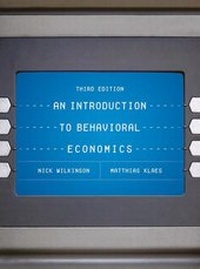
An Introduction to Behavioral Economics
Description
Alles über E-Books | Antworten auf Fragen rund um E-Books, Kopierschutz und Dateiformate finden Sie in unserem Info- & Hilfebereich.
The third edition of this successful textbook introduces students to behavioral economics. Offers a critical examination of the latest literature, research, developments and debates in the field by discussing topics such as evolutionary psychology and neuroscience. Contains a wealth of case studies, examples and review questions.
More details
Other editions
Additional editions
Persons
Nick Wilkinson is Professor of Economics at Richmond the American International University in London and has taught economics and finance in various international institutions in the UK and USA. He has also worked in business management in both countries and served as a consultant to many companies, mainly in the leisure industry. He has authored two books, 'Managerial Economics: A Problem-Solving Approach', published by Cambridge University Press. His research interests lie in behavioral economics, particularly in the implications of evolutionary biology and neuroscience for behavioral economics.
Matthias Klaes is President of the Scottish Economic Society and Convener of the Scottish Centre for Economic Methodology. He has published widely in organisational and behavioral economics and finance, and regularly acts as an adviser to both private and public sector bodies. His current research focuses on the behavioral dimensions of online marketplaces and digital finance.
Content
PART I: INTRODUCTION.- 1. Nature of Behavioral Economics.- 2. Methodology.- PART II: FOUNDATIONS.- 3. Values, Preferences and Choices.- 4. Beliefs and Expectations.- 5. Decision-making under Risk and Uncertainty.- 6. Mental Accounting.- PART III: INTERTEMPORAL CHOICE.- 7. The Discounted Utility Model.- 8. Alternative Intertemporal Choice Models.- PART IV: STRATEGIC INTERACTION.- 9. Behavioral Game Theory.- 10. Social Preferences.- PART V: CONCLUSION.- 11. Behavioral Economics: Summary and Outlook.

System requirements
File format: ePUB
Copy protection: Adobe-DRM (Digital Rights Management)
System requirements:
- Computer (Windows; MacOS X; Linux): Install the free reader Adobe Digital Editions prior to download (see eBook Help).
- Tablet/smartphone (Android; iOS): Install the free app Adobe Digital Editions or the app PocketBook before downloading (see eBook Help).
- E-reader: Bookeen, Kobo, Pocketbook, Sony, Tolino and many more (not Kindle).
The file format ePub works well for novels and non-fiction books – i.e., „flowing” text without complex layout. On an e-reader or smartphone, line and page breaks automatically adjust to fit the small displays.
This eBook uses Adobe-DRM, a „hard” copy protection. If the necessary requirements are not met, unfortunately you will not be able to open the eBook. You will therefore need to prepare your reading hardware before downloading.
Please note: We strongly recommend that you authorise using your personal Adobe ID after installation of any reading software.
For more information, see our ebook Help page.
File format: PDF
Copy-Protection: Adobe-DRM (Digital Rights Management)
System requirements:
- Computer (Windows; MacOS X; Linux): Install the free reader Adobe Digital Editions prior to download (see eBook Help).
- Tablet/smartphone (Android; iOS): Install the free app Adobe Digital Editions or the app PocketBook before downloading (see eBook Help).
- E-reader: Bookeen, Kobo, Pocketbook, Sony, Tolino and many more (only limited: Kindle).
The file format PDF always displays a book page identically on any hardware. This makes PDF suitable for complex layouts such as those used in textbooks and reference books (images, tables, columns, footnotes). Unfortunately, on the small screens of e-readers or smartphones, PDFs are rather annoying, requiring too much scrolling.
This eBook uses Adobe-DRM, a „hard” copy protection. If the necessary requirements are not met, unfortunately you will not be able to open the eBook. You will therefore need to prepare your reading hardware before downloading.
Please note: We strongly recommend that you authorise using your personal Adobe ID after installation of any reading software.
For more information, see our eBook Help page.
