

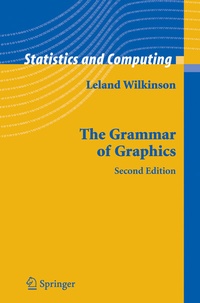
The Grammar of Graphics
Description

Reviews / Votes
From the reviews of the second edition:
"This fascinating book deconstructs the process of producing graphics and in doing so raises many fascinating questions on the nature and representation of information...This second edition is almost twice the size of the original, with six new chapters and substantial revisions." Short Book Reviews of the International Statistical Institute, December 2005
"When the first edidtion of this book appeared in 2000 it was much praised. I called it a tour de force of the highest order. (Wainer, 2001), Edward Wegman (2000) argued that it was destined to become a classic. Now, six years later this very fine book has been much improved." Howard Wainer for Psychometrika
"...The second edition is an impressive expansion beyond a quite remarkable first edition. The text remains dense and even more encyclopedic, but it is a pleasure to read, whether a novice or an expert in graphics...this book is a bargain...The second edition is a must-have volume for anyone interested in graphics." Thomas E. Bradstreet for the Journal of the American Statistical Association, December 2006
"I find myself still thinking about the book and its ideas, several weeks after I finished reading it. I love that kind of book." Mark Bailey for Techometrics, Vol. 49, No. 1, February 2007
"Warts and all, The Grammar of Graphics is a richly rewarding work, an outstanding achievement by one of the leaders of statistical graphics. Seek it out." Nicholas J. Cox for the Journal of Statistical Software, January 2007
"The second edition is a quite fascinating book as well, and it comes with many color graphics. Anyone working in this field can see how many hours the author (plus coworkers) has spent on such a volume. . Demands for good graphics are high and this book will help to wetten the appetite to create future computer packages that willmeet this demand. An occasional reader will get insights into a modern world of computing . ." (Wolfgang Polasek, Statistical Papers, Vol. 48, 2007)
More details
Other editions
Additional editions
Persons
Content
Statistics state the status of the state. All these s words derive from the Greek statis and Latin status, or standing. Standing (for humans) is a state of being, a condition that represents literally or figuratively the active status of an individual, group, or state. Modern statistics as a discipline arose in the early 18th century, when collection of data about the state was recognized as essential to serving the needs of its constituents. This Enlightenment perspective gave rise not only to the modern social sciences, but also to mathematical methods for analyzing data measured with error (Stigler, 1983).
In a graphical system, statistics are methods that alter the position of geometric graphs. We are accustomed to think of a chart as a display of a statistic or a statistical function (e.g., a bar chart of budget expenditures). As such, it would seem that we should begin by aggregating data, computing statistics, and drawing a chart. This would be wrong, however. By putting statistics under control of graphing functions, rather than whole charts under the control of statistics, we accomplish several things. First, we can represent more than one statistic in a frame. One graphic can represent a mean and another a median, in the same frame. Second, making statistics into graphing methods forces them to be views or summaries of the raw data rather than data themselves. In other words, the casewise data and a graphic are inextricably bound because we never break the connection between the variables and the graphics that represent them.
This allows us to drill-down, brush, and investigate values with other dynamic tools. This functions would be lost if we pre-aggregated the data. Finally, by putting statistics under the control of graphing functions, we can modularize and localize computations in a distributed system. Adding graphics to a frame is easy when we do not have to worry about the structure of the data and how aggregations were computed. We will return to this issue in Section 7.3 at the end of this chapter.
The simplest graphing method is the one students first learn for plotting algebraic functions: for every x, compute f(x) so that one may draw a graph based on the tuples of the form (x, f(x)) that comprise the graph. Students learn to construct a list of these tuples (a finite subset of the graph of the function) in order to plot selected points in Cartesian coordinates. In the functional no tation of this book, students usually draw graphs of algebraic functions using the graphing function line(position(f()).
While students learn graphing methods for polynomial and other simple algebraic functions, most charts are based on statistical functions of observed values of one or more variables. In our notation, examples of statistical graphs are produced by the functions
point(position(summary.mean())) and
line(position(smooth.linear())),
which implement the statistical graphing functions summary.mean() and smooth.linear(), respectively. Statistical functions can be complicated, but their output looks the same to their geometric clients as the output of algebraic functions. A line does not care who produced the points it needs to plot itself.
