

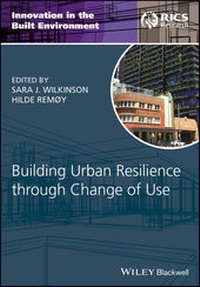
Building Urban Resilience through Change of Use
Description

This comprehensive book explores the potential to change the character of cities with residential conversion of office space in order to withstand the negative effects of climate change. It investigates the nature and extent of sustainable conversion in a number of global cities, as well as the political, economic, social, technological, environmental, and legal drivers and barriers to successful conversion. The book also identifies the key lessons learned through international comparisons with cases in the UK, US, Australia, and the Netherlands.
Building Urban Resilience Through Change of Use covers the benefits and aspects of sustainable conversion adaptation through the whole lifecycle from inception, planning, and design, to procurement, construction, and management and operational issues. It illustrates and quantifies, through empirical research, the changes that have been achieved or delivered in sustainable conversion adaptation. The book gives an overview of all aspects of performance characteristics and the conversion adaptation of existing buildings. In the end, it enables planners to make more informed decisions about whether conversion adaptation is a good choice--and if so, which types of sustainability measures are best suited for projects.
* Provides detailed, empirical knowledge based on real-world research undertaken in five countries over three continents on both a citywide scale and on individual buildings
* Case studies and exemplars demonstrate the application of the knowledge in North and South America, Canada, Australia, New Zealand, and in Europe
* Addresses the key themes of technology, finance and procurement, and the regulatory framework
The first research-based book to examine how to improve resilience to climate change through sustainable reuse of buildings, Building Urban Resilience Through Change of Use is a welcome book for researchers and academics involved in building surveying, urban development, and sustainability planning.
More details
Other editions
Additional editions
Persons
The Editors
SARA J. WILKINSON, BSc, MA, MPhil, PhD, FRICS, AAPI, is an Associate Professor at the University of Technology Sydney. Working at the intersections of sustainability, resilience, building adaptation and transformation, her research aims to improve local, national and international outcomes of urban development in respect of: climate change and a growing urbanised population. Sara practiced for several years in the public and private sectors. She engages in trans-disciplinary research with colleagues from science, health, business, technology and built environment, publishing over 150 outputs including books, research reports, journal and conference papers. She contributes to the surveying profession through national and international committees, accreditation and APC assessment.
HILDE REMØY, PhD, MSc, is Associate Professor in Real Estate Management at the Faculty of Architecture and the Built Environment of Delft University of Technology. After an international educational and professional path, including Norway, Italy, and the Netherlands, she is now teaching, researching and writing (over 100 publications) on office vacancy, sustainable building adaptation and conversion. In this work, sustainability, resilience, lifespan and continued re-use of historic buildings are the main points. Hilde is involved in research ranging from large scale European funded projects to contract research for Dutch practice, working with researchers and professionals of various disciplines and backgrounds.
Content
About the Editors ix
Contributor Biographies xi
Acknowledgements xv
Foreword: Resilience as a 'Lens' for Driving the Adaptive Capacity of Cities xvii
Chapter 1 The Context for Building Resilience through Sustainable Change of Use Adaptation 1
1.1 Introduction 1
1.2 Scale of the Problem: From City to Building Scale 4
1.3 Definitions of Key Terms 6
1.4 Background and Scope 8
1.5 The Notion of Urban Resilience 9
1.6 Synopsis 13
1.7 Summary 17
References 18
Chapter 2 Precinct?]scale Innovation and the Sharing Paradigm 21
2.1 Introduction 21
2.2 The Emergence of the Sharing Paradigm 24
2.3 Potential Benefits of the Sharing Paradigm for Cities and Precincts 25
2.4 How Building and Land Conversions Could Help Enable the Sharing Paradigm 27
2.5 Conclusions: Sharing the City 35
References 36
Chapter 3 Planning Policy Instruments for Resilient Urban Redevelopment: The Case of Office Conversions in Rotterdam, the Netherlands 39
3.1 Introduction 39
3.2 Conceptual Planning Policy Instruments 41
3.3 Planning Policy Instruments in Rotterdam 46
3.4 Classifying and Evaluating Policy Instruments in Rotterdam 51
3.5 Conclusions 54
References 54
Chapter 4 Adaptation and Demolition in a Masterplan Context 57
4.1 Introduction 57
4.2 Literature Review 58
4.3 Methodology 64
4.4 Analysis 67
4.5 Conclusion 75
4.6 Planned Continuation of Research 77
References 78
Chapter 5 Sustainable Design and Building Conversion 83
5.1 Introduction 83
5.2 Durability: Measuring 'Long Life' 85
5.3 Adaptability: Measuring 'Loose Fit' 86
5.4 Sustainability: Measuring 'Low Energy' 88
5.5 Case Studies 89
5.6 A Framework for Evaluation of Urban Renewal Projects 91
5.7 The Application and Implications of Life Cycle Costing 99
5.8 Conclusion: Implications for Future Practice 100
References 102
Chapter 6 Top?]up: Urban Resilience through Additions to the Tops of City Buildings 105
6.1 Introduction 105
6.2 Top?]up Context 105
6.3 Top?]up Typology 108
6.4 Top?]up and Heritage 109
6.5 Case Studies 111
6.6 Urban Resilience 115
6.7 Conclusion 118
References 118
Chapter 7 Conversion Potential Assessment Tool 121
7.1 Introduction: Why Adaptive Reuse? 121
7.2 Opportunities and Risks 122
7.3. Conversion Meter 126
7.4 Conversion Meter Case Studies 142
7.5 Lessons Learned from Case Studies 143
7.6 Concluding Remarks 148
7.7 Next Steps 148
References 149
Chapter 8 Rating Tools, Resilience and Sustainable Change of Use Adaptations 153
8.1 Introduction 153
8.2 Sustainability in Building Adaptation: Drivers and Barriers 154
8.3 Leading Rating Tools and Conversion Adaptation 156
8.4 Resilience Challenges 168
8.5 Conclusions 171
References 172
Chapter 9 Conclusions on Building Resilience through Change of Use Adaptation: A Manifesto for the Future 175
9.1 Introduction 175
9.2 Overview of Resilience Issues, Sustainability and Change of Use Adaptation 175
9.3 Qualities of Resilient Systems in the Context of Conversion Adaptation 182
9.4 Resilience and Sustainable Conversion Adaptation 183
9.5 The Manifesto for Sustainable and Resilient Conversion Adaptation 184
9.6 Moving Forward 185
9.7 Conclusions 186
References 187
Appendix 9.A Checklists for Building Resilient Cities though Sustainable Change of Use 188
Index 193
1
The Context for Building Resilience through Sustainable Change of Use Adaptation
Sara Wilkinson
University of Technology Sydney
1.1 Introduction
As the 21st century progresses, we are evolving our collective thinking and responses to the challenges of living with a changing climate, increasing global population and changing demographics, mass urbanisation, issues of inequality and instability, issues of food security and increasing scarcity of resources, as well as an increased need for sustainability in the built environment to name but a few (UN 2015; RICS, 2015). Climate change is held to be one of the greatest challenges of our time. The World Bank Group Report (2015) 'Building Regulation for Resilience: Managing Risks for Safer Cities' noted that in the last two decades natural disasters have claimed 1,300,000 lives, have affected 4.4 billion people - that is over half the global population, and have resulted in US$2 trillion of economic losses. They noted that high-income countries with advanced building-code systems experienced 47% of disasters but only 7% of the fatalities and therefore a prima facie case exists for rigorous regulation (The World Bank Group, 2015). Significantly, it also called for a shift from managing disasters to reducing the underlying risks. Increases in global temperature, sea level rise, ocean acidification and other climate change impacts are seriously affecting coastal areas and low-lying coastal countries. These are examples of chronic stresses and are defined in this chapter. In summary, the survival of many societies, and of the planet's biological support systems, are at risk. As a response, in December 2015, the UN published the report, 'Transforming Our World: The 2030 Agenda for Sustainable Development' stating that:
The 17 Sustainable Development Goals and 169 targets demonstrate the scale and ambition of this new universal Agenda. They seek to build on the Millennium Development Goals and complete what they did not achieve. The Sustainable Development Goals are integrated and indivisible and balance the three dimensions of sustainable development: the economic, social and environmental. The Goals and targets will stimulate action over the next 15 years in areas of critical importance for humanity and the planet.
(UN, 2015: 1)
The 17 UN Sustainable Development Goals are shown in Box 1.1. Examining the goals, those that relate most directly to the built environment are;
- Goal 6. 'Ensure availability and sustainable management of water and sanitation for all',
- Goal 7. 'Ensure access to affordable, reliable, sustainable and modern energy for all'
- Goal 11. 'Make cities and human settlements inclusive, safe, resilient and sustainable' (UN, 2015).
However, it is also clear that 'inclusive, safe, resilient and sustainable,' urban settlements and cities provide the setting for the delivery of many of the other sustainable development goals too. For example, Goal 3 'Ensure healthy lives and promote wellbeing for all at all ages' is clearly related in part to the quality of the buildings in which people live and work. Our role as built environment stakeholders is therefore pivotal and cannot be underestimated.
Set against this background, the principal focus for this book is the role of sustainable change of use projects in buildings - or 'conversion' or 'adaptive reuse', as the approach is known in some countries - to assist in meeting these sustainable development goals. The concept of resilience is defined and explained and then related to change of use adaptation. The chapter also explains what is meant by 'sustainable change of use adaptation' and sets this in the context of related terminology such as adaptive reuse, conversion, refurbishment and renovation. Key terms are defined, such as decision-making for sustainable change of use adaptation: 'how we identify, model, evaluate and prioritise potential retrofit/reuse, including risk assessment, sustainability and latent conditions'. The costs and benefits of sustainable change of use adaptation are examined alongside a discussion of the property valuation impacts. Social issues covered include housing affordability and quality, changing cities and adaptation. This book covers all commercial land uses (including office, retail, industrial) and includes exemplars from three continents and several global regions.
Within this chapter, a model is presented to show the multiple benefits that can be derived from sustainable change of use adaptation. These accrue to multiple stakeholders on multiple levels (from city scale to building scale). In this book, sustainable change of use adaptation is focused on environmental, social and economic factors. Within these areas, the chapters are presented so that city-scale solutions and research are covered first, followed by building-scale solutions.
Box 1.1 UN sustainable development goals.
Goal 1 Zero poverty: End poverty in all its forms everywhere. Goal 2 Zero hunger: End hunger, achieve food security and improved nutrition and promote sustainable agriculture. Goal 3 Good health and wellbeing: Ensure healthy lives and promote well-being for all at all ages. Goal 4 Quality education: Ensure inclusive and equitable quality education and promote lifelong learning opportunities for all. Goal 5 Gender equality: Achieve gender equality and empower all women and girls Goal 6 Clean water and sanitation: Ensure availability and sustainable management of water and sanitation for all. Goal 7 Affordable clean energy: Ensure access to affordable, reliable, sustainable and modern energy for all. Goal 8 Decent work and economic growth: Promote sustained, inclusive and sustainable economic growth, full and productive employment and decent work for all. Goal 9 Industry, innovation and infrastructure: Build resilient infrastructure, promote inclusive and Sustainable industrialisation and foster innovation. Goal 10 Reduced inequalities: Reduce income inequality within and among countries. Goal 11 Sustainable cities and communities: Make cities and human settlements inclusive, safe, resilient and sustainable. Goal 12 Responsible consumption and production: Ensure sustainable consumption and production patterns. Goal 13 Climate action: Take urgent action to combat climate and its impacts by regulating emissions and promoting developments in renewable energy. Goal 14 Life below water: Conserve and sustainably use the world's oceans, seas and marine resources. Goal 15 Life on land: Protect, restore and promote sustainable use of terrestrial ecosystems, sustainably manage forests, combat desertification, and halt and reverse land degradation and halt biodiversity loss. Goal 16 Peace just and strong institutions: Promote peaceful and inclusive societies for sustainable development, provide access to justice for all and build effective, accountable and inclusive institutions at all levels. Goal 17 Partnership for the goals: Strengthen the means of implementation and revitalize the global partnership for sustainable development.
Adapted from http://www.un.org/sustainabledevelopment/sustainable-development-goals/.
1.2 Scale of the Problem: From City to Building Scale
According to the UN (2015), it took hundreds of thousands of years for global population to grow to 1 billion - then in another 200 years, it grew sevenfold. By 2011, the world population reached 7 billion and in 2015, it increased to about 7.3 billion. This 2015 global population of 7.3 billion is predicted in 2030 to reach 8.5 billion, 9.7 billion in 2050, and 11.2 billion in 2100 (UN DESA, 2015). Growth has been driven largely by greater numbers of people surviving to reproductive age, together with significant changes in fertility rates, increasing urbanisation and accelerating migration. These trends will have far-reaching implications for generations to come (UNPF, 2015).
It is the case that the world is undergoing the largest wave of urban growth in history. More than 50% of the world's population now lives in towns and cities, and by 2030 this number will swell to about 5 billion (UNPF, 2015); it is estimated that by 2050, 66% of the total population will be urbanised (RICS, 2015). Although much of this urbanisation will unfold in Africa and Asia, bringing huge social, economic and environmental transformations, all countries and cities will be affected. There will also be migration from densely populated countries, which suffer climate change impacts such as rising sea levels and...
