

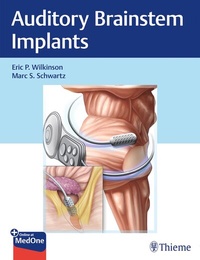
Auditory Brainstem Implants
Description

Unique textbook explores current and future applications of auditory brain implants
Research on the auditory brainstem implant (ABI) has evolved from a highly specialized, narrow field to one involving a wide spectrum of disciplines. Neurotologists, audiologists, otolaryngologists, and neurosurgeons are on the front lines of treatment, while many other specialists play active roles. Auditory Brainstem Implants by renowned ABI experts Eric P. Wilkinson and Marc S. Schwartz is the first dedicated book on ABIs published to date. The state-of-the-art monograph brings together a rich array of materials and resources from an impressive group of pioneering clinicians from around the world.
The text starts with introductory chapters encompassing the history and development of ABIs; relevant neuroanatomy and physiology; imaging of the cochlea, cochlear nerve, brainstem, and auditory system; and clinical indications for ABIs. Surgical chapters detail translabyrinthine, retrosigmoid, and retrolabyrinthine approaches, pediatric applications, auditory midbrain implants, device-specific engineering, and intraoperative monitoring. Auditory testing, performance variables, and results are also reviewed. The final chapters focus on innovative future directions, such as penetrating multisite microelectrodes and the use of optogenetics.
Key Highlights
- In-depth analyses and overviews enable clinicians from different disciplines to expand their armamentarium and solidify current areas of expertise
- Unique material on the relevant neuroanatomy of brainstem implants improves understanding of ABI challenges and outcomes
- Description of ABI results in tone languages demonstrates applications in special populations
- Pediatric topics including evaluation and surgery and implant outcomes from the Hacettepe University team provide invaluable treatment pearls
- Insightful perspectives on programming, rehabilitation, and outcome assessment in adults enhance knowledge
Trainee and practicing otolaryngologists, neurosurgeons, neurologists, audiologists, and speech pathologists will benefit from reading this comprehensive ABI resource, either cover-to-cover or by consulting specific chapters.
This book includes complimentary access to a digital copy on https://medone.thieme.com.
More details
Other editions
Additional editions
Content
1 The History and Development of Auditory Brainstem Implants
2 Neuroanatomy and Physiology Relevant to Auditory Brainstem Implants
3 Imaging of the Cochlea, Cochlear Nerve, Brainstem, and Auditory System
4 Clinical Indications for ABI: Patient Selection and Alternatives
5 Surgery for ABI: The Translabyrinthine Approach
6 The Retrosigmoid Approach in Auditory Brainstem Implantation
7 Surgery for ABI: Retrolabyrinthine Approach
8 Auditory Brainstem Implantation in Children: Evaluation and Surgery
9 Pediatric Auditory Brainstem Implantation: Colletti Team Experience and Special Considerations
10 ABI Engineering and Intraoperative Monitoring: Cochlear
11 ABI Engineering and Intraoperative Monitoring: MED-EL
12 Programming, Rehabilitation, and Outcome Assessment for Adults: I
13 Programming, Rehabilitation, and Outcome Assessment for Adults: II
14 Outcomes in Pediatric ABI: The Hacettepe University Experience
15 Auditory Brainstem Implantation in Tone Language Speakers
16 Variability in Performance of Auditory Brainstem Implants
17 ABI Program Development
18 Auditory Midbrain Implant
19 Future Development: Penetrating Multisite Microelectrodes as Cochlear Nucleus Implant
20 Future Developments: Conformable ABI Arrays and Light Stimulation of Auditory Brainstem Using Optogenetics
