

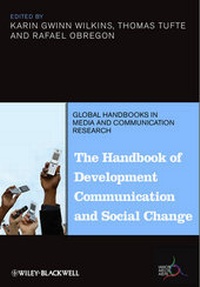
The Handbook of Development Communication and Social Change
Description

Reviews / Votes
"As a whole, this collection provides an international perspective on development communication and social change, making it a strong addition to courses on activist rhetoric, development communication, and international communication." (Technical Communication, 1 February 2015) "This handbook is a unique tool to profoundly understand thestrategic use of communication for social justice. It closescritical gaps and articulates previous traditions. The editors havebrought together a truly impressive collection of original textsand have opened new directions for the field." -Helena Sousa, University of Minho "A weakness of literature on development communication is itsdivision into streams with separate, partly artificial niches. Thisbook brings the approaches together. It not only gives an overviewof the field but it creates an integrated conceptual frameworktoward understanding communication, media, development,participation and social change." - UllamaijaKivikuru, Helsinki University "Professor Wilkins, Tufte and Obregon's edited handbookprovides a comprehensive and critical assessment of the many rolesthat communication - both theory and practice- has played indevelopment and social change over the past 60 years. It will be aninvaluable resource for development communication specialists andscholars, and for anyone committed to advancing the rights andopportunities of historically neglected or oppressedcommunities." - John Mayo, Florida StateUniversityMore details
Other editions
Additional editions

Persons
Content
Notes on Contributors
Rosa Maria Alfaro Moreno is Professor of Communication at the Universidad de Lima, Peru. Founder (in 1983) and former director of the Association of Social Communicators, “Calandria,” and founder of the Civic Observatory of Social Communication, she has also authored or edited 10 books and contributed numerous articles in communication and development issues.
Tina Askanius works in the Department of Communication and Media at Lund University. Her research concerns social movement media practices, with a particular focus on contemporary forms of video activism in online environments. Her recent work within this area has been published in international journals such as Research in Social Movements, Conflict and Change and Interface: A journal for and about social movements.
Antje Becker-Benton has led a global SBCC portfolio as Deputy Director of C-Change at FHI360. Over the past 17 years, she has designed health communication programs with key affected youth and adult populations in multiple countries in East and Southern Africa for CCP, FHI360, and GTZ. Her publications include “Guide to Community Health Communication” (GTZ 1997), Strategic Communication in the HIV/AIDS Epidemic (Sage 2004) and “Communication and the antiretroviral treatment rollout” in AIDS Education and Prevention (2009).
Emily Bockh has managed over eight years of experience in international health communication. She manages SBCC activities and contributed to the development, testing, and implementation of tools and curricula including the C-Modules and other research reports for C-Change. She has also provided technical and operational support to programs in sub-Saharan Africa, the Caribbean, and Pakistan.
Tanja Bosch is a lecturer and researcher in the Centre for Film and Media Studies at the University of Cape Town, South Africa. She teaches radio journalism, health communication, and qualitative research methods. Her areas of research and publication include talk radio, community media, and youth and gendered uses of mobile media and online social networks.
Colin Tinei Chasi is Senior Lecturer and Head of Communication Studies, University of Johannesburg. He works on philosophical aspects of communication that concern health and development.
James Deane is Director of Policy and Learning at BBC Media Action. This article is written in his personal capacity and should not necessarily be taken to reflect the views of BBC Media Action.
John D.H. Downing is professor emeritus and founding director of the Global Media Research Center in the College of Mass Communication and Media Arts, Southern Illinois University. His books include Radical Media (1984/2001), Internationalizing Media Theory (1996), Representing “Race” (2005, with Charles Husband) and the Sage Encyclopedia of Social Movement Media (2010).
Daniel Enger coordinates the Scenarios from Africa HIV communication process for the British non-profit organization Global Dialogues. Scenarios from Africa involves the production of short fiction films on HIV-related themes by leading African directors. The films are based on winning ideas contributed by young Africans to continent-wide scriptwriting contests.
Ana Fernández Viso works in the Institute of Communication at the Autonomous University of Barcelona in Spain. Her research interests include citizen journalism, community development, and communication for development and social change.
Alfonso Gumucio-Dagron is a writer, filmmaker, journalist, photographer, and development communication specialist. He is the author of several books on film and communication for social change, as well as documentary films, photographic exhibits, and hundreds of articles in journals. He has worked in five continents on social development projects, as a communication for development specialist.
Cees J. Hamelink is Emeritus Professor of International Communication at the University of Amsterdam. He is currently Professor for Technology and Information Management at the University of Aruba, and Professor of Human Rights and Public Health at the Vrije Universiteit of Amsterdam. He is also the editor-in-chief of the International Communication Gazette and Honorary President of the International Association for Media and Communication Research. He is author of 17 monographs on communication, culture, and human rights. Professor Hamelink has received lifetime achievement awards from various international organizations and has been a consultant to many national governments and agencies in the UN system.
Anastasia Kavada is Senior Lecturer at the Department of Journalism and Mass Communication at the University of Westminster. Her research concerns the use of new communication technologies, such as email lists and social media, by protest movements and advocacy groups. Her work has appeared in a variety of edited books and academic journals, including Media, Culture & Society and Information, Communication & Society.
David Kerr is a lecturer and author on African theater and media. He has taught at the Universities of Malawi, Zambia, and Botswana. He is the author of African Popular Theatre from Pre-Colonial to Modern Times (Heinemann, 1995) and Dance, Media Entertainment and Popular Theatre in South East Africa (Bayreuth University Press, 1997), and has directed numerous productions.
Joe F. Khalil is an associate professor in residence at Northwestern University and a leading expert on Arab television. He is author of a monograph on Arab satellite entertainment television and co-author of Arab Television Industries. Khalil’s scholarly interests revolve specifically around Arab youth, alternative media, and global media industries.
June Lennie is Senior Research Associate at RMIT University, educated at the Queensland University of Technology.
Emile G. McAnany is a professor at Santa Clara University in California. His work in communication and social change spans four decades and his publications include the recent Saving the World (2012) in addition to Mass Media and Free Trade (1996) and seven other books. He has focused much of his research on Latin America.
Neill McKee was the Director of C-Change at FHI360 and a communication specialist with 35 years of experience in international development, working for CUSO, IDRC, UNICEF, and CCP. He developed the Meena Communication Initiative for the South Asian girl child and is the author of Social Mobilization and Social Marketing in Developing Communities (1992), co-editor and co-author of Involving People, Evolving Behavior (2000), and co-author of Strategic Communication in the HIV/AIDS Epidemic (Sage, 2004).
Toby Miller is Distinguished Professor of Media and Cultural Studies at the University of California, Riverside. You can follow his adventures at www.tobymiller.org.
Ana María Miralles is a professor at the School of Social Science, Universidad Pontificia Bolivariana (Medellín, Colombia). She has written several books, including: Voces Ciudadanas, Una idea de periodismo público (2000), Periodismo, opinión pública y agenda ciudadana (2001), Comunicación para el desarrollo urbano (2004), Periodismo Público en la gestión del riesgo (2009), and El miedo al disenso (2011).
Rafael Obregon is Chief of the Communication for Development Section, United Nations Children’s Fund, New York, and has extensive teaching, research, and professional experience in development and health communication and in international development. He is a member of the review board of several journals, including the Journal of Health Communication, and serves as guest reviewer of Social Science Medicine, Health Policy Journal, and Biomedcentral. He is also a member of several international associations, including the International Communication Association, and has published numerous books, peer-reviewed journal articles, book chapters, and technical reports, including The Handbook of Global Health Communication (2012), co-edited with Silvio Waisbord.
James Pamment is currently a Post-Doctoral Fellow at the University of Texas at Austin. He is also Assistant Professor of Media and Communication Studies at Karlstad University, Sweden. His research is primarily in the fields of public diplomacy and international development, with a focus on the relationship between policy, organization, and accountability. He is the author of New Public Diplomacy in the 21st Century: A Comparative Study of Policy and Practice (Routledge New Diplomacy Studies, 2012) and has published in journals such as The Hague Journal of Diplomacy and the Journal of Place Branding and Public Diplomacy. He holds a PhD from Stockholm University (2011). This research was conducted with the support of a grant from the Swedish Research Council, dnr 350-2012-343.
Clemencia Rodríguez is a professor in the Department of Communication at the University of Oklahoma. Her books include Citizens’ Media Against Armed Conflict: Disrupting Violence in Colombia (2011) and Fissures in the Mediascape: An International Study of Citizens’ Media (2001)
Jo Tacchi...
