

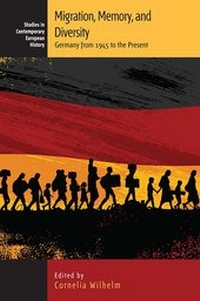
Migration, Memory, and Diversity
Germany from 1945 to the Present
1st Edition
Published on 1. November 2016
366 pages
978-1-78533-328-6 (ISBN)
Description

Within Germany, policies and cultural attitudes toward migrants have been profoundly shaped by the difficult legacies of the Second World War and its aftermath. This wide-ranging volume explores the complex history of migration and diversity in Germany from 1945 to today, showing how conceptions of "otherness" developed while memories of the Nazi era were still fresh, and identifying the continuities and transformations they exhibited through the Cold War and reunification. It provides invaluable context for understanding contemporary Germany's unique role within regional politics at a time when an unprecedented influx of immigrants and refugees present the European community with a significant challenge.
Reviews / Votes
"All contributions are of a high quality. Moreover, far from being niche studies, none of the 12 essays in the volume loses sight of its broader signi?cance. To the contrary, every author endeavours to tie their research to the big historical picture: the legacy of Nazi racial policy, the mass displacements of peoples in the war and postwar years, the use of migration and refugee policy in the service of Cold War propaganda, the recalibration of notions of 'Germanness' after 1990, and the 'Europeanisation' of migration questions over the past 30 years... While much of its content will already be familiar to scholars in the ?eld, the questions it poses and the research; directions it suggests should prove a very useful starting point for further study into Germany's inter- actions with Europe and the world." * Journal of Contemporary History"One of the greatest accomplishments of the volume is certainly that it diversifies Germany's migration history while simultaneously putting it into perspective both synchronically and diachronically. In addition, the volume has the merit of including immobility in the exploration of migration. Last but not least, it points out blind spots in the exploration of Germany's migration history and opens perspectives for future research." * German History
"Wilhelm's carefully assembled volume offers impressive and fresh overviews of postwar German history...an overall excellent contribution to the history of migration and diversity in Germany. Surely not only historians will welcome Wilhelm's fine collection." * Contemporary Austrian Studies
"There is a lot to like about this book, which offers a nice mix of American and German scholars who approach their topics from a range of perspectives. It provides useful scholarly material for specialists while offering an effective introduction for students seeking to deepen their understanding of these topics." * Adam R. Seipp, Texas A&M University
More details
Series
Language
English
Place of publication
Oxford
United Kingdom
Target group
Professional and scholarly
Illustrations
Bibliography; Index; 1 Illustrations
ISBN-13
978-1-78533-328-6 (9781785333286)
DOI
10.3167/9781785333279
Copyright in bibliographic data and cover images is held by Nielsen Book Services Limited or by the publishers or by their respective licensors: all rights reserved.
Schweitzer Classification
Other editions
Additional editions
Book
06/2018
1st Edition
Berghahn Books
€47.70
Shipment within 3-4 weeks
Book
11/2016
1st Edition
Berghahn Books
€163.80
Shipment within 3-4 weeks
Person
Cornelia Wilhelm is currently professor of modern history at Ludwig-Maximilians-Universitaet, Munich. From 2010 to 2016 she has been DAAD Visiting Professor in the Department of History and the Jewish Studies Program at Emory University in Atlanta and had also held visiting positions at Rutgers University, New Brunswick, and Leopold-Franzens-University of Innsbruck, Austria. She is author of Bewegung oder Verein? Nationalsozialistische Volkstumspokitik in den USA (1998); and Deutsche Juden in America: Buergerliches Selbstbewusstsein und Juedische Identitaet in den Orden B'nai B'rith und True Sisters (2007), also published in English translation (2011). She is currently working on an in-depth study on German refugee rabbis in the United States after 1933.
Content
Acknowledgements
Preface
Konrad H. Jarausch
Introduction: Migration, Memory, and Diversity in Germany after 1945
Cornelia Wilhelm
PART I: POSTWAR MIGRATIONS: HISTORY, MEMORY, AND DIVERSITY
Chapter 1. The Commemoration of Forced Migrations in Germany
Martin Schulze-Wessel
Chapter 2. A Missing Narrative: Displaced Persons in the History of Postwar ?West Germany
Anna Holian
Chapter 3. Inclusion and Exclusion of Immigrants and the Politics of Labeling: ?Thinking Beyond "Guest Workers," "Ethnic German Resettlers," "Refugees ?of the European Crisis," and "Poverty Migration"
Asiye Kaya
Chapter 4. Refugee Reports: Asylum and Mass Media in Divided Germany during the ?Cold War and Beyond
Patrice G. Poutrus
PART II: INSTITUTIONAL RESPONSES TO MIGRATION AND CULTURAL DIFFERENCE
Chapter 5. History, Memory, and Symbolic Boundaries in the Federal Republic of ?Germany: Migrants and Migration in School History Textbooks
Simone Laessig
Chapter 6. Representations of Immigration and Emigration in Germany's Historic ?Museums
Katharzyna Nogueira and Dietmar Osses
Chapter 7. Archival Collections and the Study of Migration
Klaus A. Lankheit
Chapter 8. Thinking Difference in Postwar Germany: Some Epistemological Obstacles ?around "Race"
Rita Chin
PART III: RECONSIDERING HISTORY, MEMORY, AND IDENTITY IN THE POSTUNIFICATION PERIOD
Chapter 9. Nationalism and Citizenship during the Passage from the Postwar ?to the Post-Postwar
Dietmar Schirmer
Chapter 10. Learning to Live with the Other Germany in the Post-Wall Federal Republic
Kathrin Bower
Chapter 11. Conflicting Memories, Conflicting Identities: Russian Jewish Immigration ?and the Image of a New German Jewry
Karen Koerber
Chapter 12. Swept Under the Rug: Home-grown Anti-Semitism and Migrants as ?"Obstacles" in German Holocaust Remembrance
Annette Seidel-Arpaci
Afterword: Structures and Larger Context of Political Change in Migration and Integration Policy: Germany between Normalization and Europeanization
Holger Kolb
Index
Preface
Konrad H. Jarausch
Introduction: Migration, Memory, and Diversity in Germany after 1945
Cornelia Wilhelm
PART I: POSTWAR MIGRATIONS: HISTORY, MEMORY, AND DIVERSITY
Chapter 1. The Commemoration of Forced Migrations in Germany
Martin Schulze-Wessel
Chapter 2. A Missing Narrative: Displaced Persons in the History of Postwar ?West Germany
Anna Holian
Chapter 3. Inclusion and Exclusion of Immigrants and the Politics of Labeling: ?Thinking Beyond "Guest Workers," "Ethnic German Resettlers," "Refugees ?of the European Crisis," and "Poverty Migration"
Asiye Kaya
Chapter 4. Refugee Reports: Asylum and Mass Media in Divided Germany during the ?Cold War and Beyond
Patrice G. Poutrus
PART II: INSTITUTIONAL RESPONSES TO MIGRATION AND CULTURAL DIFFERENCE
Chapter 5. History, Memory, and Symbolic Boundaries in the Federal Republic of ?Germany: Migrants and Migration in School History Textbooks
Simone Laessig
Chapter 6. Representations of Immigration and Emigration in Germany's Historic ?Museums
Katharzyna Nogueira and Dietmar Osses
Chapter 7. Archival Collections and the Study of Migration
Klaus A. Lankheit
Chapter 8. Thinking Difference in Postwar Germany: Some Epistemological Obstacles ?around "Race"
Rita Chin
PART III: RECONSIDERING HISTORY, MEMORY, AND IDENTITY IN THE POSTUNIFICATION PERIOD
Chapter 9. Nationalism and Citizenship during the Passage from the Postwar ?to the Post-Postwar
Dietmar Schirmer
Chapter 10. Learning to Live with the Other Germany in the Post-Wall Federal Republic
Kathrin Bower
Chapter 11. Conflicting Memories, Conflicting Identities: Russian Jewish Immigration ?and the Image of a New German Jewry
Karen Koerber
Chapter 12. Swept Under the Rug: Home-grown Anti-Semitism and Migrants as ?"Obstacles" in German Holocaust Remembrance
Annette Seidel-Arpaci
Afterword: Structures and Larger Context of Political Change in Migration and Integration Policy: Germany between Normalization and Europeanization
Holger Kolb
Index
