

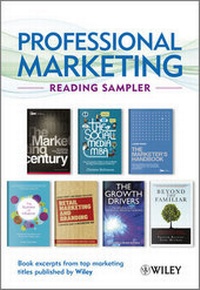
Professional Marketing Reading Sampler
Description

This Professional Marketing Reading Sampler includes bookexcerpts for a taste of our top marketing titlesfrom the following expert authors: Andy Bird, MhairiMcEwan, Philip Sheldrake, Laurie Young, The CIM, Jeremy Kourdi,Christer Holloman, Patrick Barwise, Sean Meehan, Jesko Perrey andDennis Spillecke"
More details
Other editions
Additional editions

Content
- Cover
- Copyright page
- The Growth Drivers
- Table of Contents
- Part 1: Understanding the Growth Drivers
- Chapter 1: THE GROWTH CHALLENGE
- What is Marketing?
- The Marketing Capability Challenge
- Why Growth Matters
- The Role of Marketing
- The Role of Marketers
- Key Marketing Challenges
- The Role of Marketing Capabilities
- The Social Media MBA
- Table of Contents
- Part I: Foundation
- Chapter 1: QUICK RECAP
- In short
- Overview
- 1. Recognize change
- 2. Make a deal with your employees to eliminate FUD
- 3. Be where your customers are
- 4. Listen
- 5. Permit not prohibit
- Roundup
- The Business of Influence
- Table of contents
- 1: WHERE WE ARE TODAY
- The Cluetrain and Permission Marketing
- Marketing and public relations
- Integrated marketing communications
- Summary
- THE MARKETING CENTURY
- Table of contents
- Chapter 1: STRATEGIC MARKETING
- The past is . past
- The fallacy of short-term thinking
- Beyond the Familiar
- Table of contents
- CHAPTER ONE: WHAT EVERY CEO WANTS
- Retail Marketing and Branding
- Table of contents
- Part I: Building Superior Retail Brands
- CHAPTER 1: PRINCIPLES OF SUCCESSFUL BRAND MANAGEMENT: ART - SCIENCE - CRAFT
- It takes three elements to build and sustain a strong brand in retail: art, science and craft
- The art is about balancing creativity with consistency to endow a brand with an emotional appeal that builds on its heritage
- There is more to strong brands than awareness: the science is in measuring a brand's strengths and weaknesses across the entire purchase funnel
- The craft is about bringing the essence of the brand to life at all touch points
- The Marketer's Handbook
- Table of contents
- A
- AAR MODEL
- ACCOUNT MANAGEMENT
- ADVERTISING
- "AIDA"
- ANSOFF AND HIS MATRIX
- AUDIT (THE MARKET AUDIT)
Chapter 1
QUICK RECAP
Neville Hobson
In Short
- Why social media isn’t about different websites, but people.
- How to recognize need for change.
- What to listen out for before speaking.
Overview
In this chapter London-based Neville Hobson – early adopter, opinion-leader and influencer in social media communication for business – will discuss how introducing social media into an organization means change. Change in the way everyone understands how the organization works. Social media is disruptive, challenging established orders, hierarchies and cultures. You can’t stop disruption, but you can harness it and make its introduction a less painful process than it may seem. You need to find a new way of looking at your organization and how you can get things done.
With all the talk you hear about Facebook, Twitter, YouTube, LinkedIn, Google+ and other social places online – you name it, people talk about it when they mention social media – it wouldn’t be too much of a surprise to think that social media is all about Facebook, Twitter and the like.
Social media isn’t about the tools and the channels – the software or the technology.Yet it’s not. Social media isn’t about the tools and the channels – the software or the technology. It’s all about what people do with the technology, the software, the tools and the channels: sharing pictures and video, writing product reviews, collecting content, connecting with old friends, sharing with new friends, collaborating in the workplace.
Social media is a collective term that describes the means of communicating and engaging with people. It’s something many people see as evolutionary, if not revolutionary, in helping people connect with each other in ways that are genuine, authentic and natural.
However you see it, social media usage is increasing rapidly and dramatically in all levels of society and in more countries around the world. And businesses of all shapes and sizes are embracing it.
Introducing social media into an organization usually means change: change in the way everyone understands how the organization works. It often means change in the ways people relate to and connect with others, inside and outside the organization. And change in their roles and responsibilities where what had seemed clear to everyone perhaps isn’t any more.
For the organization, social media can be hugely disruptive, challenging established orders, hierarchies and cultures. You can’t stop disruption, but you can embrace it and make the introduction of a new way of doing things a less painful process than it may initially seem.
The benefits of taking a calculated risk to embrace social media as a legitimate business tool are clear and compelling to many companies who have taken the first steps.The benefits of taking a calculated risk to embrace social media as a legitimate business tool are clear and compelling to many companies who have taken the first steps. For them, social media today is an integral element in their marketing, public relations and overall approach to building business relationships.
The key word is calculated. The stakes are high: everything you do should be considered against objectives you can measure. You need to see a new way of looking at your organization and the people it comprises, and create the environment that lets them get things done effectively and with confidence.
Following are five tips to point the way.
1. Recognize Change
The web is rapidly evolving and is having a big impact on millions of people’s behaviours in countries around the world. Little more than a decade ago, all you could really do was read static content on websites. Today, you can create rich and interactive content on websites from anywhere in the world where there’s a network connection, on almost any kind of device, wired or wireless. Anyone can do this, not just the big companies of the past decade.
This society-level change means we’re seeing disruption to traditional business models and new ideas springing up on how people want to communicate and connect using social media – the new tools of the web – whether for personal interests or to get things done at work.
From giving a concise opinion on Twitter, checking in on Foursquare, to saying “Like” on Facebook, there is a dramatic shift in people’s behaviours, which manifests itself in the changes in how we communicate online, with whom, where we do it and when.
Another way of looking at it is to consider changes in our social structures in which easier technology puts power in the hands of individuals and communities instead of only organizations and institutions.
Why should we care? Because social media is changing how marketing and communication works and how people want to connect with brands.Why should we care? Because social media is changing how marketing and communication works and how people want to connect with brands. It presents an organization with an affordable way to get measurable results quickly when it’s employed effectively. It’s rapidly growing, and customers turn to their peers for answers increasingly using social networks and other online tools and channels – precisely the places where today’s organization needs to be present, too, in the right way.
It’s an unmistakable trend. You only need to look around you to see it happening right in front of your eyes.
2. Make a Deal with Your Employees to Eliminate FUD
What often holds organizations back from introducing any aspect of social media – whether it’s a single public blog, uploading video to YouTube or creating a brand page on Facebook or Google+ – are fear, uncertainty and doubt:
- Fear of perceived security risks in allowing employees access to social media tools and channels: “What if someone stole our secrets or released them without permission, or brought a virus into our network?”
- Uncertainty over the effects of losing control: “Isn’t there a huge risk that employees will say something they shouldn’t if we don’t monitor what they’re allowed to do?”
- Doubt over productivity: “Surely it increases the chances for employees to waste time?”
While you can learn from examples of how other organizations have addressed such concerns – just Google the phrase “concerns about social media” – you can also cut to the chase and begin your calculated risk assessment by starting with creating a climate of trust with your employees.
Such a contemporary approach in the workplace sees employer and employee in a partnership where, through the establishment of trust and mutual respect over time, each partner recognizes the critical stake the other has in the organization’s success and how enabling employees, with effective tools, to engage with others online can measurably benefit the organization and support its business goals.
A key component of the climate of trust is helping everyone understand what the rules of engagement are – in essence, what’s permitted and what’s not when employees reach out to others via social channels – as well as an ongoing education framework where employees have access to formal and informal learning opportunities to help them gain knowledge of and confidence in the tools and channels available to them.
Developing policies and guidelines are key building blocks in your engagement planning, and demonstrate your willingness as the employer to foster a trust climate, especially when development is carried out jointly rather than only via the traditional employer-to-employee cascade system.
None of these essential foundational activities as elements in your overall risk assessment will actually eliminate the perceived risks associated with letting go of control. What they can do is eliminate the FUD.
3. Be Where Your Customers are
Engaging with customers on their terms, not yours, is a prerequisite for building genuine and sustainable online relationships. The days are long gone when a primary marketing goal was to make your website “sticky”, where visitors came to your site and didn’t leave. Nowadays, the goal is to offer your visitors content they will value – even if that content is at places other than yours.
What consumers want are honesty, transparency and authenticity.What consumers want are honesty, transparency and authenticity. For companies, this means having a genuine and open personality, one that reflects today’s new consumer values. Therefore, the people in the company must be visible and engaged with people outside the company, talking with customers in their own genuine and individual voices.
Research shows that customers typically like to do three things online:
1. Share ideas – “Let’s improve the next product or service together.” 2. Share product knowledge – “Here is what I know … I hope it helps you.” 3. Help peers with problems – “I had the same problem, here is what I did.”Many...
