

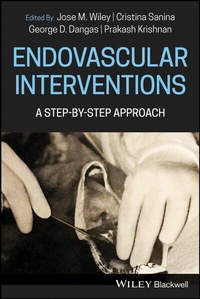
Endovascular Interventions
A Step-by-Step Approach
1st Edition
Published on 11. July 2023
272 pages
978-1-119-46784-7 (ISBN)
Description

ENDOVASCULAR INTERVENTIONS
A practical and systematic approach to current endovascular surgical techniques
An increasingly popular alternative to open vascular surgery, endovascular intervention offers many advantages, including reduced patient discomfort, smaller incisions, shorter recovery time, and decreased risk of adverse complications. Practitioners and trainees alike require expert guidance on current technologies and up-to-date techniques. Endovascular Interventions provides clinicians with an easy-to-follow guide for minimally invasive treatment of vascular disease. This invaluable resource delivers concise and accurate instructions on a wide range of endovascular interventions, including aorta, renal and mesenteric interventions, lower extremity interventions, venous interventions, and supra-aortic interventions in high-risk patients.
Sequential phases of skill development broaden the reader's abilities as they progress through each chapter, supplying step-by-step instructions on when each procedure should be used and how it can be safely and effectively performed. This book offers a complete reference to essential techniques and procedures, suitable for both novice and experienced vascular surgeons, cardiologists, and radiologists. Endovascular Interventions also:
* Reinforces comprehension of each procedure with templated chapters, equipment lists and boxed key learning points
* Provides full-color clinical images and detailed illustrations to demonstrate surgical procedures
* Presents authoritative coverage of modern endovascular technologies and techniques
* Written by a team of respected experts and practicing surgeons from internationally recognized hospitals and universities
Suitable for varying skill levels, Endovascular Interventions is a precise, accessible instruction manual for safe and effective endovascular intervention, helping practicing clinicians sharpen their existing abilities and keep pace with the latest surgical technologies while instructing trainees on this innovative approach to vascular surgery.
A practical and systematic approach to current endovascular surgical techniques
An increasingly popular alternative to open vascular surgery, endovascular intervention offers many advantages, including reduced patient discomfort, smaller incisions, shorter recovery time, and decreased risk of adverse complications. Practitioners and trainees alike require expert guidance on current technologies and up-to-date techniques. Endovascular Interventions provides clinicians with an easy-to-follow guide for minimally invasive treatment of vascular disease. This invaluable resource delivers concise and accurate instructions on a wide range of endovascular interventions, including aorta, renal and mesenteric interventions, lower extremity interventions, venous interventions, and supra-aortic interventions in high-risk patients.
Sequential phases of skill development broaden the reader's abilities as they progress through each chapter, supplying step-by-step instructions on when each procedure should be used and how it can be safely and effectively performed. This book offers a complete reference to essential techniques and procedures, suitable for both novice and experienced vascular surgeons, cardiologists, and radiologists. Endovascular Interventions also:
* Reinforces comprehension of each procedure with templated chapters, equipment lists and boxed key learning points
* Provides full-color clinical images and detailed illustrations to demonstrate surgical procedures
* Presents authoritative coverage of modern endovascular technologies and techniques
* Written by a team of respected experts and practicing surgeons from internationally recognized hospitals and universities
Suitable for varying skill levels, Endovascular Interventions is a precise, accessible instruction manual for safe and effective endovascular intervention, helping practicing clinicians sharpen their existing abilities and keep pace with the latest surgical technologies while instructing trainees on this innovative approach to vascular surgery.
More details
Other editions
Additional editions
Book
02/2023
1st Edition
Wiley-Blackwell
€120.50
Shipment within 15-20 days
Persons
Jose M. Wiley, MD, MPH, Sidney W. and Marilyn S. Lassen Chair in Cardiovascular Medicine, Professor of Medicine, Chief, Section of Cardiology, John W. Deming Department of Medicine, Tulane University School of Medicine, New Orleans, LA, USA.
Cristina Sanina, MD, Interventional Cardiology Fellow, Beth Israel Deaconess Medical Center, Harvard Medical School, Boston, MA, USA.
George D. Dangas, MD, PhD, Professor of Medicine-Cardiology and Vascular Surgery, Director of Cardiovascular Innovation, Icahn School of Medicine at Mount Sinai, New York, NY, USA.
Prakash Krishnan, MD, Professor of Medicine-Cardiology, Director of Endovascular Services, Icahn School of Medicine at Mount Sinai, New York, NY, USA.
Cristina Sanina, MD, Interventional Cardiology Fellow, Beth Israel Deaconess Medical Center, Harvard Medical School, Boston, MA, USA.
George D. Dangas, MD, PhD, Professor of Medicine-Cardiology and Vascular Surgery, Director of Cardiovascular Innovation, Icahn School of Medicine at Mount Sinai, New York, NY, USA.
Prakash Krishnan, MD, Professor of Medicine-Cardiology, Director of Endovascular Services, Icahn School of Medicine at Mount Sinai, New York, NY, USA.
Content
- Cover
- Title Page
- Copyright Page
- Contents
- List of Contributors
- Chapter 1 Innominate & Carotid Artery Intervention in High-Risk Patients
- Introduction
- Innominate Interventions in High-Risk Patients
- Catheter-based Therapy for An Innominate (Brachiocephalic) Stenosis
- Carotid Artery Intervention in High-Risk Patients
- Endovascular Treatment of A Carotid Stenosis
- Catheter-based Therapy for Carotid Stenosis
- Conclusions
- References
- Chapter 2 Subclavian Artery Intervention: Catheter-Based Therapy
- Introduction
- Endovascular Versus Open Surgical Revascularization
- Endovascular Revascularization Techniques
- Conclusion
- References
- Chapter 3 Vertebral Artery Intervention: Catheter-Based Therapy
- Introduction
- Preprocedural Considerations
- Step 1. Procedural Planning with Diagnostic Angiography
- Step 2. Vertebral Artery Intervention (Percutaneous Transluminal Angioplasty)
- Step 3. Vertebral Artery Intervention (Stenting)
- Management of Potential Complications
- Postprocedural Care
- References
- Chapter 4 Endovascular Repair of Thoracic Aortic Aneurysms: Catheter-Based Therapy
- Introduction
- Relevant Anatomy
- Aortic Anatomy
- Crawford Classification for TAA/TAAA
- Landing Zones (Figure 4.1)
- Indications/Contraindications to Procedure
- Indications
- Contraindications/Caveats
- Available Endografts
- Preoperative Evaluation
- Positioning and Intraoperative Monitoring Needs
- Procedural Steps
- Postoperative Course/Surveillance
- Monitored Setting
- Spinal Drain
- Blood Pressure Control
- Arm Ischemia Symptoms
- CTA Surveillance/Endoleak Types
- References
- Chapter 5 Endovascular Abdominal Aortic Aneurysm Repair (EVAR)
- Introduction
- Patient Selection
- Preoperative Imaging and Measurements
- Graft Selection
- Graft Sizing
- Neck Length
- Neck Diameter
- Branch Vessels
- Aortic Length Measurements
- Step 1. Vascular Access
- Percutaneous
- Open
- Iliac Disease and Conduits
- Step 2. Imaging
- Equipment
- Neck Angulation
- Renal Arteries
- Step 3. Wires
- Step 4. Delivery and Deployment
- Main Body
- Contralateral Gate Cannulation
- Limb Deployment
- Completion Angiogram
- Step 5. Troubleshooting
- Endoleaks
- Inadvertent Coverage of Renal Arteries
- Iliac Artery Considerations
- Conclusion
- References
- Chapter 6 Severe Renal Artery Stenosis: How to Intervene
- Introduction
- Background and Clinical Significance
- Epidemiology
- Clinical Manifestations
- Patient Selection: Who to Screen for RAS
- RAS Assessment
- Noninvasive RAS Assessment
- Invasive RAS Assessment
- Indications for Revascularization
- Intervention
- References
- Chapter 7 Mesenteric Ischemia: Chronic and Acute Management
- Introduction
- Chronic Mesenteric Ischemia
- Step 1. Vascular Access and Sheath Selection
- Step 2. Diagnostic Angiography
- Step 3. Vessel Selection
- Step 4. Selective Angiography
- Step 5. Placement of a Working Wire
- Step 6. Stent Placement
- Step 7. Posttreatment Angiography
- Step 8. Revision
- Complications
- Follow-Up and Outcomes
- Acute Mesenteric Ischemia
- Step 1. Arterial Vascular Access and Sheath Selection
- Step 2. Selection of the SMA
- Step 3. Aspiration Embolectomy
- Step 4. Angiogram
- Step 5. Thrombolysis
- Step 6. Infusion and Follow-Up
- Mesenteric Venous Thrombosis
- Follow-Up and Outcomes
- References
- Chapter 8 Aorto-Iliac Interventions
- Introduction
- Preoperative Workup
- Noninvasive Studies
- Computed Tomographic Angiography
- Ultrasound Duplex
- Magnetic Resonance Angiography
- Invasive Imaging
- Angiography
- Classification of Lesion and Planning of Intervention
- TransAtlantic InterSociety Consensus II Classification (TASC II)
- Planning for the Intervention
- Step 1. Patient Factors
- Step 2. Vascular Access
- Step 3. Crossing the Lesion
- Step 4. Intervention
- Step 5. Closure
- Step 6. Complications
- Rupture
- Embolization
- Access Complications
- Cases
- Case 1
- Case 2
- References
- Chapter 9 Femoropopliteal Arterial Interventions in the Claudicant
- Introduction
- Patient Evaluation and Indications for Treatment of Femoropopliteal Arterial Pathology
- Indications for Revascularization Femoropopliteal Claudication
- Vascular Imaging in Endovascular Treatment
- Contrast Angiography
- CO2 Angiography
- Extravascular and Intravascular Ultrasound
- Vascular Access and Lesion Crossing Techniques
- Steps for Crossover "Up and Over" technique
- Radial
- Tibio-Pedal Approach
- Antegrade Femoral Access
- Working Wire Size and Changing Between Systems
- Lesion Preparation
- Atherectomy
- Directional Atherectomy
- Orbital Atherectomy
- Embolic Protection
- Troubleshooting Embolic Protection Devices
- Stenting for Femoropopliteal Disease
- Alternative Stent Technologies
- Conclusions
- Acknowledgments
- References
- Chapter 10 Tibial Interventions in Patients with Critical Limb-Threatening Ischemia
- Introduction
- Indications and Goals of Endovascular Revascularization
- Considerations for Access Site
- Single Versus Multitibial Artery Revascularization
- Antegrade Tibial Artery Intervention
- Retrograde Access for Retrograde Lesion Crossing and Wire Externalization with Antegrade Revascularization
- TAMI Retrograde Revascularization
- Reentry and Externalization Devices
- Deep Venous Arterialization (DVA)
- References
- Chapter 11 Acute Limb Ischemia: Endovascular Approach
- Introduction
- Procedure Planning, Equipment, and Considerations
- References
- Chapter 12 Pedal Reconstruction
- Introduction
- Pedal Arch Reconstruction
- Indications for Pedal Revascularization
- Technical Considerations
- Access
- Lesion Crossing
- CTO Lesion Subtype
- Special Considerations of the Pedal Intervention
- Troubleshooting
- Summary
- References
- Chapter 13 Endovascular Management of Access Site Complications
- Introduction
- Complications Related to Common Femoral Artery Access
- Access Site Bleeding
- Crossover Technique
- Balloon Tamponade, Endovascular Coiling, and Covered Stent Placement
- Femoral Pseudoaneurysms
- Ultrasound-Guided Compression Repair
- Ultrasound-Guided Thrombin Injection
- Covered Stent Placement
- Other Techniques
- Arteriovenous Fistulas
- Vascular Closure Device Related Complications
- Radial Artery Related Complications
- Radial Artery Spasm
- Radial Artery Occlusion
- Bleeding Complications
- References
- Chapter 14 Acute Deep Vein Thrombosis
- Introduction
- Treatment Strategy
- Initial and Long-Term Treatment of VTE
- Oral Anticoagulants
- Thrombolysis
- Vena Cava Filters
- Compression Stockings
- Cancer-Associated VTE
- Isolated Distal DVT
- Extended Treatment
- Unprovoked VTE
- Oral Anticoagulants
- Conclusion
- References
- Chapter 15 Lower-Extremity Venous Stenting
- Introduction
- Follow-Up
- References
- Chapter 16 Intervention for Pulmonary Embolism
- Introduction
- Pulmonary Angiography
- Vascular Access
- Injection and X-Ray Detector Positioning
- Catheter-Directed Thrombolysis
- EKOST Catheter-Directed Thrombolysis
- Preparation of System
- Access
- Mechanical Disruption
- Catheter Fragmentation of Clot
- Large Catheter Aspiration
- FlowTrieverT
- Access
- Penumbra
- AngioVac
- Patient Selection and Central Venous Access
- AngioVac Circuit Setup and Thrombus Aspiration
- AngioVac for Clot-in-Transit
- AngioVac for Right Heart Vegetation
- Patient Selection and Approach
- Technique
- References
- Chapter 17 Catheter-Based Therapy for Varicose Veins
- Introduction
- Thermal Techniques
- Radiofrequency (RF) Ablation
- Follow-Up
- Endovenous Laser Ablation (EVLA)
- Nonthermal Techniques
- Mechanico-Chemical Ablation (MOCA)
- Limitations
- Summary
- References
- Index
- EULA
