

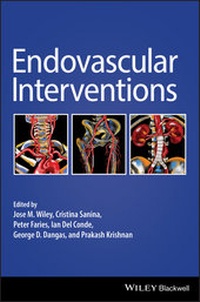
Endovascular Interventions
Description

This book provides medical professionals (vascular surgeons, interventional cardiologists, interventional radiologists, endovascular neurologists, vascular medicine specialists) with a reference guide to the most common and accepted approach to endovascular management of peripheral vascular disease. It also addresses urgent interventions in the acute setting of the various vascular beds, and covers emerging areas such as stroke intervention and endovascular treatment of pulmonary embolism and vascular trauma.
Edited by a multidisciplinary team, Endovascular Interventions offers in-depth coverage of the field in seven parts: Overview; Supra-Aortic Intervention in High Risk Patients: Innominate, Subclavian, Carotid, Vertebral and Intracranial Interventions; Interventions of the Aorta; Renal and Mesenteric Interventions; Lower Extremity Interventions; Venous Disease; and Vascular Trauma. Each section covers the technical aspects of the procedures as well as the fundamental clinical aspects which are necessary in the evaluation of patients considered for interventions. Chapters feature illustrations, case studies, key learning points, equipment lists, and sample questions and answers which can be used for Board exam practice.
* Practical review of vascular and endovascular medicine covering both elective and emergency procedures
* Illustrated, templated chapters provide rapid answers to questions and include case studies, key learning points, and equipment lists
* Includes sample questions and answers that are handy for Board exam practice
* Edited by multidisciplinary experts
Endovascular Interventions is an excellent review book for all practicing and aspiring vascular and endovascular specialists.
More details
Other editions
Additional editions
Persons
Jose M. Wiley, MD, MPH, Associate Professor of Clinical Medicine, Director of the Cardiac Catheterization Laboratory - Moses Division, Director of Endovascular Interventions, Division of Cardiology, Montefiore Medical Center, Albert Einstein College of Medicine, Bronx, NY, USA
Cristina Sanina, MD, Division of Internal Medicine, Montefiore Medical Center, Albert Einstein College of Medicine, Bronx, NY, USA
Peter Faries, MD, Professor of Surgery, Chief Division of Vascular Surgery, Department of Surgery, Icahn School of Medicine at Mount Sinai, New York, NY, USA
Ian Del Conde, MD, Associate Professor of Medicine and Radiology, Morsani College of Medicine, University of South Florida, Director of Vascular Medicine, Miami Cardiac and Vascular Institute, Miami, FL, USA
George D. Dangas, MD, PHD, Professor of Medicine, Director of Cardiovascular Innovation, Icahn School of Medicine at Mount Sinai, New York, NY, USA
Prakash Krishnan, MD, Associate Professor of Medicine, Director of Endovascular Services, Division of Cardiology, The Zena and Michael A. Weiner Cardiovascular Institute, Icahn School of Medicine at Mount Sinai, New York, NY, USA
Content
List of Contributors vii
1 Vascular Biology 1
Cristina Sanina, Olga L. Bockeria, Karlo A. Wiley and Jonathan E. Feig
2 Non-Invasive Testing in Peripheral Arterial Disease 17
Ian Del Conde and James F. Benenati
3 Carotid and Innominate Artery Stenting for High-Risk Patients 25
Reid Ravin, Shivani Kumar and Peter Faries
4 Subclavian Artery Stenosis: When and How to Intervene 37
Parham Parto and Tyrone J. Collins
5 Vertebral Artery Occlusive Disease 45
Mark H.Wholey and Jason M. Andrus
6 Stroke Interventions 53
Italo Linfante
7 Endovascular Management of Thoracoabdominal Aneurysms 61
William E. Beckerman and James F. McKinsey
8 Abdominal Aortic Aneurysms: Catheter-Based Interventions 77
Sean P. Wengerter, Kurt R. Wengerter and Michael L. Marin
9 Aortic Dissection: Urgent Endovascular Treatment 99
Ratna C. Singh and Evan C. Lipsitz
10 Management of Acute Aortic Syndrome 111
Rajesh Malik, Michael Siah and Edward Y.Woo
11 Severe Renal Artery Stenosis:When and How to Intervene 121
Jose D. Tafur and Christopher J.White
12 Mesenteric Ischemia: Chronic and Acute Management 135
Vincent Gallo, Kevin "Chaim" Herman and John H. Rundback
13 Catheter-Based Management of Peripheral AVMs 143
Allan M. Conway, Alfio Carroccio and Robert J. Rosen
14 Aortoiliac Interventions 15
Subhash Banerjee, Houman Khalili and Mehdi Shishehbor
15 Femoropopliteal Interventions in the Claudicant Patient 167
Pedro A. Villablanca, Cristina Sanina, Pedro R. Cox-Alomar, Prakash Krishnan and Jose M.Wiley
16 Tibial and Pedal Plantar Interventions in Patients with Critical Limb Ischemia 183
Anand Prasad and Haley Hughston
17 The Diagnosis, Evaluation and Contemporary Management of Acute Limb Ischemia 207
Michael N. Young and Douglas E. Drachman
18 Pedal Reconstruction in Critical Limb Ischemia 221
Amjad AlMahameed and Craig Walker
19 Access Site Complications 227
Miguel Alvarez Villela, Fernando D. Pastor and Robert T. Pyo
20 Acute Deep Vein Thrombosis 243
Ian Del Conde and James F. Benenati
21 Chronic Venous Disorders 251
Brett J. Carroll, Duane S. Pinto and Cristina Sanina
22 Endovascular Treatment of Pulmonary Embolism 267
Ian Del Conde and Barry T. Katzen
23 Inferior Vena Cava Filters 275
Merrill H. Stewart and James S. Jenkins
24 Endovascular Treatment for Vascular Trauma 291
Hallie E. Baer-Bositis, Georges M. Haidar, Taylor D. Hicks and Mark G. Davies
Index 307
1
Vascular Biology
Cristina Sanina1, Olga L. Bockeria2, Karlo A. Wiley3 and Jonathan E. Feig4
1Department of Internal Medicine, Montefiore Medical Center, Albert Einstein College of Medicine, Bronx, NY, USA
2Department of Cardiovascular Surgery, Bakoulev Center for Cardiovascular Surgery, Moscow, Russia
3Cornell University, College of Agriculture and Life Sciences, Ithaca, NY, USA
4Johns Hopkins Heart and Vascular Institute, The Johns Hopkins Hospital, Baltimore, MD, USA
Introduction
Like many contemporary sciences, vascular biology has been progressively developing at the junction of many disciplines. New knowledge has been obtained in regard to vessel growth biology, physiology, and genetics as well as physiological and pathophysiological mechanisms underlying endothelial dysfunction and atherogenesis. Based on studies that extend back to the 1920s, regression and stabilization of atherosclerosis in humans have gone from just a dream to something that is achievable. Review of the literature indicates that successful attempts at regression applied robust measures to improve plasma lipoprotein profiles. Examples include extensive lowering of plasma concentrations of atherogenic apolipoprotein B and enhancement of reverse cholesterol transport from atheromata to the liver. Possible mechanisms responsible for lesion shrinkage include decreased retention of atherogenic apolipoprotein B within the arterial wall, efflux of cholesterol and other toxic lipids from plaques, emigration of lesional foam cells out of the arterial wall, and an influx of healthy phagocytes that remove necrotic debris as well as other components of the plaque. Until very recently, with the approval of the PCSK9 inhibitors, the available clinical agents caused less dramatic changes in plasma lipoprotein levels, and thereby failed to stop most cardiovascular events. In addition, although the use of angioplasty and stenting has undoubtedly been beneficial, it does not offer a cure or address the underlying mechanisms of vascular disease.
Vascular Anatomy
Blood vessels are composed of three layers: the inner lining of intima (a monolayer of endothelial cells), the middle layer, the media (a layer or layers of vascular smooth muscle cells), and the outer layer, the adventitia (contains collagen type 1, elastic fibers, myofibroblasts, mesenchymal stem cells, vasa vasorum, and nerves). These three layers are separated with internal and external elastic laminas, a thin layer of connective tissue. Large arteries contain more layers of smooth muscle cells and more elastin, and medium-sized arteries contain more collagen. The smallest vessels (capillaries) are built from a single layer of endothelial cells with surrounding basal lamina and pericytes. A number of pericytes and their functions differ in respect to the organs in which they are found. Vascular smooth muscle cells and pericytes regulate peripheral vascular resistance, vascular diameter, and direction of blood flow [1].
Endothelium, the Largest Body Organ
The endothelium is a large and complex organ with endocrine, autocrine, and paracrine proprieties that produces nitric oxide (), endothelin-1, prostacyclin-2, interleukin-6, vascular endothelial growth factor (), von Willebrand factor, plasminogen activator, plasminogen activator inhibitor-1, angiopoietin-2, adhesion molecules such as P-selectin, E-selectin, integrins, and other bioactive molecules. Endothelium controls the recruitment of inflammatory cells and thrombocytes, regulates the coagulation process, extravasation, and vascular tone, and is involved in wound healing through angiogenesis. Endothelial cells cover the entire vasculature in vertebrates with the largest estimated surface amounting to 3000-6000 m2. The total weight of endothelium in an adult person is approximately 720 g, of which 600 g is capillaries [2]. Interestingly, endothelial cells not only from arteries and veins but also from different tissues possess diverse tissue-specific protein expression [3]. NO is a major vasodilator molecule that was discovered by Dr. Furchott in 1980 and named endothelium-derived relaxing factor. In 1992 NO was identified and in 1998 three US scientists, Robert F. Furchott, Louis J. Ignarro, and Ferid Murad, were awarded the Nobel Prize for NO discovery [4]. NO plays an essential role in vascular smooth muscle cell relaxation, thrombocyte aggregation, endothelial cell turnover, and immune/anti-inflammatory processes. Endogenous NO is generated from L-arginine by a family of three calmodulin-dependent NO synthase () enzymes that are primarily expressed by three cell types: endothelial cells (eNOS), neurons (nNOS), and immune cells (iNOS) [5]. However, NO can also be released non-enzymatically from S-nitrosothiols or nitrate/nitrate. Decreased production or bioavailability of NO and increased expression of endothelin-1, an endothelium-derived potent vasoconstrictor, suggest endothelial dysfunction and are associated with hypertension, inflammation, prothrombogenesis, atherogenesis, and cardiovascular events [1]. Inflammation or an increase in proinflammatory circulating molecules such as interleukin-1 and interleukin-6, tumor necrosis factor-a, C-reactive protein, and neutrophils and macrophages boost C-reactive protein production by the liver which, in turn, causes eNOS downregulation and increases endothelin-1 bioavailability, leading to decreased vasodilation, increased shear stress, and vascular atherogenesis. In particular, inflammation upregulates the expression of endothelial cell adhesion molecules that facilitate low-density lipids (s) and macrophage migration across the vascular endothelium via monocyte chemoattractant protein 1 [6]. Inflammatory cytokines also induce tissue factor and von Willebrand factor synthesis by endothelial cells, initiating coagulation cascade and platelet aggregation. Metalloproteinase ADAMTS-13, also produced by endothelial cells, stellar liver cells, platelets, and kidney podocytes, cleaves large molecules of von Willebrand factor, but inflammatory conditions decrease ADAMTS-13 activity, promoting the prothrombotic state. Endothelial cells also provide a rescue mechanism for thrombogenesis by continually producing tissue plasminogen activator, which is cleared by the liver unless fibrin binds to it. Furthermore, inflammatory cytokines promote endothelial cells to produce another tissue plasminogen activator-urokinase-type to cleave substantial fibrin deposition. Thrombin, a procoagulation protease that converts soluble fibrinogen into insoluble fibrin, in turn activates eNOS leading to NO and prostacyclin-2 production, causing vasodilatation and platelet aggregation inhibition. In this way endothelium regulates thrombogenesis and thrombolysis [2].
Vasculogenesis, Angiogenesis, and Arteriogenesis
Endothelial cells originate from mesoderm (hemangioblasts), which gives rise to hematopoietic stem cells and endothelial progenitor cells (angioblasts). The vascular network is formed due to three primary processes: vasculogenesis, angiogenesis, and arteriogenesis. The term "vasculogenesis" was defined by Risau in 1997 as the de novo formation of vessels from endothelial progenitor cells, i.e. angioblasts [7]. During vasculogenesis stem cells form primitive primary vascular plexus, i.e. capillaries. Initially, it was considered that vasculogenesis occurs only during the early stages of embryogenesis; however, further studies suggested that vasculogenesis occurs in various diseases, tumorogenesis, and regenerative processes. Prenatal vasculogenesis begins after initiation of gastrulation with the formation of blood islets in the yolk sac and angioblast precursors in the head mesenchyme and posterior lateral plate mesoderm. Blood islets are mostly composed of hemangioblast, the precursor of endothelial and hematopoietic cells. Angioblasts, future endothelial cells, and the peripheral cells of blood islets join together to construct primary vascular plexus. Multiple molecules and growth factors, including FGF-2, VEGF, Tie-1, Tie-2, angiopoietin, TGF-ß, neuropilins, hedgehog, fibronectin, ß1 integrin, etc., are involved at different times in fetal vasculogenesis [ 7-9]. In 2010 Ricci-Vitiani et al. showed that tumor vasculogenesis exists and a variable number (range from 20% to 90%, mean 60.7%) of endothelial cells in glioblastoma carried the same genetic alteration as tumor cells, indicating that tumor stem-like cells partially give rise to tumor vasculature [10].
Angiogenesis is the growth of blood vessels from anlage (preexisting blood vessels) that provides a massive proliferation of the vascular plexus. Angiogenesis occurs in utero and in adults. Angiogenesis is the most extensively studied area in vascular biology. The term "angiogenesis" was introduced in 1935 by Arthur George Tansley, who studied the formation of new vessels in the placenta. The modern history of angiogenesis began with Judah Folkman, who in 1971 described tumor growth as angiogenesis-dependent [11]. There are two types of angiogenesis: sprouting angiogenesis and intussusceptive or splitting angiogenesis. Sprouting angiogenesis or hypoxia-induced angiogenesis mostly is initiated in the hypoxic environment by...
