

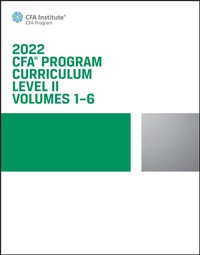
2022 CFA Program Curriculum Level II Box Set
1st Edition
Published on 20. May 2021
608 pages
978-1-119-70507-9 (ISBN)
Description

CFA Institute is a global association of investment professionals. The organization offers the Chartered Financial Analyst (CFA) designation, the Certificate in Investment Performance Measurement (CIPM) designation, and the Claritas Investment Certificate. It provides continuing education conferences, seminars, webcasts, and publications to allow members and other participants to stay current on developments in the investment industry.
More details
Other editions
Additional editions
CFA Institute
2022 CFA Program Curriculum Level II Box Set
Book
05/2021
1st Edition
CFA Institute
€282.26
Article exhausted; check for reprint
Content
Table of Contents
- Title Page
- Table of Contents
- How to Use the CFA Program Curriculum
- Quantitative Methods
- Study Session 1. Quantitative Methods (1)
- Reading Assignments
- Reading 1. Introduction to Linear Regression
- Learning Outcomes
- 1. Simple Linear Regression
- 2. Estimating the Parameters of a Simple Linear Regression
- 3. Assumptions of the Simple Linear Regression Model
- 4. Analysis of Variance
- 5. Hypothesis Testing of Linear Regression Coefficients
- 6. Prediction Using Simple Linear Regression and Prediction Intervals
- 7. Functional Forms for Simple Linear Regression
- Summary
- Practice Problems
- Solutions
- Reading 2. Multiple Regression
- Learning Outcomes
- 1. Multiple Linear Regression Assumptions, Testing Coefficients, and Prediction
- 2. Testing the Whole Multiple Linear Regression Model and Adjusted R-square
- 3. Dummy Variables in a Multiple Linear Regression
- 4. Violations of Regression Assumptions: Heteroskedasticity
- 5. Violations of Regression Assumptions: Serial Correlation
- 6. Violations of Regression Assumptions: Multicollinearity
- 7. Model Specification Errors
- 8. Multiple Linear Regression with Qualitative Dependent Variables
- Summary
- References
- Practice Problems
- Solutions
- Reading 3. Time-Series Analysis
- Learning Outcomes
- 1. Introduction to Time-Series Analysis and Challenges of Working with Time Series
- 2. Linear Trend Models
- 3. Log-Linear Trend Models
- 4. Trend Models and Testing for Correlated Errors
- 5. Autoregressive (AR) Time-Series Models and Covariance-Stationary Series
- 6. Detecting Serially Correlated Errors in an Autoregressive Model
- 7. Mean Reversion and Multiperiod Forecasts and the Chain Rule of Forecasting
- 8. Comparing Forecast Model Performance
- 9. Instability of Regression Coefficients
- 10. Random Walks
- 11. The Unit Root Test of Nonstationarity
- 12. Moving-Average Time-Series Models
- 13. Seasonality in Time-Series Models
- 14. Autoregressive Moving-Average Models and Autoregressive Conditional Heteroskedasticity Models
- 15. Regressions with More Than One Time Series
- 16. Other Issues in Time Series and Suggested Steps in Time-Series Forecasting
- Summary
- References
- Practice Problems
- Solutions
- Study Session 2. Quantitative Methods (2)
- Reading Assignments
- Reading 4. Machine Learning
- Learning Outcomes
- 1. Introduction
- 2. What is Machine Learning
- 3. Overview of Evaluating ML Algorithm Performance
- 4. Supervised Machine Learning Algorithms: Penalized Regression
- 5. Support Vector Machine
- 6. K-Nearest Neighbor
- 7. Classification and Regression Tree
- 8. Ensemble Learning and Random Forest
- Case Study: Classification of Winning and Losing Funds
- 9. Unsupervised Machine Learning Algorithms and Principal Component Analysis
- 10. Clustering
- 11. K-Means Clustering
- 12. Hierarchical Clustering: Agglomerative and Dendrograms
- Case Study: Clustering Stocks Based on Co-Movement Similarity
- 13. Neural Networks, Deep Learning Nets and Reinforcement Learning and Neural Networks
- 14. Deep Learning Nets, Reinforcement and Learning
- Case Study: Deep Neural Network-Based Equity Factor Model
- 15. Choosing an Appropriate ML Algorithm
- Summary
- References
- Practice Problems
- Solutions
- Reading 5. Big Data Projects
