

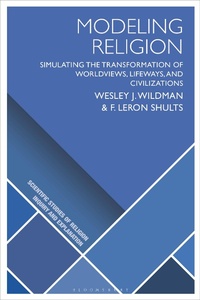
Modeling Religion
Simulating the Transformation of Worldviews, Lifeways, and Civilizations
1st Edition
Published on 13. June 2024
256 pages
978-1-350-36731-9 (ISBN)
Description

What role has religion played in the major civilizational transformations associated with the Neolithic Revolution, the Axial Age, and Modernity? This book introduces new methodological tools and material insights for guiding conversations about these debates.
The authors introduce a new branch of computational humanities, using computational modeling to simulate civilizational transformations. They integrate multiple theories across many disciplines, including the scientific study of religion, and evaluate the relative importance of those causal theories in processes of civilizational change. Materially, the book sheds new light on major debates among historians, archaeologists, and other social theorists on the role of religion within these major transitions.
The book tackles the urgent question of what sort of civilizational transformations might be possible in a world where the influence and significance of religion continues to decline wherever technology, education, freedom, and cultural pluralism are most advanced.
The authors introduce a new branch of computational humanities, using computational modeling to simulate civilizational transformations. They integrate multiple theories across many disciplines, including the scientific study of religion, and evaluate the relative importance of those causal theories in processes of civilizational change. Materially, the book sheds new light on major debates among historians, archaeologists, and other social theorists on the role of religion within these major transitions.
The book tackles the urgent question of what sort of civilizational transformations might be possible in a world where the influence and significance of religion continues to decline wherever technology, education, freedom, and cultural pluralism are most advanced.
More details
Series
Edition
1. Auflage
Language
English
Place of publication
London
United Kingdom
Publishing group
Bloomsbury Publishing PLC
Target group
Professional and scholarly
Illustrations
40 bw illus
ISBN-13
978-1-350-36731-9 (9781350367319)
Copyright in bibliographic data and cover images is held by Nielsen Book Services Limited or by the publishers or by their respective licensors: all rights reserved.
Schweitzer Classification
Other editions
Additional editions
Wesley J. Wildman | F. LeRon Shults
Modeling Religion
Simulating the Transformation of Worldviews, Lifeways, and Civilizations
Book
01/2026
Bloomsbury Academic
€44.40
Shipment within 15-20 days
Persons
Wesley J. Wildman is Professor of Philosophy, Theology, and Ethics, and of Computing and Data Sciences at Boston University, USA; Professor II in the Institute for Global Development and Planning at the University of Agder, Norway; Executive Director of the Center for Mind and Culture in Boston; and Executive Director of Wildheart Evolution in Boston.
F. LeRon Shults is Professor in the Institute for Global Development and Planning at the University of Agder, Norway and Research Professor at the NORCE Center for Modeling Social Systems in Kristiansand, Norway.
F. LeRon Shults is Professor in the Institute for Global Development and Planning at the University of Agder, Norway and Research Professor at the NORCE Center for Modeling Social Systems in Kristiansand, Norway.
Content
List of Figures
Preface
1. Why Model Religion?
2. Civilizational Transformation
3. Computational Simulation
4. Modeling the Neolithic Transition
5. Modeling the Axial Age Transition
6. Modeling the Modernity Transition
7. Insights and Prospects
Appendices
Bibliography
Index
Preface
1. Why Model Religion?
2. Civilizational Transformation
3. Computational Simulation
4. Modeling the Neolithic Transition
5. Modeling the Axial Age Transition
6. Modeling the Modernity Transition
7. Insights and Prospects
Appendices
Bibliography
Index
