

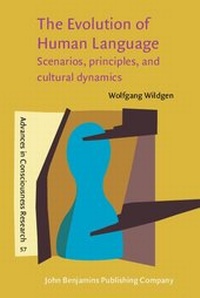
The Evolution of Human Language
Scenarios, principles, and cultural dynamics
1st Edition
Published on 30. June 2004
XII, 240 pages
978-90-272-9545-3 (ISBN)
Description

Wolfgang Wildgen presents three perspectives on the evolution of language as a key element in the evolution of mankind in terms of the development of human symbol use. (1) He approaches this question by constructing possible scenarios in which mechanisms necessary for symbolic behavior could have developed, on the basis of the state of the art in evolutionary anthropology and genetics. (2) Non-linguistic symbolic behavior such as cave art is investigated as an important clue to the developmental background to the origin of language. Creativity and innovation and a population's ability to integrate individual experiments are considered with regard to historical examples of symbolic creativity in the visual arts and natural sciences. (3) Probable linguistic 'fossils' of such linguistic innovations are examined. The results of this study allow for new proposals for a 'protolanguage' and for a theory of language within a broader philosophical and semiotic framework, and raises interesting questions as to human consciousness, universal grammar, and linguistic methodology. (Series B)
More details
Other editions
Additional editions
Book
06/2004
John Benjamins Publishing Co
€95.40
Shipment within 10-15 days
Person
Content
- The Evolution of Human Language
- Editorial page
- Title page
- Dedication page
- LCC page
- Table of contents
- Acknowledgments
- Introduction
- Basic scenarios and forces in the evolution of human language
- 2.1. First scenario: Cognitive and physical predispositions for language
- 2.1.1. Motor rhythms and programs as predispositions for language
- 2.1.2. Sensory preadaptations for language
- 2.1.3. The evolution of the neo-cortex as predisposition for language
- 2.1.4. The evolution of the larynx as predisposition for language
- 2.2. Second scenario: Bottleneck situations and the rapid evolution of language
- 2.3. Third scenario: Sexual selection and a run-away evolution of language
- 2.4. Fourth scenario: Language as a universal symbolic medium
- 2.5. Initial conclusions
- Expression and appeal in animal and human communication with special consideration of laughter
- 3.1. From animal motion to animal sign behavior
- 3.2. From animal communication to human language
- 3.3. Laughter and the origin of the comical genre
- 3.3.1. Classical analyses of laughter and the comical
- 3.3.2. Laughing in communicative contexts
- 3.3.3. Neural mechanisms responsible for the comical
- 3.4. The place of laughter in the evolution of semiotic behavior
- 3.4.1. Critique of emotional expressivity (and appeal) as origin of language
- 3.4.2. Argumentation in archaic societies
- The evolution of cognitive control in tool-making and tool-use and the emergence of a theory of mind
- 4.1. The vector-space of goal directed motion
- First cognitive principle of causation: Specification of a vector space
- 4.2. Instrumentality in higher mammals and man
- Second cognitive principle of causation: Instrumentality
- 4.3. Controllers and their semantic consequences
- 4.4. Mentally or communicatively caused events and theories of mind
- Third cognitive principle of causation: Theory of mind and mental causation
- The evolution of pre-historic art and the transition to writing systems
- 5.1. The evolution of art from the Paleolithic to the Mesolithic
- 5.1.1. The engravings on tools
- 5.1.2. Paleolithic sculptures
- 5.1.3. Paleolithic cave paintings
- 5.1.4. The representation of humans in a social context
- 5.2. The topology of Cro-Magnon life space and the semiotic space of decorated caves
- 5.3. Living and moving forms in the classical cave-paintings (Chauvet, Lascaux and Altamira)
- 5.4. From iconic schemata to abstract signs and to writing
- 5.4.1. Rock engravings from the Paleolithic to modern time
- 5.4.2. The evolution of writing
- 5.5. Is the esthetical function basic for art and language?
- Symbolic creativity in language, art, and science and the cultural dynamics of symbolic forms
- 6.1. Symbolic creativity and human evolution
- 6.2. Creativity and lexical innovation
- 6.2.1. Dynamic principles of nominal composition
- 6.2.2. The dependence of creative compounds on the context
- 6.2.3. The blending of image and compound in comical texts
- 6.3. Creativity in art and the dynamics of symbolic innovation
- 6.3.1. Creativity and symbolic innovation in the art of Leonardo da Vinci
- 6.3.2. Symbolic abstraction and innovation in the art of William Turner
- 6.3.3. Creativity and radical analysis of human body postures in the art height8pt depth3pt width0pt of Henry Moore
- 6.3.4. Remarks on the acceptance of innovation in art
- 6.4. Creativity in science and the role of mental modeling for the evolution of language
- 6.5. The evolutionary dynamics of symbolic innovation
- ``Fossils'' of evolution in the lexicon of HAND and EYE (mainly in German, English and French)
- 7.1. Preliminary remarks on morphological continuity, linguistic ``fossils'' and conceptual development
- 7.2. A comparative analysis of the object-category HAND in different languages
- 7.3. A comparative analysis of the object category EYE
- 7.4. The synergetics of hand and eye, ear and mouth as dynamic threshold for higher symbolic behavior
- 7.5. The lexicon of HAND and EYE as a starting point for syntactic deep structures
- 7.6. The emergence of a syntactic ``machinery''
- 7.7. Some methodological conclusions
- The form of a ``protolanguage'' and the contours of a theory of language evolution
- 8.1. An informed guess at the form of protolanguage
- 8.1.1. The plausible time span of a protolanguage
- 8.1.2. Can artifacts tell us something about a protolanguage?
- 8.1.3. Anatomical evolution and the shape of a protolanguage
- 8.2. The format of an evolutionary grammar
- 8.2.1. The semantics of space and time in a protolanguage
- 8.2.2. Representation of actions and events
- 8.2.3. Beyond the grasp scenario
- 8.2.4. The complexity of (nominal) phrases
- 8.2.5. The self-organization of a grammatical system
- 8.2.6. Major levels of an evolutionary (biological) grammar and the transition towards a culturally based grammar
- 8.3. The contours of a theory of language evolution
- 8.3.1. The genetic code and human grammar. What is the relevant analogy, if there is one?
- 8.3.2. Darwinian principles of language change as a basis of an evolutionary theory of language
- 8.3.3. Long range selective advantages of linguistic features
- 8.3.4. Selective advantage through ``symbolic theft'' and the exploitation of the ``mirror system''
- 8.3.5. Conclusions for a theory of the evolution of language
- Symbolic forms, generalized media, and their evolution
- 9.1. Symbol formation and symbolic forms (in Cassirer's philosophy of symbolic forms)
- 9.2. Sociological models of semiotic genres (Luhmann, Habermas)
- 9.3. The evolution of symbolic forms and generalized media
- Consciousness, linguistic universals, and the methodology of linguistics
- 10.1. Consciousness and linguistic signs
- 10.2. Linguistic universals based on evolutionary principles
- 10.3. Consequences for linguistic methodology
- Notes
- Chapter 1
- Chapter 2
- Chapter 4
- Chapter 5
- Chapter 7
- Chapter 8
- Chapter 9
- Chapter 10
- References
- Index of proper names
- Subject index
- Index of principles and hypotheses
- The series Advances in Consciousness Research
