

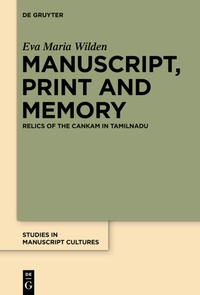
Manuscript, Print and Memory
Description

The ancient Tamil poetic corpus of the Ca?am ("The Academy") is a national treasure for Tamilians and a battle-ground for linguists and historians of politics, culture and literature. Going back to oral predecessors probably dating back to the beginning of the first millennium, it has had an extremely rich and variegated history. Collected into anthologies and endowed with literary theories and voluminous commentaries, it became the centre-piece of the Tamil literary canon, associated with the royal court of the Pandya dynasty in Madurai. Its decline began in the late middle ages, and by the late 17th century it had fallen into near oblivion, before being rediscovered at the beginning of the print era. The present study traces the complex historical process of its transmission over some 2000 years, using and documenting a wide range of sources, in particular surviving manuscripts, the early prints, the commentaries of the literary and grammatical traditions and a vast range of later literature that creates a web of inter-textual references and quotations.
More details
Other editions
Additional editions
Person
Content
- Intro
- Contents
- Preface
- List of Abbreviation
- I Introduction
- 1 Sources, Methods and Aims
- 2 The Corpus
- 2.1 Its Constitution
- 2.2 Its Fate
- 3 Research History and Programme
- 3.1 The Tamil Renaissance
- 3.2 Tamil Manuscripts
- II The Manuscripts
- 1 Surviving Ca?kam Manuscripts: Descriptive Catalogue
- 1.1 Libraries of Origin
- 1.2 Manuscript list
- 1.3 Manuscript Catalogue
- 2 Manuscripts Reported in Catalogues and Editions
- 2.1 Catalogues
- 2.2 Manuscript Descriptions in the Editions
- 3 Colophons and Library Information
- 3.1 List of Available Colophons
- 3.2 Scribal Colophons and/or Information on Title Pages
- 4 Summary: Age and Distribution of the Remaining Witnesses
- III Transmissional History
- 1 The Invocation Stanzas (kat?avu? va?ttu)
- 1.1 Kur_untokai 1
- 1.2 The Series by Paratam Pat?iya Perunteva?atr
- 2 Traditional Colophons
- 2.1 Et?t?uttokai
- 2.2 Pattupat?t?u
- 2.3 Information from the Traditional Colophons
- 3 Mnemonic Stanzas
- 3.1 Et?t?utokai (14 Verses)
- 3.2 Pattupat?t?u (19 Plus 12 Verses)
- 4 The Ca?kam Legends
- 4.1 Introduction
- 4.2 The Preamble to Nakkira? and Its Late Metrical Echo
- 4.3 Academicians Infiltrating the Saiva Canon
- 4.4 Siva's Sports in Maturai
- 4.5 The Tiruva??uvar Branch
- 4.6 Legend Merging into "History"
- 5 Reception in the Grammatical Tradition
- 5.1 The Legend Reflected in the Commentaries
- 5.2 The Corpus Reflected in the Commentaries
- Appendix 1: Tables of Quotations from the Poetological Commentaries
- Appendix 2: The Distribution of Quoted Poems in Poetological Commentaries
- Appendix 3: The Distribution of Quoted Poems in Grammatical Commentaries
- 5.3 Glimpses from Discussions of Literature
- Coda: The Maturaic Cokkanatar Aru?iya Tami? Vit?ututu
- 6 Summary: The Rise and Fall of a Canon
- IV The Editing Process
- 1 Notes on the Development of the Tamil Script
- 2 The Path from Palm-Leaves to Paper to Printed Editions
- 3 The Early Ca?kam Editions
- 4 Case Studies: The Kur_untokai, the Nar_r_i?ai and the Akana?ur_u
- 5 Later Ca?kam Editions
- Appendix: Manuscripts Containing Exegetical Material
- 6 Summary: Decipherment, Standardisation, Popularisation
- V Conclusion: The Restitution of a Canon
- Literature
- List of Acknowledgements for the Illustrations
- Index

