

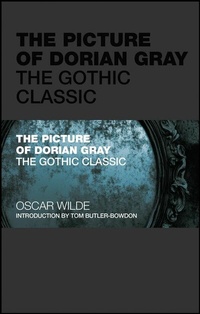
The Picture of Dorian Gray
Description

A timeless story of beauty, hedonism, and morality
A new addition to the widely read Capstone Classics series, The Picture of Dorian Gray: The Gothic Classic, by Oscar Wilde, explores the brutal consequences of hedonism, loose morals, and an obsessive focus on beauty and pleasure. Wilde's novel follows a young man, Dorian Gray, who becomes infatuated with his own beauty as it is captured in a portrait by artist Basil Hallward.
Dorian 's physical beauty endures through the years as his picture grows ever more grotesque. The portrait becomes a window into his soul, withering and decaying as he pursues a hollow life, devoid of meaningful achievement or virtue.
One of the great Victorian Gothic novels, The Picture of Dorian Gray is as insightful and gripping as when first published.
This deluxe hardback Capstone edition includes a new Introduction by Tom Butler-Bowdon that offers historical and cultural context for the modern reader and provides deeper insights into the text.
Perfect for every fan of literature - or simply those looking for their next great story - The Picture of Dorian Gray is an unmissable classic in the tradition of horror, gothic, dark, and supernatural fiction.
More details
Other editions
Additional editions
Persons
Oscar Wilde (born October 16, 1854, Dublin, Ireland-died November 30, 1900, Paris, France) was an Irish wit, poet, and dramatist whose enduring fame rests on his only novel, The Picture of Dorian Gray (1891), and on his comic masterpieces Lady Windermere's Fan (1892) and The Importance of Being Earnest (1895). Wilde was a spokesman for the late 19th-century Aesthetic movement in England, which advocated art for art's sake. He was also known for his flamboyant style and sharp wit, which made him a popular figure in London's social and artistic circles2. However, his career was marred by scandal when he was imprisoned for homosexual acts in 1895. After his release, Wilde lived in straitened circumstances and died at the age of 46.
Tom Butler-Bowden was working as a political adviser in Australia when, at 25, he read Stephen Covey's The 7 Habits of Highly Effective People. Captivated by it and other books in the personal development field, he left his career and went on to write critical introductions to self-development and prosperity classics through the best-selling Capstone Classics series published by Wiley. He then went on to write bestselling 50 Self-Help Classics, the first guide to the personal development literature and a winner of the Benjamin Franklin Award.
Content
Introduction By Tom Butler-Bowdon vii
Oscar Wilde Chronology xxviii
The Picture of Dorian Gray xxxiii
The Preface xxxv
Chapter I 1
Chapter II 23
Chapter III 49
Chapter IV 71
Chapter V 97
Chapter VI 117
Chapter VII 131
Chapter VIII 151
Chapter IX 173
Chapter X 189
Chapter XI 205
Chapter XII 237
Chapter XIII 249
Chapter XIV 261
Chapter XV 283
Chapter XVI 299
Chapter XVII 313
Chapter XVIII 323
Chapter XIX 339
Chapter XX 355
INTRODUCTION
TOM BUTLER-BOWDON
Some famous novels make little impact at the time of publication, with critics and readers needing to slowly come to a positive judgement on their value. Others touch a public nerve and achieve notoriety within days of release. Oscar Wilde's The Picture of Dorian Gray is of the latter.
To give a sense of early reviews:
"Mr. Oscar Wilde's 'The Picture of Dorian Gray' is a book to which we must object strongly. It is a book in which the author.shows himself an adept in the art of dressing up vice to make it appear attractive.It is an unhealthy, unmanly, meretricious, and silly book."
-The Daily Chronicle, July 1890
"Mr. Wilde.has contrived to be more than a disappointment. For a man of talent, who could have done so well, to have chosen to do so ill is something of a discredit to himself and to literature. He has written a book that is an open sewer, a book which can only be read in a brothel."
-The Scots Observer, July 1890
Taken aback by the critical and public response, Wilde defended himself in letters to the editors, pointing out that, "The sphere of art and the sphere of ethics are absolutely distinct and separate." (St. James's Gazette).
Privately, he was pleased that the book had made an impact. After all, as one of his protagonists, Lord Henry Wotton, states in Chapter 1:
"There is only one thing in the world worse than being talked about, and that is not being talked about."
The Picture of Dorian Gray is a tragedy, and seemed to foreshadow Wilde's fate at the hands of the British public and legal system. His death a decade after its release, as an exile in France and cut off from family funds and in poor health, was a sad end to a career that had already delivered much and promised more.
In time, however, critics would laud the stylistic brilliance and psychological insight of Dorian Gray. It became a key work of the Gothic macabre and part of the canon of Aesthetic and Decadent works celebrating hedonism, beauty, and the freedom of the individual. Each generation finds something new to appreciate in the novel, and academic interest today is high.
With its strong visual component, the story is made for stage and screen. Adaptations include the classic 1945 film by Albert Lewin, which is shot in black and white except for the Technicolor scenes involving Dorian's portrait. A lurid 2009 version with Colin Firth as Lord Henry was a box office success. It followed The League of Extraordinary Gentlemen (2004), featuring Dorian among a team of famous Victorian literary characters. Recent stage productions include the Sydney Theatre Company's use of technology to enable star Eryn Jean Norvill to play all 22 characters.
This Introduction examines the famous Preface of Dorian Gray and its importance, before discussing the work's themes of beauty, power, and influence. I highlight Wilde's use of London as the perfect backdrop to his characters, and examine the meaning of Dorian as the ultimate Gothic dandy.
At the end is a note on the text and its history, followed by a chronology of Wilde's life.
The Picture of Dorian Gray as main feature in the July, 1890 edition of Philadelphia's Lippincott's magazine. Ward, Lock & Co.'s revised book edition was published in April, 1891.
Source: Unknown Author, Wikimedia Commons. Public domain.
DORIAN GRAY AS DECADENT MANIFESTO
A reader new to The Picture of Dorian Gray might expect to open it at the first chapter and be thrown into a story. Instead, they find a Preface which reads like the manifesto of an art or literary movement.
The Preface is a defence against the moral outrage that greeted the original story of The Picture of Dorian Gray-in Philadelphia's Lippincott's Monthly Magazine in 1890-which included homoerotic passages and scenes of louche London that were normally kept under wraps.
Wilde wanted to challenge the Victorian belief that art's purpose was to be didactic and morally uplifting. As he wrote only a few months after Dorian Gray in the essay, "The Soul of Man Under Socialism" (1891):
"art is individualism, and individualism is a disturbing and disintegrating force. There lies its immense value. For what it seeks is to disturb the monotony of type, slavery of custom, tyranny of habit, and the reduction of man to the level of a machine"
The Preface itself includes maxims such as "The artist is the creator of beautiful things" and "All art is quite useless." Art should have no moral purpose, and no reason to exist beyond beauty or challenging rigid ideas or perceptions. "Diversity of opinion about a work of art shows that the work is new, complex, and vital," Wilde says. In other words, controversy is a sign of artistic success.
That Wilde feels the need to front his novel with this Preface tells us much about where he was as an artist and person at the time of writing, and the cultural trends and controversies swirling about him. Indeed, it's hard to understand the book without having some knowledge of the philosophy of Aestheticism, or the Decadent movement that grew out of it.
When a student at Oxford University (1874-1878), Wilde was profoundly influenced by Walter Pater and his Studies in the History of the Renaissance (1873). Pater's emphasis on living a life dedicated to art and sensation is a cornerstone of Aestheticism, a movement whose core principle was "Art for art's sake." Art might have no purpose beyond expressing beauty. No moralising was needed. This notion is expressed in the dialogue and soliloquys of a range of Dorian Gray characters, such as portraitist Basil Hallward's declaration that "art is always more abstract than we fancy. Form and colour tell us of form and colour-that is all."
With its themes of hedonism, moral decay, and radical individualism, Aestheticism scandalised Victorian society. A Picture of Dorian Gray-and to some extent Wilde's essay The Decay of Lying (1889)-includes plenty of each theme, and it is why critics described it as a Gothic work.
But in depicting a man who remains physically pure while his soul, captured in a painting, becomes old and grotesque, Wilde did not simply swallow the Aesthetic line. In fact, it was the Decadent movement, which emerged from and built upon Aestheticism and took its principles to a more extreme conclusion, that was a greater influence on Wilde. Whereas Aestheticism concerned beauty as a means of escape from the ugliness of the industrial age, Decadence embraced the artificial and the morbid, finding beauty in what was often considered grotesque or unnatural. Yet Wilde does not glorify his main character. Dorian Gray's descent into existential and physical malaise shows where unchecked pursuit of pleasure and beauty for its own sake can lead.
The Decadent movement flourished in France and England during the fin de siècle ("end of the century") period, and was a reaction to the prim morality and artistic emptiness of bourgeois society. Decadents prized intense sensory experiences, from perfumes to exotic flowers, and sought to shock by exploring mind-altering drugs and transgressive sexuality. They were fascinated by death, decay, and corruption, and particularly inspired by the fall of the Roman Empire and its cultural representations. Not surprisingly, their artistic elitism, world-weariness, and cynicism did not endear them to the upbeat Victorians. Wilde became their target not just because he was homosexual but because of the decadence he represented.
Two key figures of the Decadent movement were Maurice Barrès, French novelist and politician and author of a trilogy of novels, Le Culte du moi ("The Cult of the Ego," 1888-1891), and Charles Baudelaire, author of Les Fleurs du mal (The Flowers of Evil, 1857). Other writers including Théophile Gautier, Félicien Rops, Paul Verlaine, Stéphane Mallarmé, Tristan Corbière, Theodore Hannon, and artist Fernarnd Khnopff, were part of the movement. Into the mix was added the English Gothic writer Arthur Symons, poet Charles Algernon Swinburne, and American poet and writer Edgar Allen Poe.
Joris-Karl Huysmans's book À Rebours (translated as Against Nature or Against the Grain), a novel of a Parisian man that gives himself to hedonistic pleasures, was integral to Decadence. It gave rise to Anatole Baju's Le Décadent magazine in 1886, and inspired its cousin Symbolism, expressed in the Symbolist Manifesto by Jean Moréas. In Chapter 10, Wilde's narrator describes a "strange" yellow book-a fictional representation of Huysmans's À Rebours-that the aristocratic Lord Henry Wotton sends to Dorian:
"The style in which it was written was that curious jewelled style, vivid and obscure at once, full of argot and of archaisms, of technical expressions and of elaborate paraphrases, that characterizes the work of some of the finest artists of the French school of Symbolistes."
The Symbolists liked to see the external world as a mere reflection of deeper,...
