

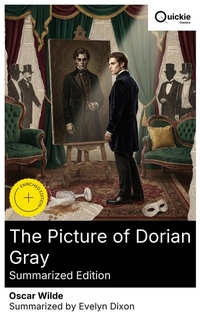
The Picture of Dorian Gray (Summarized Edition)
Enriched edition. A Victorian London tale of aestheticism, youthful vanity, and moral decay-where beauty masks corruption and art bares the soul
Published on 10. January 2026
115 pages
8596547882343 (EAN)
Description

The Picture of Dorian Gray follows a beautiful youth whose portrait bears his corruption while he remains outwardly unmarked. Wilde blends Gothic fable, society comedy, and philosophical dialogue into a Faustian study of desire, influence, and the ethics of looking. Lush, epigrammatic prose situates the tale within fin-de-siècle aestheticism and decadence, in conversation with Huysmans's À rebours, the dandy tradition, and the Victorian moral novel it subverts. An Irish classicist shaped by Walter Pater's aesthetic doctrine, Wilde drew on metropolitan wit and a critic's eye for respectability. First published in Lippincott's Magazine (1890) and expanded in 1891 with a defiant preface, the novel tests "art for art's sake" against publicity, sexual secrecy, and moral panic. Its worldly aphorisms and painterly scenes reflect his dual vocation as dramatist and art critic. Readers seeking a concise yet inexhaustible meditation on beauty, conscience, and celebrity will find this novel indispensable. It rewards courses in Victorian literature, Gothic fiction, and aesthetics, and invites debate in ethics and queer studies. Return for the glitter of its sentences and the chill of its fable-and for the unsettling truth that surfaces can enthrall while the portrait tells what we deny.
Quickie Classics summarizes timeless works with precision, preserving the author's voice and keeping the prose clear, fast, and readable-distilled, never diluted. Enriched Edition extras: Introduction · Synopsis · Historical Context · Author Biography · Brief Analysis · 4 Reflection Q&As · Editorial Footnotes.
More details
Persons
Oscar Wilde, born Oscar Fingal O'Flahertie Wills Wilde on October 16, 1854, in Dublin, Ireland, was a towering figure in the late 19th-century literary world, renowned for his sharp wit, flamboyant style, and sparkling conversation. Wilde's education at Trinity College, Dublin, and subsequently at Magdalen College, Oxford, where he adopted aesthetic principles and aligned himself with the philosophy of 'art for art's sake', profoundly influenced his literary endeavors. He is best remembered for his novel 'The Picture of Dorian Gray' (1890), a masterful exploration of morality, vanity, and the interplay between art and life, which has left an indelible mark on the canon of English literature. Beyond his one novel, Wilde's literary achievements include a substantial oeuvre of plays, such as 'The Importance of Being Earnest', which showcased his genius for social satire and his ability to encapsulate the paradoxes of human experience. Although his career was beset with controversy, leading to a tragic downfall and imprisonment, Wilde's incisive social commentary and eloquent articulation of the human condition continue to resonate with readers and scholars alike. His work is characterized by its blend of beauty, irony, and moral contemplation, reflecting a life lived in passionate pursuit of art.
