

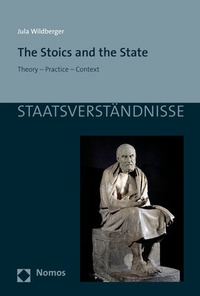
The Stoics and the State
Theory - Practice - Context
1st Edition
Published on 22. March 2018
263 pages
978-3-8452-7448-5 (ISBN)
Description

How did the Stoics conceive of a polis and statehood? What happens when these ideas meet different biographies and changing historical environments? To answer these questions, 'The Stoics and the State' combines close philological reading of original source texts and fine-grained conceptual analysis with wide-ranging contextualisation, which is both thematic and diachronic. A systematic account elucidates extant definitions, aspects of statehood (territory, institutions, population and state objectives) and the constitutive function of the common law. The book's diachronic part investigates how Stoics from Zeno to Marcus Aurelius used their theory of the state to assess particular states, explain the origin of political communities and shape their own political practice. A glimpse at modern adaptations from Justus Lipsius to Martha C. Nussbaum explains the peculiarities of Stoic notions and their basis in a conception of human nature as not only political but essentially sociable and beneficent.
More details
Other editions
Additional editions
Book
03/2018
1st Edition
Nomos
€39.00
Shipment within 7-9 days
Person
Content
- Cover
- 1. Introduction
- 1.1 A State?
- 1.2 The Analytical Grid
- 2. Definitions: Four Sources for a Stoic Concept of the State
- 2.1 The State of Our Sources
- 2.2 Chrysostom: "Human Beings Administrated by Law"
- 2.3 Clement of Alexandria
- 2.3.1 "Neither Expugnable nor Subjugable"
- 2.3.2 The Wise State vs. the People as an Organized Group
- 2.4 Cleanthes: A Construction for Refuge and Justice
- 2.5 Arius Didymus: Dwelling and Organized Group
- 3. A Dwelling
- 3.1 Urban Structures and Institutions
- 3.1.1 Gymnasia
- 3.1.2 Temples
- 3.1.3 Justice and the Urban Center
- 3.2 A Common Home and the Theory of Attachment
- 3.2.1 Non-instrumental sociability
- 3.2.1.1 Expansional Social Attachment
- 3.2.1.2 Essential Social Attachment
- 3.2.2 The Cosmos as a Dwelling Made for Gods and Humans
- 4. The Cosmos as a State
- 4.1 The Cosmic Home as a World State
- 4.2 Only a Comparison?
- 4.2.1 The Citizen of the Cosmos in Therapy and Exhortation
- 4.2.2 A Cosmic Model-State
- 4.3 From Household to Kingdom
- 4.3.1 Household Terminology in Stoicism
- 4.3.2 Polis or Politeia?
- 4.3.3 The Cosmic Disposition: Fate, Nature, and Providence
- 4.3.4 The Cosmic Constitution and a Rational Animal's End
- 5. The Law
- 5.1 The Definition of Law as Nature's Right Word
- 5.1.1 Law as a Prescriptive and Prohibitive Body
- 5.1.2 Fate and Seed-Description (Logos Spermatikos)
- 5.2 Justice and the Cosmic Disposition
- 5.3 Are Stoic Laws Rules?
- 5.4 Experience, Concepts, and Patterns in Nature
- 6. Inhabitants and Citizens
- 6.1 Reason as a Prerequisite for Citizenship
- 6.2 Gods
- 6.2.1 Hierarchies in the World State
- 6.2.2 Is God a Citizen Too?
- 6.3 Sages
- 6.3.1 Right Reason
- 6.3.2 Reason Twisted
- 6.4 Fools
- 6.4.1 Women
- 6.4.2 Slaves
- 6.4.3 Exiles, Rustics, and Feral Persons
- 6.4.4 Children
- 6.5 Eros
- 6.5.1 The Erotic Efforts of Sages
- 6.5.2 Eros and Concord
- 6.6 Becoming a Citizen: A Rational Animal's End and the State Objective
- 7. Particular Polities
- 7.1 Utopia or Reality?
- 7.1.1 The Reality of the Common Law
- 7.1.2 Individual Polities and the Primacy of the Law
- 7.2 Objectives of Particular States and Best Constitutions
- 7.3 The Origin of Particular States
- 7.3.1 The Earliest Humans: "Fresh from the Gods"
- 7.3.2 Technology
- 7.3.3 A Golden Age or a Lucky Age?
- 7.3.4 Early Political Philosophy
- 7.3.5 Tyrants and Legislation
- 8. The Early Stoics and the Question of Political Practice
- 8.1 Is Zeno's Society of Equals a Democracy?
- 8.2 The Early Stoics and the City State
- 8.2.1 Historical Context and Theory
- 8.2.2 Early Stoics in Politics
- 8.3 The Early Stoics' Attitudes to Leagues and Monarchies
- 8.3.1 Engagement with Monarchy and Monarchs
- 8.3.2 Distance and Mediation
- 8.4 Stoic Discussions of Political Involvement
- 8.4.1 Adaptive Agency
- 8.4.2 In Defense of a Contemplative Life: The Evidence in Seneca
- 8.4.3 Incurable Polities and Progressor Polities
- 8.4.4 Just by Nature
- 8.4.5 Philosophy as Legislation
- 9. Stoicism in Rome
- 9.1 The Middle Stoics
- 9.2 Imperial Stoics: The Emperor
- 9.2.1 The Body Politic in Seneca's De Clementia
- 9.2.2 Epictetus on the Emperor as a Source of Enslaving Desires
- 9.2.3 Marcus Aurelius
- 9.2.3.1 Marcus Conceptualizes His Status as Emperor
- 9.2.3.2 A Sociable and Political Animal in the World State
- 9.2.3.3 Ruling in Rome
- 9.3 Imperial Stoics: The Senate
- 9.3.1 The Stoic Opposition and Marcus' Political Dream
- 9.3.2 Seneca's Aristocracy of Virtue
- 9.3.2.1 A Change of Mind
- 9.3.2.2 A New Start
- 9.3.2.3 A New Elite of Equals: The Network of Progressor Friends
- 10. A Few Modern Receptions and Parallels
- 10.1 Justus Lipsius
- 10.1.1 Public Evils and Contingent Laws in De Constantia
- 10.1.2 Human Selfishness and Protective State Power in the Politica
- 10.2 Immanuel Kant and Modern Cosmopolitanism
- 10.2.1 Anthropology
- 10.2.2 State, Law, and Institutions
- 10.3 Martha Nussbaum's Capabilities Approach
- 10.3.1 Human Dignity and Human Rights
- 10.3.2 Capabilities vs. Functions: Chrysippus' Modal Logic
- 10.3.3 Quietistic Disregard for Human Vulnerability?
- 10.3.4 The Common Law, Cultural Diversity, and Minimal Consensus
- 10.3.5 In Conclusion: Radical Evil or Innate Love of Others?
- Literature
- Index of Primary Sources Cited
- Index of Selected Greek and Latin Terms
