

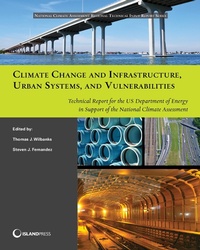
Climate Change and Infrastructure, Urban Systems, and Vulnerabilities
Description

Hurricane Irene ruptured a Baltimore sewer main, resulting in 100 million gallons of raw sewage flooding the local watershed. Levee failures during Hurricane Katrina resulted in massive flooding which did not recede for months. With temperatures becoming more extreme, and storms increasing in magnitude, American infrastructure and risk-management policies require close examination in order to decrease the damage wrought by natural disasters. Climate Change and Infrastructure, Urban Systems, and Vulnerabilities addresses these needs by examining how climate change affects urban buildings and communities, and determining which regions are the most vulnerable to environmental disaster. It looks at key elements of urban systems, including transportation, communication, drainage, and energy, in order to better understand the damages caused by climate change and extreme weather. How can urban systems become more resilient? How can citizens protect their cities from damage, and more easily rebound from destructive storms? This report not only breaks new ground as a component of climate change vulnerability and impact assessments but also highlights critical research gaps in the material. Implications of climate change are examined by assessing historical experience as well as simulating future conditions.
Developed to inform the 3rd National Climate Assessment, and a landmark study in terms of its breadth and depth of coverage and conducted under the auspices of the U.S. Department of Energy, Climate Change and Infrastructure, Urban Systems, and Vulnerabilities examines the known effects and relationships of climate change variables on American infrastructure and risk-management policies. Its rich science and case studies will enable policymakers, urban planners, and stakeholders to develop a long-term, self-sustained assessment capacity and more effective risk-management strategies.
More details
Other editions
Additional editions
Persons
Dr. Steven J. Fernandez is a senior research and developmstaff member at Oak Ridge National Laboratory. His interests at the laboratory include the modeling of the interdependelectric grid disruptions, obtaining real-time grid status as data ingestion points and how these results can help utility and community response plans. His experience includes directing the National Infrastructure Simulation and Analysis Center efforts in the electric grid, economic analysis at Los Alamos National Laboratory and leading critical infrastructure protection efforts for national security research organizations at the Idaho National Laboratory. In Idaho, Dr. Fernandez established the national SCADA test bed, currently a critical componof the Departmof Energy Office of Electricity Delivery and Energy Reliability strategy. He received a Bachelor of Science in chemical physics from Centre College, a Master of Science in engineering from Washington State University and a doctorate in chemistry from the University of Idaho.
Content
Chapter 1 INTRODUCTION Chapter 2 BACKGROUND A. The Development Of The Report B. The Scope Of The Report C. Emerging Contexts For Infrastructure And Urban System Implications Of Climate Change CHAPTER 3 FRAMING CLIMATE CHANGE IMPLICATIONS FOR INFRASTRUCTURES AND URBAN SYSTEM A. Sensitivities Of Infrastructures And Urban Systems To Climate Change B. Infrastructure Systems Services C. Linkages Between Infrastructures D. Assessment Findings CHAPTER 4 URBAN SYSTEMS AS PLACE-BASED FOCI FOR INFRASTRUCTURE INTERACTIONS A. Why The Urban Systems Lens B. Overviewing Urban Infrastructure Sectors and Services C. Vulnerabilities Associated With Infrastructure Interdependencies In Urban Systems D. Infrastructure Interdependencies And Cascading Impacts: A Case Study E. Emerging Leadership In Adaptation/Resilience Enhancement F. Assessment Findings CHAPTER 5 IMPLICATIONS FOR FUTURE RISK MANAGEMENT STRATEGIES A. Overview B. Two Case Studies - Boston and New York C. Adaptive Infrastructure in Other Countries D. Assessment Findings CHAPTER 6 KNOWLEDGE, UNCERTAINTIES, AND RESEARCH GAPS A. The Landscape Of Needs B. Assessment Findings CHAPTER 7 DEVELOPING A SELF-SUSTAINED CONTINUING CAPACITY FOR MONITORING, EVALUATION, AND INFORMING DECISIONS A. Science Issues B. Institutional Challenges C. Assessment Findings.
