

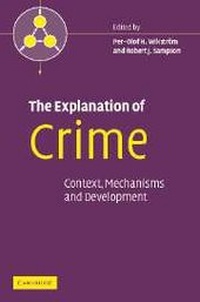
The Explanation of Crime
Context, Mechanisms and Development
1st Edition
Published on 14. August 2007
978-0-511-29208-8 (ISBN)
Description

Integration of disciplines, theories and research orientations has assumed a central role in criminological discourse yet it remains difficult to identify any concrete discoveries or significant breakthroughs for which integration has been responsible. Concentrating on three key concepts: context, mechanisms, and development, this volume aims to advance integrated scientific knowledge on crime causation by bringing together different scholarly approaches. Through an analysis of the roles of behavioural contexts and individual differences in crime causation, The Explanation of Crime seeks to provide a unified and focused approach to the integration of knowledge. Chapter topics range from individual genetics to family environments and from ecological behaviour settings to the macro-level context of communities and social systems. This is a comprehensive treatment of the problem of crime causation that will appeal to graduate students and researchers in criminology and be of great interest to policy-makers and practitioners in crime policy and prevention.
Reviews / Votes
'This is a terrific book. With its focus on different situational mechanisms linking social contexts to individual actions, it will appeal not only to criminologists but also to sociologists and other social scientists interested in explaining why individuals do what they do.' Peter Hedstroem, Nuffield College, Oxford 'The essays in this volume are amongst the most stimulating and original collections so far published, focusing explicitly on the theoretical foundations of developmental criminology. They take the analyses way beyond risk factors and a preoccupation with statistical sophistication to address the core questions of the processes through which human beings across the lifecourse shape and are shaped by their environments, and how individual factors and social contexts at multiple levels can be theorized simultaneously. In short, the authors provide a range of powerful new tools for thinking creatively about pathways into and out of crime.' Ross Homel, Foundation Professor of Criminology and Criminal Justice, Griffith University, Australia 'This first volume in the 'Pathways in Crime' series is a very timely book. It will definitely enhance scholarly debate in international criminology and significantly add to progress in empirical research on the complex dynamics of crime causation and control. By means of addressing an integrating/integrative approach with three key concepts: 'context', 'mechanisms', and 'development', Per-Olof H. Wikstroem and Robert J. Sampson as editors and authors, together with the other internationally highly renowned authors, have been extremely successful in delineating a unified scholarly perspective of the dynamic interplay of behavioural contexts and individual differences in crime causation. This will also considerably influence practitioners and policy-makers in the field of community crime prevention.' Hans-J. Kerner, Director of the Institut fuer Kriminologie, Universitaet Tuebingen 'In the last 25 years, the idea of 'integration' in criminology has been bandied about as the wave of the future of the field, but nowhere has this concept been embraced with such vigour or commitment as displayed in The Explanation of Crime: Context, Mechanisms, and Development edited by Per-Olof H. Wikstroem and Robert J. Sampson. Assembling a stellar group of first-rate scholars representing a wide range of disciplinary interests, this volume is organized around three of the most important concepts in the understanding of crime - social context, mechanisms (processes), and individual development. A variety of fundamental topics including models of scientific explanation, the role of community context, situational mechanisms, behavioural genetics and environmental contributions, developmental risk and serious delinquency, self-control and social control, and desistance from crime are covered here and each in a provocative and innovative manner. Each author challenges the reader and often encourages them to disagree, all for the sake of a better understanding of crime. In a field that has become increasingly timid and afraid of bold ideas, this volume is a welcome relief. I highly recommend this book to anyone interested in cross-level knowledge of crime.' John H. Laub, Department of Criminology, University of Maryland 'In The Explanation of Crime, Wikstroem and Sampson have brought together the field's best inter- and multi-disciplinary thinkers to consider how context, mechanisms and development integrate to shape crime over the life course.' King's Law Journal '... mindful of the readership of this journal, I encourage the profession to approach the many teachings found in this well-written and superbly edited (and elegant) book as if the book's conclusions regarding the integrated scientific knowledge on crime causation were couched by probation officers in the course of a highly technical pre-sentence report.' The Criminal Law QuarterlyMore details
Series
Language
English
Place of publication
Cambridge
United Kingdom
Publishing group
Cambridge University Press
Target group
Professional and scholarly
Illustrations
Worked examples or Exercises
File size
2,20 MB
ISBN-13
978-0-511-29208-8 (9780511292088)
Copyright in bibliographic data and cover images is held by Nielsen Book Services Limited or by the publishers or by their respective licensors: all rights reserved.
Schweitzer Classification
Other editions
Additional editions
Per-Olof H. Wikstroem | Robert J. Sampson
The Explanation of Crime
Context, Mechanisms and Development
Book
09/2009
Cambridge University Press
€67.30
Shipment within 15-20 days
Per-Olof H. Wikstroem | Robert J. Sampson
The Explanation of Crime
Context, Mechanisms and Development
Book
11/2006
Cambridge University Press
€129.70
Shipment within 15-20 days
Persons
Per-Olof H. Wikstrom is Professor of Ecological and Developmental Criminology at the University of Cambridge. Robert J. Sampson is Henry Ford II Professor of the Social Sciences at Harvard University.
Content
Introduction: Toward a unified approach to crime and its explanation Per-Olof H. Wikstroem and Robert J. Sampson; 1. A systematic perspective on crime Mario Bunge; 2. How does community context matter? Social mechanisms and the explanation of crime rates Robert J. Sampson; 3. Individuals, settings and acts of crime: situational mechanisms and the explanation of crime Per-Olof H. Wikstroem; 4. Evidence from behavioral genetics for environmental contributions to antisocial conduct Terrie Moffitt and Avshalom Caspi; 5. A three-dimensional, cumulative developmental model of serious delinquency Rolf Loeber, N. Wim Slot and Magda Stouthamer-Loeber; 6. Self-control and social control of deviant behavior in context: development and interactions along the life course Marc LeBlanc; 7. Desistance, social bonds and human agency: a theoretical explanation Anthony Bottoms; Index.
