

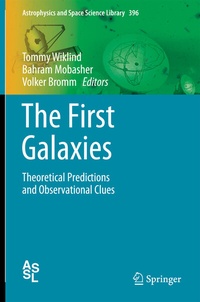
The First Galaxies
Description

New observations of the period between the cosmic recombination and the end of reionization are posing intriguing questions about where the first generations of stars were formed, how the first galaxies were assembled, whether these galaxies have low redshift counterparts, and what role the early galaxies played in the reionization process. Combining the new observational data with theoretical models can shed new light on open issues regarding the star formation process, its role in the reionization of the Universe, and the metal enrichment in galaxies at those early epochs.
This volume brings together leading experts in the field to discuss our current level of understanding and what may come in the near future as our observational as well as theoretical tools improve. The book confronts the theory of how the first stars, black holes, and galaxies formed with current and planned observations. This synthesis is very timely, just ahead of the establishment of major new facilities, such as the James Webb Space Telescope (JWST), a next-generation, millimeter/sub-millimeter observatory in the Atacama desert (ALMA), and ground-based Extremely Large Telescopes (ELT). Together, they will revolutionize the study of the most distant objects in the Universe.
This volume is aimed at beginning graduate students but can also serve as a reference work for active researchers in the field. Apart from presenting the fundamental concepts involved, it also provides an introduction to the methods and techniques used. The book will also be useful to anyone with an astrophysical background who needs an effective starting point for learning about the first stars and galaxies.
Reviews / Votes
From the reviews:
"The First Galaxies is one of several recent books which attempt to review our current understanding of the rapidly changing research area of astrophysics dealing with the formation, evolution, and impact of the first stars and galaxies to form in the early history of the Universe. . this volume will serve as an excellent research resource for advanced undergraduate and post-graduate researchers studying high-redshift galaxy formation, either from a theoretical or observational standpoint." (Ross McLure, The Observatory, Vol. 133 (1237), December, 2013)
More details
Other editions
Additional editions
Persons
Tommy Wiklind (ESO/Joint ALMA Observatory), Bahram Mobasher (UCLA, Riverside) and Volker Bromm (University of Texas, Austin) are leaders in the field of first stars and first galaxies.
Content
Part I The First Sources of Light.- Chapter 1 The Basic Theoretical Framework.- Chapter 2 The Epoch of Reionization.- Chapter 3 The First Stars.- Part II The First Galaxies and Normal Stellar Populations.- Chapter 4 Formation of the First Galaxies: Theory and Simulations.- Chapter 5 Observing the First Galaxies.- Chapter 6 The Formation of the First Massive Black Holes.- Part III Tools & Techniques.- Chapter 7 Evolutionary Synthesis Models as a Tool and Guide Towards the First Galaxies.- Chapter 8 Exploring the Universe with Metal-Poor Stars.- Chapter 9 The Potential Impact of Future Observatories.
