

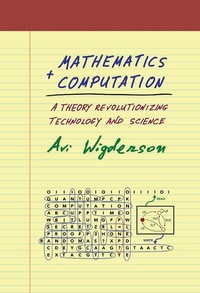
Mathematics and Computation
A Theory Revolutionizing Technology and Science
1st Edition
Published on 18. November 2019
440 pages
978-0-691-19254-3 (ISBN)
Description

From the winner of the Turing Award and the Abel Prize, an introduction to computational complexity theory, its connections and interactions with mathematics, and its central role in the natural and social sciences, technology, and philosophy
Mathematics and Computation provides a broad, conceptual overview of computational complexity theory-the mathematical study of efficient computation. With important practical applications to computer science and industry, computational complexity theory has evolved into a highly interdisciplinary field, with strong links to most mathematical areas and to a growing number of scientific endeavors.
Avi Wigderson takes a sweeping survey of complexity theory, emphasizing the field's insights and challenges. He explains the ideas and motivations leading to key models, notions, and results. In particular, he looks at algorithms and complexity, computations and proofs, randomness and interaction, quantum and arithmetic computation, and cryptography and learning, all as parts of a cohesive whole with numerous cross-influences. Wigderson illustrates the immense breadth of the field, its beauty and richness, and its diverse and growing interactions with other areas of mathematics. He ends with a comprehensive look at the theory of computation, its methodology and aspirations, and the unique and fundamental ways in which it has shaped and will further shape science, technology, and society. For further reading, an extensive bibliography is provided for all topics covered.
Mathematics and Computation is useful for undergraduate and graduate students in mathematics, computer science, and related fields, as well as researchers and teachers in these fields. Many parts require little background, and serve as an invitation to newcomers seeking an introduction to the theory of computation.
- Comprehensive coverage of computational complexity theory, and beyond
- High-level, intuitive exposition, which brings conceptual clarity to this central and dynamic scientific discipline
- Historical accounts of the evolution and motivations of central concepts and models
- A broad view of the theory of computation's influence on science, technology, and society
- Extensive bibliography
Mathematics and Computation provides a broad, conceptual overview of computational complexity theory-the mathematical study of efficient computation. With important practical applications to computer science and industry, computational complexity theory has evolved into a highly interdisciplinary field, with strong links to most mathematical areas and to a growing number of scientific endeavors.
Avi Wigderson takes a sweeping survey of complexity theory, emphasizing the field's insights and challenges. He explains the ideas and motivations leading to key models, notions, and results. In particular, he looks at algorithms and complexity, computations and proofs, randomness and interaction, quantum and arithmetic computation, and cryptography and learning, all as parts of a cohesive whole with numerous cross-influences. Wigderson illustrates the immense breadth of the field, its beauty and richness, and its diverse and growing interactions with other areas of mathematics. He ends with a comprehensive look at the theory of computation, its methodology and aspirations, and the unique and fundamental ways in which it has shaped and will further shape science, technology, and society. For further reading, an extensive bibliography is provided for all topics covered.
Mathematics and Computation is useful for undergraduate and graduate students in mathematics, computer science, and related fields, as well as researchers and teachers in these fields. Many parts require little background, and serve as an invitation to newcomers seeking an introduction to the theory of computation.
- Comprehensive coverage of computational complexity theory, and beyond
- High-level, intuitive exposition, which brings conceptual clarity to this central and dynamic scientific discipline
- Historical accounts of the evolution and motivations of central concepts and models
- A broad view of the theory of computation's influence on science, technology, and society
- Extensive bibliography
More details
Other editions
Additional editions
Book
10/2019
Princeton University Press
€59.50
Shipment within 10-20 days
Person
Avi Wigderson is the Herbert H. Maass Professor in the School of Mathematics at the Institute for Advanced Study in Princeton. He is a recipient of the Turing Award, the highest distinction in computer science, and the Abel Prize, widely considered to be the highest recognition of impact in mathematics.
Content
- Cover
- Contents
- Acknowledgments
- 1. Introduction
- 1.1 On the interactions of math and computation
- 1.2 Computational complexity theory
- 1.3 The nature, purpose, and style of this book
- 1.4 Who is this book for?
- 1.5 Organization of the book
- 1.6 Notation and conventions
- 2. Prelude: Computation, undecidability, and limits to mathematical knowledge
- 3. Computational complexity 101: The basics, P, and NP
- 3.1 Motivating examples
- 3.2 Efficient computation and the class P
- 3.2.1 Why polynomial?
- 3.2.2 Why worst case?
- 3.2.3 Some problems in P
- 3.3 Efficient verification and the class NP
- 3.4 The P vs. NP question: Its meaning and importance
- 3.5 The class coNP, the NP vs. coNP question, and efficiently characterizable structures
- 3.6 Reductions: A partial order of computational difficulty
- 3.7 Completeness: Problems capturing complexity classes
- 3.8 NP-completeness
- 3.9 Some NP-complete problems
- 3.10 The nature and impact of NP-completeness
- 4. Problems and classes inside (and around) NP
- 4.1 Other types of computational problems and complexity classes
- 4.2 Between P and NP
- 4.3 Constraint satisfaction problems (CSPs)
- 4.3.1 Exact solvability and the dichotomy conjecture
- 4.3.2 Approximate solvability and the unique games conjecture
- 4.4 Average-case complexity
- 4.5 One-way functions, trap-door functions, and cryptography
- 5. Lower bounds, Boolean circuits, and attacks on P vs. NP
- 5.1 Diagonalization and relativization
- 5.2 Boolean circuits
- 5.2.1 Basic results and questions
- 5.2.2 Boolean formulas
- 5.2.3 Monotone circuits and formulas
- 5.2.4 Natural Proofs, or, Why is it hard to prove circuit lower bounds?
- 6. Proof complexity
- 6.1 The pigeonhole principle-a motivating example
- 6.2 Propositional proof systems and NP vs. coNP
- 6.3 Concrete proof systems
- 6.3.1 Algebraic proof systems
- 6.3.2 Geometric proof systems
- 6.3.3 Logical proof systems
- 6.4 Proof complexity vs. circuit complexity
- 7. Randomness in computation
- 7.1 The power of randomness in algorithms
- 7.2 The weakness of randomness in algorithms
- 7.2.1 Computational pseudo-randomness
- 7.2.2 Pseudo-random generators
- 7.3 Computational pseudo-randomness and pseudo-random generators
- 7.3.1 Computational indistinguishability and cryptography
- 7.3.2 Pseudo-random generators from hard problems
- 7.3.3 Final high-level words on de-randomization
- 8. Abstract pseudo-randomness
- 8.1 Motivating examples
- 8.2 General pseudo-random properties and finding hay in haystacks
- 8.3 The Riemann hypothesis
- 8.4 P vs. NP
- 8.5 Computational pseudo-randomness and de-randomization
- 8.6 Quasi-random graphs
- 8.7 Expanders
- 8.8 Structure vs. pseudo-randomness
- 9. Weak random sources and randomness extractors
- 9.1 Min-entropy and randomness extractors
- 9.1.1 Min-entropy: Formalizing weak random sources
- 9.1.2 Extractors: Formalizing the purification of randomness
- 9.2 Explicit constructions of extractors
- 9.3 Structured weak sources, and deterministic extractors
- 10. Randomness and interaction in proofs
- 10.1 Interactive proof systems
- 10.2 Zero-knowledge proof systems
- 10.3 Probabilistically checkable proofs (PCPs), and hardness of approximation
- 10.3.1 Hardness of approximation
- 10.4 Perspective and impact
- 11. Quantum computing
- 11.1 Building a quantum computer
- 11.2 Quantum proofs, quantum Hamiltonian complexity, and dynamics
- 11.2.1 The complexity of ground state energy
- 11.2.2 Ground states, entanglement, area law, and tensor networks
- 11.2.3 Hamiltonian dynamics and adiabatic computation
- 11.3 Quantum interactive proofs, and testing quantum mechanics
- 11.4 Quantum randomness: Certification and expansion
- 12. Arithmetic complexity
- 12.1 Motivation: Univariate polynomials
- 12.2 Basic definitions, questions, and results
- 12.3 The complexity of basic polynomials
- 12.3.1 Symmetric polynomials
- 12.3.2 Matrix multiplication
- 12.3.3 The determinant
- 12.3.4 The permanent
- 12.4 Reductions and completeness, VP and VNP
- 12.5 Restricted models
- 12.5.1 Monotone circuits
- 12.5.2 Multilinear circuits
- 12.5.3 Bounded-depth circuits
- 12.5.4 Non-commutative circuits
- 13. Interlude: Concrete interactions between math and computational complexity
- 13.1 Number theory
- 13.2 Combinatorial geometry
- 13.3 Operator theory
- 13.4 Metric geometry
- 13.5 Group theory
- 13.6 Statistical physics
- 13.7 Analysis and probability
- 13.8 Lattice theory
- 13.9 Invariant theory
- 13.9.1 Geometric complexity theory
- 13.9.2 Simultaneous conjugation
- 13.9.3 Left-Right action
- 14. Space complexity: Modeling limited memory
- 14.1 Basic space complexity
- 14.2 Streaming and sketching
- 14.3 Finite automata and counting
- 15. Communication complexity: Modeling information bottlenecks
- 15.1 Basic definitions and results
- 15.2 Applications
- 15.2.1 VLSI time-area trade-offs
- 15.2.2 Time-space trade-offs
- 15.2.3 Formula lower bounds
- 15.2.4 Proof complexity
- 15.2.5 Extension complexity
- 15.2.6 Pseudo-randomness
- 15.3 Interactive information theory and coding theory
- 15.3.1 Information complexity, protocol compression, and direct sum
- 15.3.2 Error correction of interactive communication
- 16. On-line algorithms: Coping with an unknown future
- 16.1 Paging, caching, and the k-server problem
- 16.2 Expert advice, portfolio management, repeated games, and the multiplicative weights algorithm
- 17. Computational learning theory, AI, and beyond
- 17.1 Classifying hyperplanes: A motivating example
- 17.2 Classification/Identification: Some choices and modeling issues
- 17.2.1 Target class of functions
- 17.2.2 Hypothesis class
- 17.2.3 Admissible presentation of data
- 17.2.4 Quality measures for identification algorithms
- 17.3 Identification in the limit: A linguistic/recursion theoretic approach
- 17.4 Probably, approximately correct (PAC) learning: A statistical approach
- 17.4.1 Basics of the PAC framework
- 17.4.2 Efficiency and optimization
- 17.4.3 Agnostic PAC learning
- 17.4.4 Compression and Occam's razor
- 17.4.5 Boosting: Making weak learners strong
- 17.4.6 The hardness of PAC learning
- 18. Cryptography: Modeling secrets and lies, knowledge and trust
- 18.1 The ambitions of modern cryptography
- 18.2 Information theory vs. complexity theory: Take 1
- 18.3 The axioms of modern, complexity-based cryptography
- 18.4 Cryptographic definitions
- 18.5 Probabilistic encryption
- 18.6 Basic paradigms for security definitions
- 18.6.1 The simulation paradigm
- 18.6.2 The ideal functionality paradigm
- 18.7 Secure multi-party computation
- 18.8 Information theory vs. complexity theory: Take 2
- 18.9 More recent advances
- 18.9.1 Homomorphic encryption
- 18.9.2 Delegation of computation
- 18.9.3 Program obfuscation
- 18.10 Physical attacks
- 18.11 The complexity of factoring
- 19. Distributed computing: Coping with asynchrony
- 19.1 High-level modeling issues
- 19.2 Sharing resources and the dining philosophers problem
- 19.3 Coordination: Consensus and Byzantine generals
- 19.4 Renaming, k-set agreement, and beyond
- 19.4.1 Sperner's lemma and Brouwer's fixed-point theorem
- 19.4.2 Proof sketch of the impossibility theorem
- 19.4.3 General input-output problems and simplicial homology
- 19.5 Local synchronous coloring
- 20. Epilogue: A broader perspective of ToC
- 20.1 Close collaborations and interactions
- 20.1.1 Computer science and engineering
- 20.1.2 Mathematics
- 20.1.3 Optimization
- 20.1.4 Coding and information theory
- 20.1.5 Statistical physics
- 20.2 What is computation?
- 20.3 ToC methodology
- 20.4 The computational complexity lens on the sciences
- 20.4.1 Molecular biology
- 20.4.2 Ecology and evolution
- 20.4.3 Neuroscience
- 20.4.4 Quantum physics
- 20.4.5 Economics
- 20.4.6 Social science
- 20.5 Conceptual contributions
- or, algorithms and philosophy
- 20.6 Algorithms and technology
- 20.6.1 Algorithmic heroes
- 20.6.2 Algorithms and Moore's law
- 20.6.3 Algorithmic gems vs. deep nets
- 20.7 Some important challenges of ToC
- 20.7.1 Certifying intractability
- 20.7.2 Understanding heuristics
- 20.7.3 Resting cryptography on stronger foundations
- 20.7.4 Exploring physical reality vs. computational complexity
- 20.8 K-12 education
- 20.9 The ToC community
- 20.10 Conclusions
- References
